
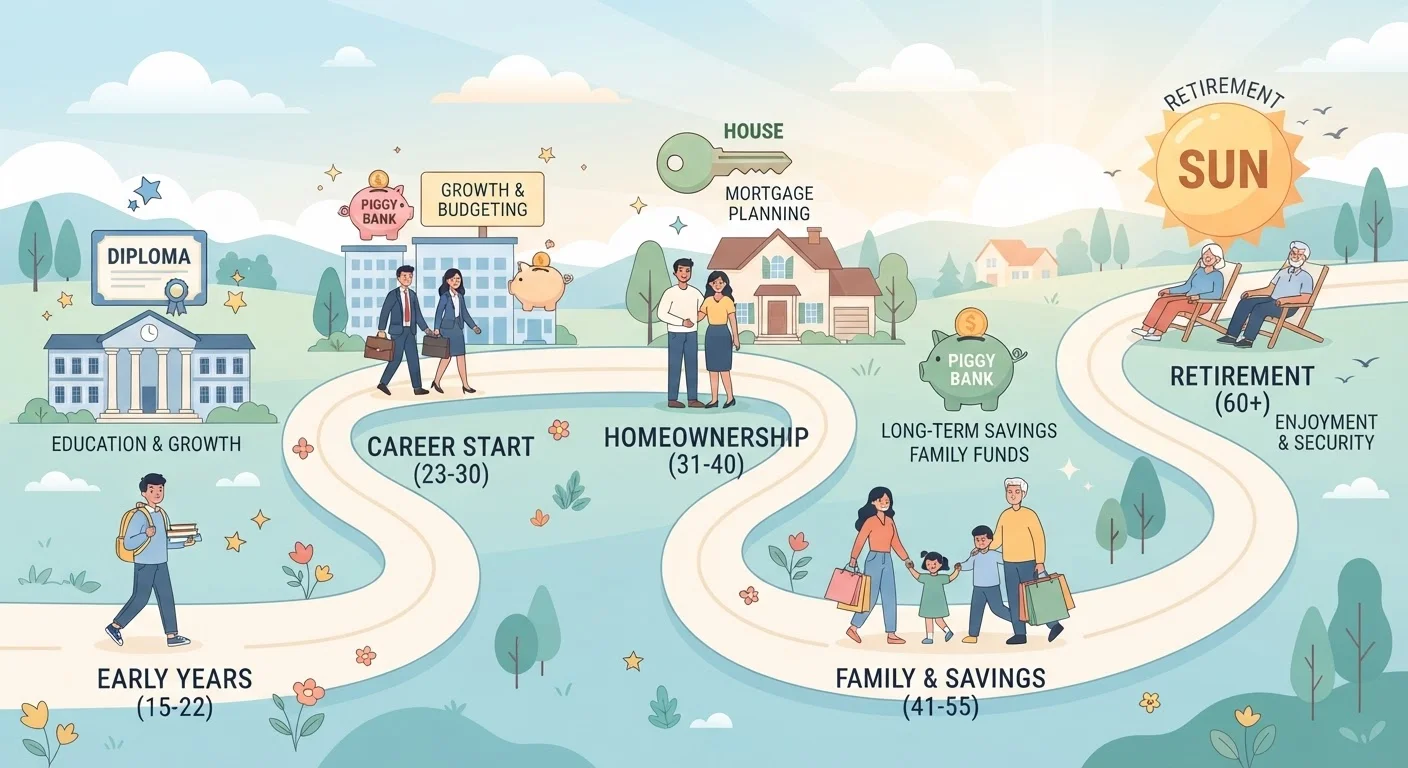
Why Life-Stage Planning Matters
Most Americans navigate money decisions reactively - responding to crises, windfalls, or major changes as they arrive. A more effective approach is anticipating the milestones that tend to arrive at different stages of life and preparing for them before they become urgent.
Financial priorities in your 20s look nothing like those in your 50s. The tools and strategies that serve you well during one chapter may actively work against your goals in another. That's why life-stage planning isn't a one-time exercise - it's an ongoing process of alignment between where you are, where you're headed, and what your money is doing in between.
The milestones below represent the financial turning points most Americans encounter. They're not a rigid timeline - life doesn't follow a script - but understanding each one helps you make smarter decisions when it arrives. For a broader framework, see the essential building blocks of a complete financial plan.
Life Stages Are Not a Fixed Timeline
The milestones described in this article represent common financial turning points - not a mandatory sequence. Some people buy homes before paying off student debt; others never marry or have children. Use this as a reference for what to consider when a given milestone approaches, not a checklist you must complete in order. Financial planning should reflect your actual life, not an idealized version of it.
Key Financial Milestones to Plan Around
Landing Your First Real Income
Your first steady paycheck is the foundation of everything that follows. The decisions made here - whether to establish a budget, begin contributing to a workplace retirement plan, or let spending expand unchecked - create habits that tend to persist for years.
Key priorities at this stage include building a starter emergency fund (typically three to six months of essential expenses), enrolling in any employer-sponsored retirement plan, and understanding your take-home pay versus your gross income. Exploring basic budgeting strategies early can prevent lifestyle inflation from outpacing your earnings.
Habits formed with your first paycheck tend to shape financial behavior for years to come.
Managing Student Loan Debt
For millions of Americans, student loan repayment is among the first major financial obligations of adulthood. Federal loans offer a range of repayment plans, including income-driven options that cap monthly payments as a percentage of discretionary income. Private loans typically offer fewer protections and less flexibility.
The core question at this stage is how to balance debt repayment against other goals - particularly early retirement savings. There's no universal answer, but the general principle is to capture any employer retirement match first (since that's effectively part of your compensation), then direct remaining resources strategically. Balancing short- and long-term financial goals explores this tradeoff in more depth.
Capture any employer retirement match before aggressively accelerating loan repayment.
Getting Married or Combining Finances
Marriage or long-term partnership introduces a new layer of financial complexity: two income streams, two sets of debts, possibly two different money philosophies, and a shared legal status with tax implications. Couples often benefit from deciding early how they'll manage joint versus individual accounts and how financial decisions will be made together.
This milestone typically involves updating beneficiary designations on retirement accounts and insurance policies, reviewing how filing taxes jointly versus separately affects your household, and aligning on savings priorities. Transparency about existing debt and spending habits before combining finances tends to prevent significant conflict later.
Updating beneficiaries and discussing debt openly are two of the most overlooked steps newlyweds skip.
Buying a Home
Homeownership is often the largest single financial commitment an American will make. Beyond the down payment - traditionally 20% of the purchase price, though many loan programs allow less - buyers should account for closing costs, property taxes, homeowner's insurance, ongoing maintenance, and the opportunity cost of capital tied up in a property.
The decision to rent versus buy involves more than comparing monthly payments. It factors in how long you plan to stay, local market conditions, your credit profile, and the stability of your income. If homeownership is on the horizon, strengthening your credit score and building a dedicated savings fund years in advance creates significantly more flexibility. Vehicle costs often intersect with this stage, too - see how vehicle ownership costs shift across life stages.
Maintenance, insurance, and taxes can add 1-3% of a home's value in annual costs beyond the mortgage.
Starting or Growing a Family
Adding a child to the household reshapes nearly every line of a budget. Childcare alone is among the largest single expenses for working parents in many U.S. states. This milestone also makes life insurance and an updated will non-optional rather than aspirational - ensuring your dependents are protected if something unexpected occurs.
Education savings vehicles such as 529 plans allow families to set aside money that grows tax-free when used for qualified education expenses. Starting contributions early, even in small amounts, can meaningfully reduce the financial pressure of college costs later. For broader savings strategies, practical approaches to growing savings and managing debt can provide useful context.
Life insurance and an updated will become essential, not optional, once dependents are in the picture.
Navigating a Major Career Transition
Job changes, career pivots, periods of self-employment, or unexpected layoffs each carry distinct financial consequences. When leaving an employer, decisions about what to do with a workplace retirement account - leave it, roll it into an IRA, or roll it into a new employer's plan - have long-term implications that are worth reviewing carefully, ideally with a financial adviser.
Self-employment introduces additional complexity: estimated quarterly tax payments, self-employment tax on top of income tax, and the need to fund your own retirement account and health coverage. Building a larger cash reserve before making a voluntary career leap provides a meaningful buffer against income gaps during the transition.
Decisions about your old 401(k) during a job change deserve more attention than most people give them.
Planning for Retirement
Retirement planning is not a single event but a decades-long process. In earlier working years, the focus is on maximizing contributions and allowing compounding to do its work. In the decade approaching retirement, the focus typically shifts toward understanding projected income sources - Social Security, workplace pensions if applicable, personal savings - and stress-testing whether they're likely to cover anticipated expenses.
Social Security claiming age meaningfully affects lifetime benefits. Claiming at 62 reduces monthly payments; waiting until 70 increases them. Health care costs in retirement are commonly underestimated and deserve their own planning consideration. Engaging a fee-only financial adviser as retirement approaches can help translate savings balances into a realistic income plan. Note that investment performance involves risk and past returns do not guarantee future results.
Delaying Social Security benefits beyond 62 can substantially increase lifetime monthly income.
Review Your Plan at Every Major Change
A financial plan isn't a document you write once and file away. Major life changes - a new job, a marriage, a new child, a home purchase - are natural trigger points to revisit your priorities, update beneficiaries, and adjust your savings and insurance coverage. Setting a recurring annual review date, separate from any event-driven check-in, helps ensure nothing falls through the cracks.
Bringing It All Together
No milestone exists in isolation. Paying off student loans affects how aggressively you can save for a home. Starting a family changes insurance needs, childcare costs, and your will. Approaching retirement reshapes how you think about risk in your investment portfolio - though general investment principles should always be weighed against your individual circumstances with help from a licensed financial adviser.
The goal isn't to check boxes in order - it's to recognize which milestones are approaching and give yourself enough runway to prepare. A practical place to start is the annual financial planning checklist for American households, which covers the recurring tasks most households should revisit each year regardless of life stage.
If you're ready to build a more structured approach, building a financial plan you'll actually stick to offers a practical starting point for turning priorities into action.
This article is for general informational and educational purposes only and does not constitute personalized financial, investment, tax, or legal advice. Consult a qualified financial adviser, accountant, or attorney for guidance specific to your situation.