How the Minimum Payment Trap Works
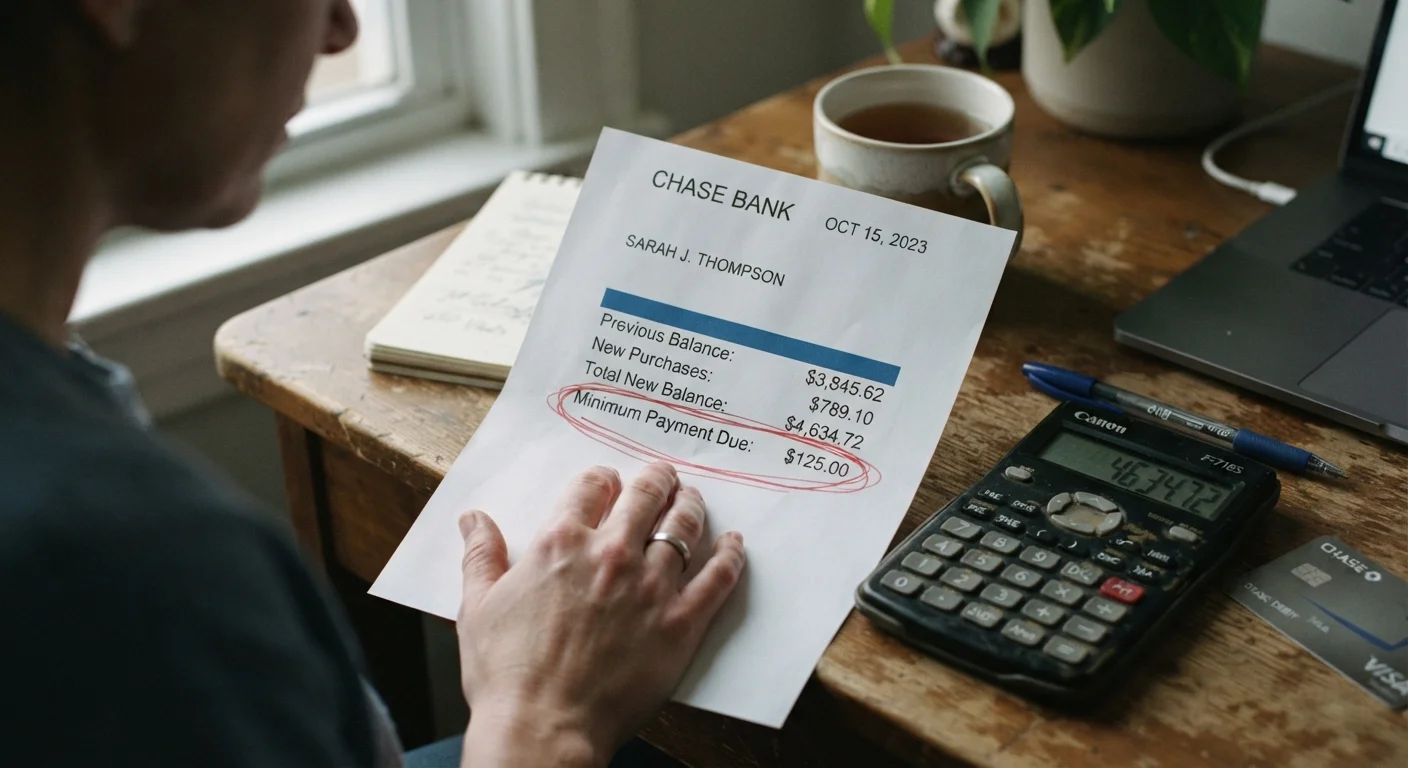
Credit card minimum payments are typically calculated as either a flat dollar amount (often $25-$35) or a small percentage of your balance - usually 1% to 2% plus interest charges. This design keeps your account current while ensuring the bulk of your balance carries forward, accumulating more interest every day.
Because U.S. credit cards compound interest daily using a daily periodic rate, your balance isn't just static between payments. It grows continuously. When your payment covers little more than the current month's interest, the principal barely moves - and next month's interest charge is calculated on nearly the same high balance.
20+ years
Estimated payoff time on minimum payments
Consumer Financial Protection Bureau examples show a $5,000 balance at ~20% APR can take more than two decades to pay off at minimum payment levels.
~2x
Total cost vs. original balance
Interest accumulation can roughly double the amount repaid compared to the original balance when only minimum payments are made over time.
Daily
How often credit card interest compounds
Most U.S. credit card issuers calculate interest using a daily periodic rate applied to the average daily balance each billing cycle.
The result is a repayment cycle that can stretch years or even decades. Cardholders who focus only on making on-time minimum payments often don't realize they're essentially renting their debt rather than eliminating it.
Common Mistakes That Keep You Stuck
Staying in the minimum-payment cycle isn't usually a matter of carelessness - it's the result of patterns that seem reasonable in isolation. Understanding exactly where the thinking goes wrong is the first step toward changing it.
Treating the minimum payment as the intended monthly payment.
Why it happens: Card statements display the minimum payment prominently, and paying it on time feels responsible. Many people assume that if they're meeting the minimum, they're on track.
Ignoring how daily compounding interest erodes every payment.
Why it happens: Interest feels abstract. Readers see one monthly charge on the statement and don't realize it's the product of interest accruing every single day on the outstanding balance.
Prioritizing saving aggressively while carrying high-interest revolving debt.
Why it happens: Saving feels productive and forward-looking. Many people are told to always save first, without accounting for the guaranteed 'return' of eliminating a 20% interest rate.
Assuming a tight budget leaves no room to pay more than the minimum.
Why it happens: When money is stretched thin, extra debt payments feel impossible. The minimum feels like the only realistic option, so it becomes the default indefinitely.
Treating all financial goals as equally urgent without a clear priority order.
Why it happens: Competing priorities - retirement contributions, emergency savings, vacation funds, debt payments - feel equally important in the moment, causing paralysis or scattered effort.
Each of these errors reinforces the others. When you underestimate compounding, overestimate your savings yield advantage, and underestimate budget flexibility all at once, the minimum payment becomes a permanent fixture rather than a temporary measure.
Low Minimums Can Mask a Growing Problem
As your balance grows, so does your minimum payment - but not fast enough to outpace interest. In some months, a minimum payment barely covers the interest charge, leaving your principal almost untouched. If this pattern sounds familiar, see signs your debt load is becoming a structural problem for patterns worth watching.
What a Slightly Larger Payment Actually Changes
The payoff math shifts significantly even with modest payment increases. On a $4,000 balance at 19% APR, increasing a minimum payment from roughly $80 to $150 per month can cut repayment time from over 30 years to under 3 years - and save thousands in interest. These figures are illustrative; actual results depend on your specific rate, balance, and payment structure.
The key insight is that early, larger payments reduce the principal faster, which means subsequent interest charges are smaller. That compounding effect works in your favor when you pay more, just as it works against you when you pay less.
Minimum Payments Are Not a Payoff Strategy
Credit card issuers set minimum payments low enough to keep balances - and interest charges - active for as long as possible. On a $5,000 balance at 20% APR, paying only the minimum could take over 20 years to clear and cost more than $7,000 in interest alone. This is general educational information, not personalized financial advice. Consult a licensed financial professional for guidance specific to your situation.
If draining savings to accelerate payoff is something you're considering, it's worth working through key questions before tapping your savings to make sure the move fits your full financial picture. This article is for general informational purposes only and does not constitute personalized financial advice. Consult a qualified financial professional before making decisions about your debt repayment strategy.