The Core Mechanic: Interest on Interest
Most people understand that saving money earns interest. Fewer realize that compound interest means those earnings themselves start earning - and that the same logic applies to money you owe.
Consider a simple example. If you deposit $1,000 at a 5% annual interest rate, you earn $50 in the first year, bringing your balance to $1,050. In year two, you earn 5% on $1,050 - not the original $1,000. That extra dollar may seem trivial, but extend the math over 20 or 30 years and the difference between compound and simple interest becomes substantial.
This is why the formula matters: Balance = Principal × (1 + rate/n)nt, where n is the number of compounding periods per year and t is time in years. You don't need to memorize this, but understanding what drives it - rate, frequency, and time - tells you what levers to pull.
Compounding Frequency Varies by Product
Savings accounts often compound daily or monthly, while some bonds compound semi-annually. Credit cards typically compound daily. The frequency doesn't change the stated interest rate, but it does affect how quickly a balance grows. Always confirm the compounding schedule when evaluating any financial product.
How Compound Interest Builds Savings
On the savings side, compound interest rewards patience. The longer money sits and compounds, the more powerful the effect. A dollar saved today has more compounding runway than a dollar saved ten years from now.
Accounts that compound more frequently - daily rather than monthly - produce slightly higher effective yields at the same stated rate. That's why the APY is the number to watch when comparing savings products; it already reflects compounding frequency. See our overview of high-yield savings accounts to understand how different account types translate rates into real returns.
Regular contributions amplify the effect further. Adding to the principal consistently gives compounding a larger base to work from in every subsequent cycle. This is why consistent savings habits tend to outperform occasional large deposits over the long run.
Daily
Compounding frequency on most credit cards
The Consumer Financial Protection Bureau notes that most credit card issuers calculate interest charges based on a daily periodic rate applied to the average daily balance.
~$830
Extra earned on $10,000 at 5% APY vs. simple interest over 10 years
Based on standard compound interest calculations comparing annual compounding to simple interest at the same rate and term - illustrating the compounding premium on savings.
40%+
U.S. adults carrying credit card debt month to month
Federal Reserve survey data has consistently found that a substantial share of American cardholders do not pay their full balance each month, making compound interest on debt a widespread household concern.
How Compound Interest Works Against Borrowers
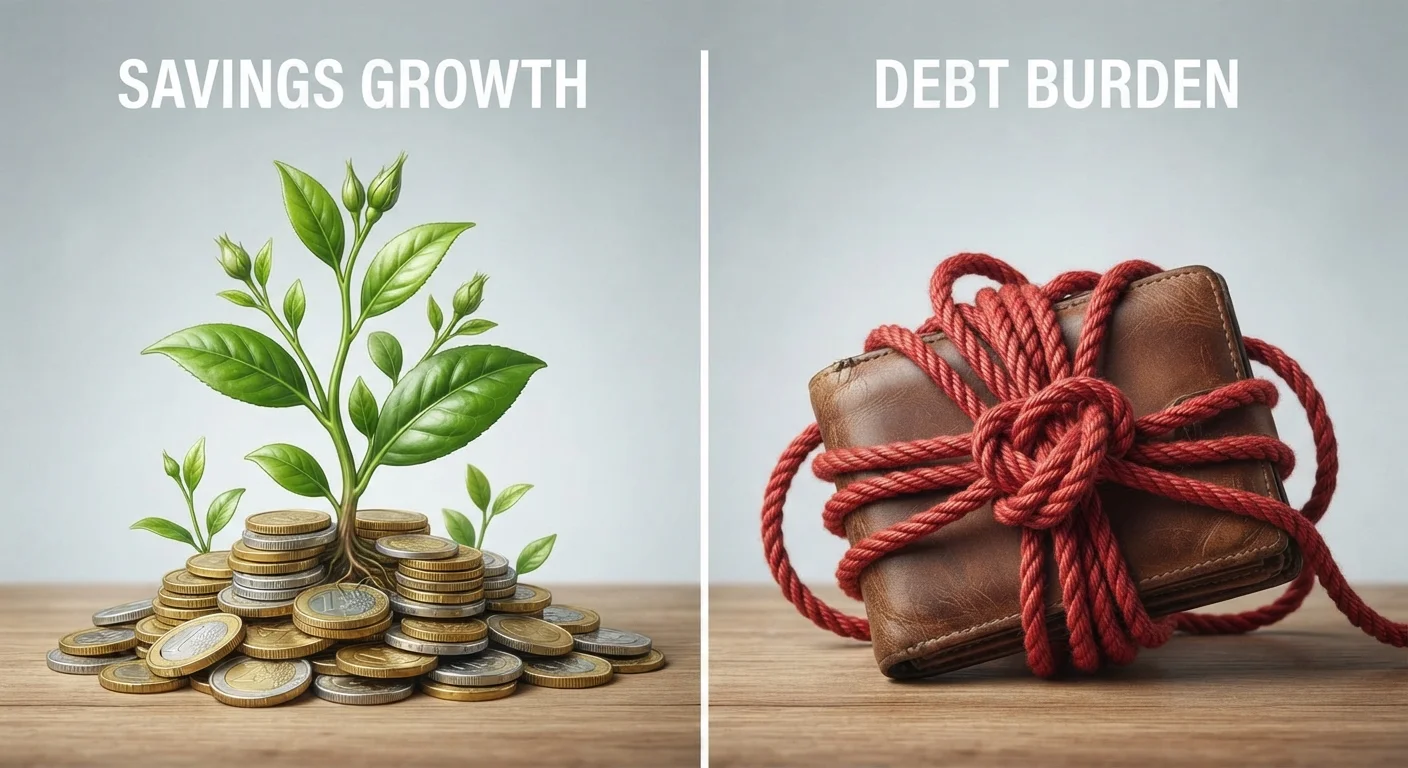
The same mechanic that grows savings can quietly expand debt. Credit cards are the most common example: most charge interest daily based on the outstanding balance. If you carry a balance month to month, interest accrues on your previous interest - exactly the compounding effect, now working in reverse.
Making only minimum payments on high-rate debt can keep a balance surprisingly persistent. A cardholder paying the minimum on a $3,000 balance at a high interest rate could spend years paying before seeing the principal meaningfully drop. The math isn't a punishment - it's just the compounding formula operating as designed, on the lender's behalf.
This is why interest rate comparisons matter before borrowing. A personal loan at a lower rate compounds less aggressively than a credit card at a higher one, even if the borrowed amount is the same. Understanding the rate and compounding structure of any debt you carry is basic financial self-defense.
Navigating the Tension Between Saving and Paying Down Debt
For many households, compound interest creates a genuine tension: high-rate debt is growing while savings may be growing more slowly. Resolving this isn't one-size-fits-all, but the underlying logic is clear. When debt carries a higher rate than savings earn, every dollar parked in savings is effectively costing the difference.
That said, completely depleting savings to eliminate debt can create its own problems - leaving no cushion for unexpected expenses. Before making any major move between savings and debt, it's worth working through the trade-offs carefully. Our article on tapping savings to pay off debt walks through key questions to ask before making that call.
Compound interest also intersects with longer-term financial goals like retirement saving and investing. For a broader view of how saving compares to investing over time, see the real difference between saving and investing.
Check Compounding Frequency Before Committing
When evaluating a savings account or loan, look beyond the stated interest rate to the APY (for savings) or APR (for loans). APY reflects how compounding frequency translates a rate into actual annual growth. Two accounts with identical rates but different compounding schedules will produce different outcomes - sometimes meaningfully so over several years.
This article is for general informational and educational purposes only and does not constitute personalized financial, tax, or legal advice. Consult a qualified financial professional before making decisions about your specific situation.