
What Each One Actually Means
The words "saving" and "investing" are often used as though they're interchangeable, but financially they describe two very different behaviors - each with its own purpose, risk profile, and ideal use case.
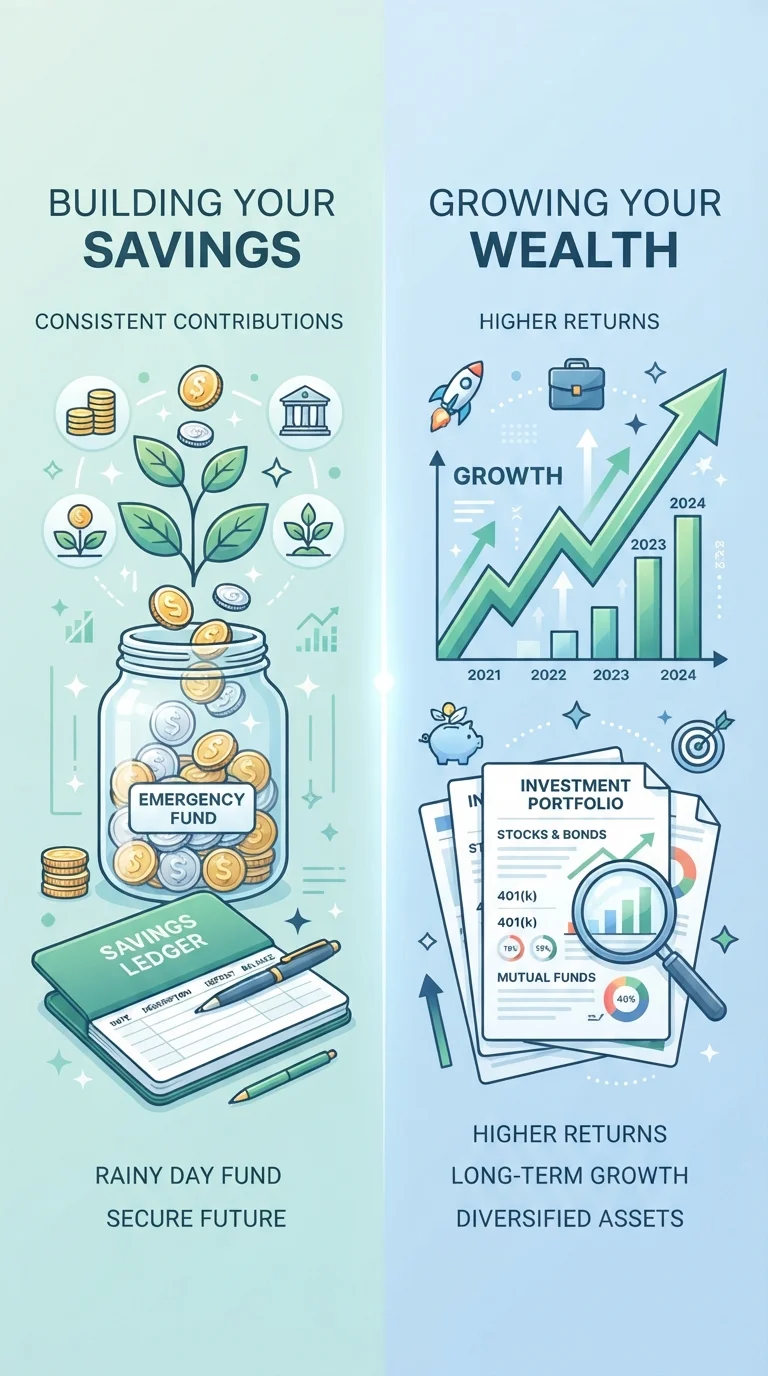
Saving means setting aside money in a secure, accessible account - typically a bank savings account or a federally insured account - where the principal (the amount you deposit) is protected. The trade-off is modest growth. Interest rates on savings accounts are generally low, though high-yield options can be more competitive. For a plain-language breakdown of how savings accounts work, see Savings Account Terms Every Beginner Should Know.
Investing means putting money into assets - such as stocks, bonds, mutual funds, or real estate - with the expectation that they will grow in value over time. Unlike saving, investing involves real risk: the value of investments can go down as well as up, and there is no federal protection equivalent to FDIC insurance on investment accounts. Returns are not guaranteed.
The core distinction is certainty versus potential. Saving preserves what you have. Investing aims to grow it - but asks you to accept uncertainty in exchange.
| Criterion | Saving | Investing |
|---|---|---|
| Primary purpose | Preserve money, maintain access | Grow money over time |
| Risk level | Very low (FDIC-insured accounts) | Moderate to high; loss is possible |
| Typical return | Low; tied to prevailing interest rates | Potentially higher; not guaranteed |
| Liquidity | High - funds accessible quickly | Variable; selling assets may take time |
| Best time horizon | Short-term (under 3 years) | Long-term (5+ years, ideally 10+) |
| Inflation protection | Weak - may lag behind inflation | Stronger potential over long periods |
| Federal protection | Yes - FDIC up to $250,000 | No equivalent guarantee |
Why Time Horizon Changes Everything
The single most important question when deciding between saving and investing isn't "Which one earns more?" - it's "When do I need this money?"
If a goal is fewer than three years away - a vacation fund, a car down payment, a home repair buffer - keeping that money in savings makes practical sense. Markets can drop sharply in any given year, and a short time horizon gives a portfolio little room to recover before you need to access the funds.
For goals ten years or more out - retirement, a child's college fund, long-term wealth building - investing has historically offered stronger growth potential over time. That extended horizon allows you to ride out periods of market volatility rather than being forced to sell at a loss.
3-6 months
Recommended emergency fund size
Most financial education organizations, including the Consumer Financial Protection Bureau, recommend keeping three to six months of essential expenses in accessible savings.
~3%
Average annual U.S. inflation (long-run)
The Federal Reserve targets 2% annual inflation; over longer periods, savings that earn less than the inflation rate lose real purchasing power quietly over time.
This is why most financial educators recommend addressing your emergency fund before directing money toward investment accounts. Without a cash cushion, a sudden job loss or medical bill could force you to liquidate investments - potentially at the worst possible moment. For more on balancing near-term and long-term financial goals, see Short-Term Goals vs. Long-Term Goals.
The Role of Risk - and How to Think About It
Saving carries very little risk in the conventional sense. FDIC-insured bank accounts protect deposits up to $250,000 per depositor, per institution. Your money won't disappear overnight. The quiet risk of saving, however, is inflation: if your savings account earns less than the rate of inflation, the real purchasing power of your money shrinks over time - even as the nominal balance grows. Understanding how interest compounds in your favor (and against you in debt) is explored in detail in How Compound Interest Works - For Savings and Against Debt.
Investing carries market risk - the possibility that the value of your holdings declines. This risk is real and should not be minimized. Asset values fluctuate based on economic conditions, company performance, interest rates, and investor sentiment. Diversification (spreading money across different asset types) can reduce - but never eliminate - that risk. Past performance of any investment does not guarantee future results.
The practical implication: money you genuinely cannot afford to lose should never be invested. This includes your emergency fund, near-term savings goals, and any cash you'd need immediately in a crisis. If you've ever wondered whether beliefs about investing being "only for the wealthy" hold up, Money Beliefs That Quietly Undermine Financial Progress takes a clear-eyed look at common financial myths.
Using Both Together: A Practical Framework
Most sound financial plans don't treat saving and investing as an either/or choice - they treat them as sequential steps that eventually run in parallel.
A common starting framework, widely recommended by financial educators and nonprofits, looks something like this:
- Build a starter emergency fund - even $500 to $1,000 in an accessible savings account provides a buffer against small unexpected costs.
- Pay down high-interest debt - carrying high-interest debt while investing is generally counterproductive, since debt interest often outpaces investment returns.
- Grow your emergency fund - aim for three to six months of essential expenses in savings before increasing investment contributions.
- Begin or increase investing - once the foundation is stable, direct additional dollars toward longer-term growth vehicles appropriate to your goals and risk tolerance.
This isn't a rigid formula - personal circumstances vary widely - and a licensed financial adviser can help tailor any approach to your specific situation. If you want to make saving more automatic and less dependent on daily decisions, Automating Your Savings Without Overthinking It offers practical guidance on building a system that runs in the background.
This article is for general informational and educational purposes only and does not constitute personalized financial, investment, or tax advice. Please consult a qualified financial professional before making decisions about your own financial situation.