
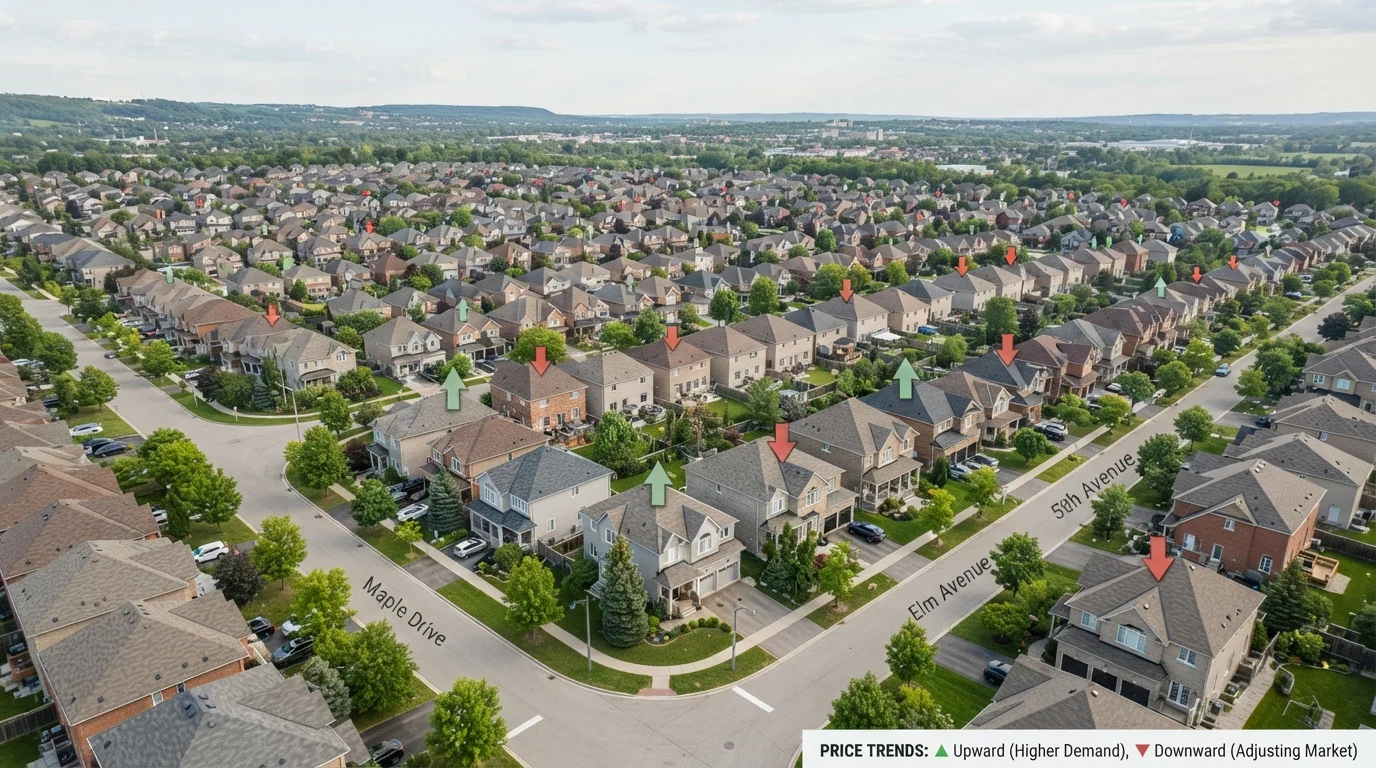
Supply and Demand: The Foundation of Every Price Movement
At the core of every home price change is a straightforward dynamic: how many homes are available versus how many buyers want them. When demand outpaces supply, sellers gain leverage and prices climb. When supply exceeds demand, buyers gain leverage and prices soften. What makes housing complicated is that both sides of this equation are constantly being pushed and pulled by other forces.
Understanding what low housing supply actually does to prices helps clarify why markets can feel impossible to enter even when economic news sounds mixed. Inventory - the number of homes actively for sale - is one of the most direct indicators of near-term price direction. When months of supply drop below three or four months, markets historically tend to favor sellers and support price increases.
4-6 months
Inventory level considered a balanced housing market
Industry practitioners commonly use months of supply - how long it would take to sell all listed homes at the current sales pace - as a gauge of market conditions favoring buyers or sellers.
~1%
Typical monthly payment change per 1-point rate shift
On a $300,000 mortgage, a one-percentage-point increase in interest rates adds roughly $175-$200 per month to the payment, illustrating how rate sensitivity shapes affordability and demand.
12-24 months
Average time from permit to new home completion
The National Association of Home Builders has noted that construction timelines mean new supply cannot quickly respond to demand spikes, which prolongs price pressure in fast-growing markets.
Interest Rates and Affordability: The Invisible Hand on Demand
Mortgage interest rates shape what buyers can actually afford to borrow. When rates rise, the monthly payment on a given loan amount increases - meaning buyers either pay more each month, accept a smaller loan, or exit the market entirely. This pulls demand down and can cool price growth or push prices lower in rate-sensitive markets.
The reverse is also true. When rates fall, monthly costs drop, qualifying becomes easier, and more buyers enter the market simultaneously. That surge in demand - often against a backdrop of limited inventory - can accelerate price increases quickly. This is why the Federal Reserve's interest rate decisions ripple directly into housing markets, even though the Fed does not set mortgage rates directly.
“Housing is the one asset that most Americans will ever own, which means mortgage rates are not just financial abstractions - they are the mechanism by which monetary policy enters daily life for ordinary households.”
— Lawrence Yun, Chief Economist, National Association of Realtors
Local Jobs, Population, and the Geography of Price
National headlines describe broad trends, but home prices are intensely local. A metro area adding tens of thousands of jobs in a growing industry will attract workers who need housing - driving up demand without a matching increase in supply. The result is upward price pressure specific to that geography.
Conversely, cities that lose major employers or experience population outmigration often see prices stagnate or fall, even during national booms. This is why your zip code tells a very different story than the national average. Wage levels, in-migration rates, and the age profile of the local population all shape how much housing demand a community generates.
Construction, Zoning, and the Cost of Building New Homes
When demand exceeds existing supply, the natural release valve is new construction. But building homes takes time - typically 12 to 24 months from permit to completion - and faces real obstacles: land availability, zoning restrictions, labor shortages, and material costs all affect what gets built and when.
In many high-demand metros, restrictive zoning limits the density and type of housing that can be built. This structural constraint on supply keeps prices elevated even as demand grows. Areas with more permissive zoning and lower construction barriers tend to see more moderate price growth over time because supply can respond more fluidly to demand.
Investor Activity, Speculation, and Sentiment
Beyond owner-occupants, investors - from individual landlords to large institutional buyers - participate in housing markets and can amplify price movements. During periods of strong price appreciation, investment activity increases as buyers seek returns, adding demand on top of organic household formation. This can accelerate price gains in certain markets.
Market sentiment also plays a role. When buyers expect prices to rise, they may act urgently and bid aggressively. When expectations shift - perhaps due to rising rates or economic uncertainty - hesitation sets in, fewer offers arrive, and sellers may accept lower prices. Watching early signals of a market shift before headlines catch up can help buyers and sellers make more informed timing decisions.
It is also worth remembering that the same data can be interpreted in very different ways depending on who is presenting it. Understanding how buyers, sellers, and economists interpret the same numbers differently is a useful skill for anyone navigating housing market information.
This article is for general informational and educational purposes only. It does not constitute financial, investment, or legal advice. Real estate markets vary significantly by location and time. Consult a qualified real estate professional or financial adviser before making decisions based on your specific circumstances.