Three Costs, Three Different Jobs
When you buy a home, you'll hear about earnest money, a down payment, and closing costs in quick succession - sometimes in the same breath. They're all money you pay before or at the moment you take ownership, but each one serves a fundamentally different purpose. Mixing them up can lead to budget shortfalls or misplaced expectations right when the stakes are highest.
This reference breaks each cost down: what it is, when you pay it, what happens to it, and how much to expect. For a fuller picture of how these payments fit into the overall transaction, see the home-buying process from start to finish.
Earnest Money: Your Good-Faith Deposit
What it is: Earnest money is a deposit paid shortly after a seller accepts your offer. It signals that you're a serious buyer - not someone who will back out casually - and it protects the seller if you do walk away without a valid contractual reason.
When you pay it: Typically within one to three business days of an accepted offer, though the purchase contract specifies the exact timeline.
How much: There is no fixed national standard, but earnest money commonly ranges from 1% to 3% of the purchase price. In competitive markets, buyers sometimes offer more to strengthen their offer.
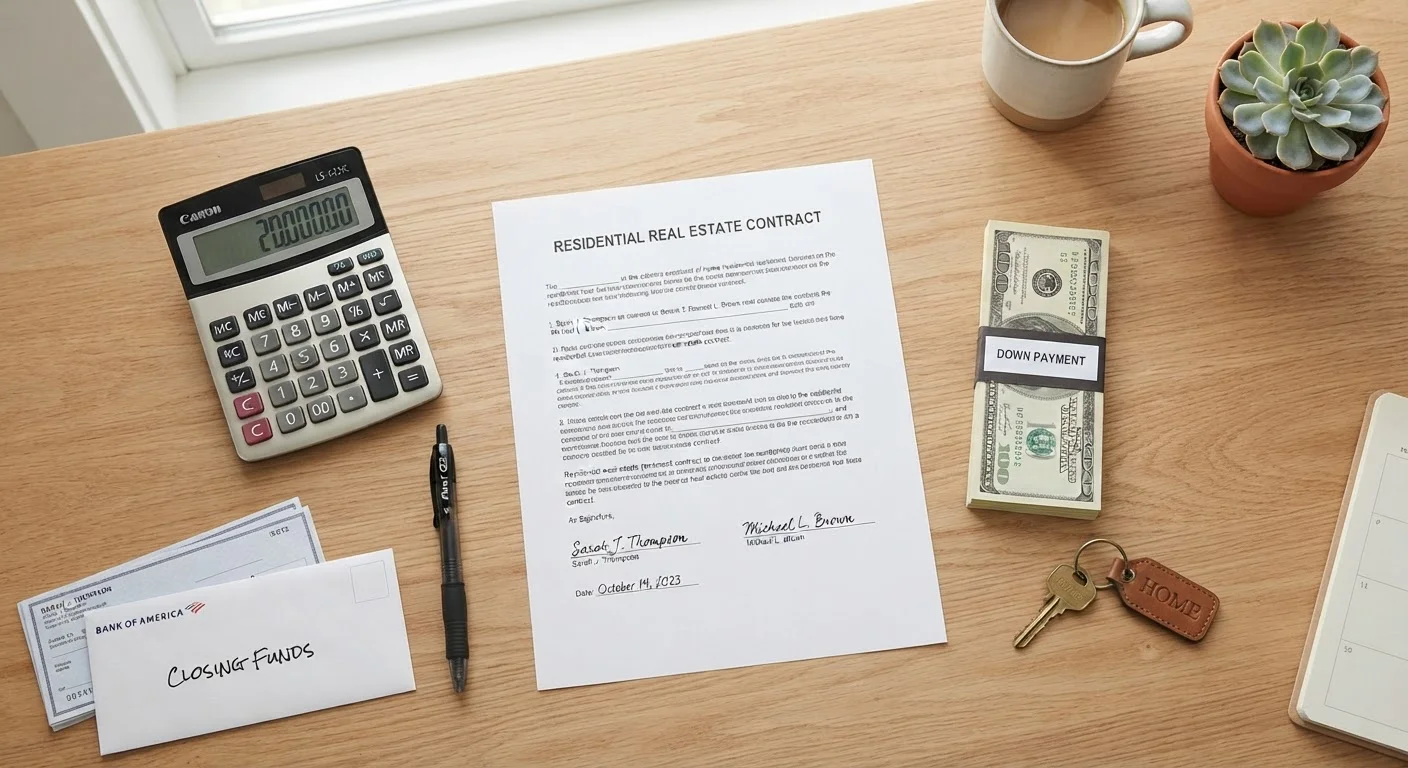
Where it goes: The funds go into an escrow account - held by a neutral third party such as a title company or escrow firm - until closing. At closing, earnest money is almost always applied toward your down payment or closing costs, so it is not an extra expense on top of those; it is an advance toward them.
When you could lose it: If you back out of the deal for a reason not protected by a contingency in your contract (such as a financing contingency or inspection contingency), the seller may keep the deposit. Review your contract's contingency language carefully.
Contingencies Protect Your Deposit
Most purchase contracts include contingencies - conditions that, if unmet, allow you to exit the deal and recover your earnest money. Common examples are a financing contingency (if your loan falls through) and an inspection contingency (if serious defects are discovered). Without these protections in writing, walking away could cost you the deposit. Always review contingency deadlines with your real estate agent or attorney before signing.
Down Payment: Your Ownership Stake
What it is: The down payment is the portion of the home's purchase price you pay in cash at closing. It is the equity you own on day one, and it reduces the amount you need to borrow.
How much: The oft-cited figure is 20%, but that is not a requirement. Conventional loans can be obtained with as little as 3% down for qualified buyers. FHA loans require 3.5% with a qualifying credit score. VA and USDA loans, available to eligible borrowers, may require no down payment at all. Putting less than 20% down on a conventional loan typically triggers private mortgage insurance (PMI) - an added monthly cost until you reach sufficient equity.
When you pay it: At closing, via wire transfer or certified check. Your earnest money deposit is credited toward this amount, so the wire you send at closing reflects the remaining balance.
If you're still weighing whether buying or renting makes sense for your situation, understanding the real trade-offs between renting and buying is a useful starting point before committing to the down payment math.
3%
Minimum down payment on many conventional loans
Fannie Mae and Freddie Mac guidelines allow some qualified first-time buyers to put down as little as 3% on a conforming conventional loan.
2%-5%
Typical closing cost range as a share of loan amount
The Consumer Financial Protection Bureau cites this range as a general benchmark, though costs vary meaningfully by state and lender.
1%-3%
Typical earnest money deposit
In highly competitive markets, buyers sometimes deposit more to signal commitment; amounts are negotiated in the purchase contract.
Closing Costs: The Transaction Expenses
What they are: Closing costs are the fees charged by all the parties who make a real estate transaction happen - your lender, the title company, government recording offices, appraisers, attorneys (where required), and others. Unlike earnest money or the down payment, closing costs do not build equity; they are the cost of completing the transaction.
Common line items include:
- Loan origination fee
- Appraisal fee
- Title search and title insurance (lender's and, optionally, owner's)
- Government recording fees
- Prepaid interest and property taxes
- Homeowners insurance premium (first year, often collected at closing)
How much: Closing costs generally run 2% to 5% of the loan amount, though the exact figure varies by location, loan type, and lender. On a $350,000 loan, that's roughly $7,000-$17,500. Your lender is required by federal law to provide a Loan Estimate within three business days of your application, itemizing projected costs. Learning how to read the Loan Estimate form helps you spot discrepancies early and ask informed questions.
When you pay them: At closing, alongside the remaining down payment balance. Some costs can be rolled into the loan or covered through seller concessions negotiated in the purchase contract, though both options have trade-offs.
For a detailed walkthrough of what actually occurs on closing day - and what paperwork to expect - see what to expect on closing day.
This article is for general informational purposes only and does not constitute financial, legal, or real estate advice. Costs, requirements, and rules vary by lender, loan program, state, and local jurisdiction. Consult a licensed real estate professional, mortgage lender, or attorney regarding your specific circumstances.