How Each Loan Type Is Structured
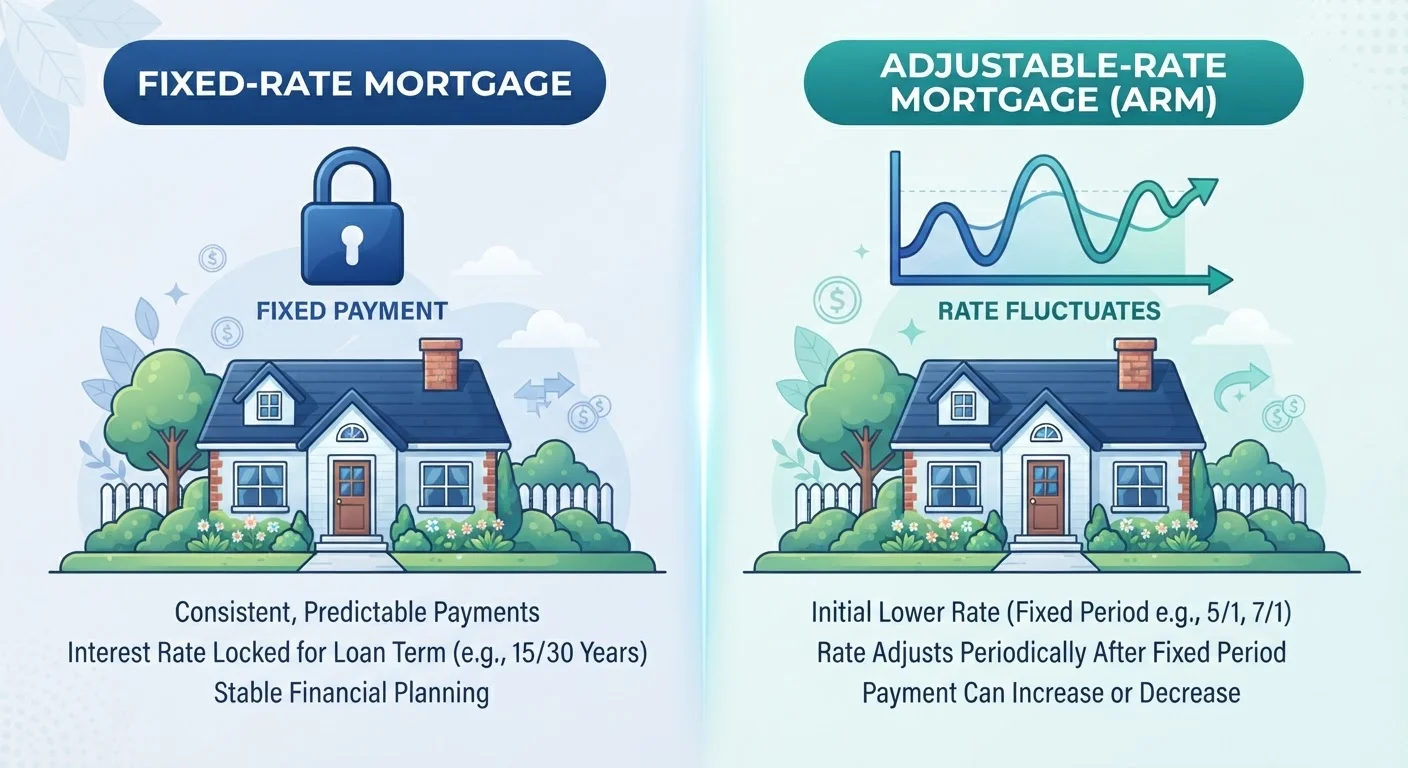
A fixed-rate mortgage carries an interest rate that never changes. Whether your loan term is 15 or 30 years, the rate established at closing is the rate you pay through the final payment. That means your monthly principal and interest amount stays identical each month - a predictability that makes budgeting straightforward.
An adjustable-rate mortgage (ARM) works in two distinct phases. First comes the fixed period - commonly 3, 5, 7, or 10 years - during which the rate remains stable, often set below prevailing fixed-rate levels. After that initial window, the rate enters an adjustment period and resets periodically (typically once per year) based on a benchmark index, such as the Secured Overnight Financing Rate (SOFR), plus a lender margin. ARMs are often labeled by their structure: a 5/1 ARM has a 5-year fixed period and adjusts annually thereafter.
Understanding this two-phase design is essential because the initial rate is not the rate you'll necessarily carry for life. For more context on how rate levels affect your purchasing power, see what mortgage rates actually do to buying power.
| Criterion | Fixed-Rate Mortgage | Adjustable-Rate Mortgage (ARM) |
|---|---|---|
| Interest Rate | Locked for life of loan | Fixed initially, then adjusts periodically |
| Monthly Payment Stability | Completely predictable | May rise or fall after fixed period |
| Initial Rate Level | Typically higher than ARM intro rate | Usually lower during fixed period |
| Rate Risk | None - rate never changes | Rises if market index increases |
| Rate Caps | Not applicable | Per-adjustment and lifetime caps apply |
| Common Terms | 15-year or 30-year | 3/1, 5/1, 7/1, 10/1 structures |
| Best Ownership Horizon | Long-term (10+ years) | Shorter-term (within fixed period) |
| Refinancing Need | Only to access lower rates | Often used to exit before adjustments begin |
Rate Caps, Indexes, and the Risk Equation
One of the most important ARM safeguards is the rate cap structure, which limits how much your interest rate can move. A typical cap notation like 2/2/5 means: the rate can rise no more than 2 percentage points at the first adjustment, no more than 2 points at any subsequent adjustment, and no more than 5 points above the initial rate over the life of the loan. These caps provide a ceiling on worst-case scenarios, but they do not eliminate payment risk entirely.
With a fixed-rate loan, no such complexity exists - your rate is insulated from market movements whether rates climb or fall. That insulation cuts both ways: if rates drop significantly after you close, you'd generally need to refinance to benefit.
30 years
Most common fixed-rate mortgage term in the U.S.
The 30-year fixed-rate mortgage has historically been the most widely chosen loan product among American homebuyers, according to Freddie Mac survey data.
~1-2%
Typical initial rate advantage of ARMs over fixed loans
The spread between fixed and adjustable introductory rates varies with market conditions; historically, ARMs have started roughly 1-2 percentage points below comparable fixed rates.
5 pts
Maximum lifetime rate cap common on many ARMs
Many conventional ARMs include a lifetime cap of 5 percentage points above the initial rate, though specific terms vary by lender and loan agreement.
Budgeting for either loan type benefits from the same foundational framework. The distinction between fixed and variable costs is a useful lens here - the same principles that govern household budgeting apply to mortgage structure. See fixed vs. variable expenses for a broader look at how these dynamics play out in a personal budget.
Choosing the Right Structure for Your Situation
The decision between a fixed and adjustable rate is less about which product is inherently superior and more about how each aligns with your specific timeline and financial profile. Key questions to consider:
- How long do you plan to stay? If you're confident you'll sell or refinance before the ARM's fixed period ends, the lower initial rate could mean real savings. If this is your forever home, locking in a fixed rate removes uncertainty.
- What is your risk tolerance? An ARM introduces payment variability after the initial period. If budget predictability is a priority, that variability may outweigh the initial savings.
- What does the rate environment look like? When fixed and adjustable rates are close together, the risk premium of an ARM offers less incentive. When the spread is wide, ARMs become more attractive for the right buyer.
If you're still weighing the broader question of whether homeownership makes sense at all, renting vs. buying a home offers a balanced look at the financial and lifestyle factors involved. And if you're currently renting and curious how lease flexibility compares to ownership commitment, month-to-month vs. fixed-term leases draws a parallel worth considering.
This article is for general informational and educational purposes only and does not constitute personalized financial, mortgage, or legal advice. Consult a licensed mortgage professional or financial adviser before making decisions about your specific situation.