The Basic Math Behind Rates and Payments
Mortgage interest is charged on your outstanding loan balance every month. Even a half-percentage-point difference in your rate changes that monthly charge - and therefore the total loan amount a lender will approve for a given income level.
Consider a straightforward example. On a 30-year fixed mortgage:
- At 6%, a $400,000 loan carries a principal-and-interest payment of roughly $2,398 per month.
- At 7%, that same $400,000 loan costs roughly $2,661 per month - about $263 more every month, or more than $3,100 more per year.
- At 8%, the payment climbs to roughly $2,935 per month.
Those differences compound over a 30-year term into tens of thousands of dollars in additional interest. But the more immediate effect for a buyer is what those higher monthly payments do to the loan amount they can qualify for.
~10%
Buying power lost per 1% rate increase
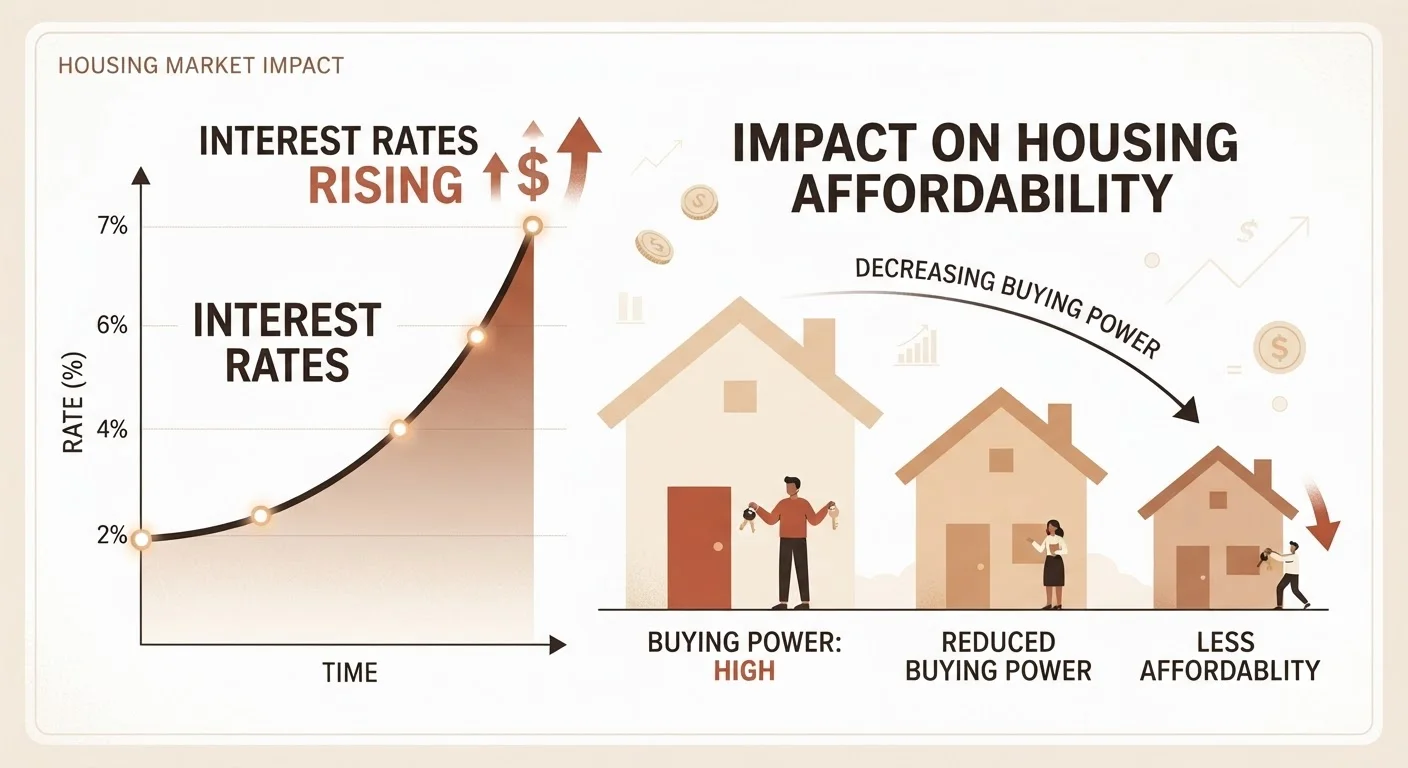
Industry mortgage analysis consistently shows that a 1-percentage-point rise in rates reduces a buyer's qualifying loan amount by approximately 10%, holding income and DTI constant.
$263/mo
Added monthly cost: 6% vs. 7% on $400K loan
On a 30-year fixed $400,000 mortgage, moving from a 6% to a 7% interest rate adds roughly $263 to the monthly principal-and-interest payment.
43%
Common maximum debt-to-income ratio
Many conventional lenders use a 43% DTI ceiling as a standard qualifying threshold, though specific lender guidelines vary by loan type and borrower profile.
To understand the full context of how rate changes ripple through the market, it helps to first understand how the housing market actually works.
How Lenders Translate Rates Into Loan Limits
Most lenders use a debt-to-income (DTI) ratio to determine how large a mortgage you can carry. This ratio compares your total monthly debt obligations - car payments, student loans, credit cards, and the proposed mortgage - to your gross monthly income. A common guideline is a maximum DTI of 43%, though specific lender requirements vary.
Here is where rate increases bite hardest: if a higher rate increases your proposed monthly payment by $300, your lender may determine that you no longer qualify for the loan amount you wanted. You are not suddenly less creditworthy - the rate simply pushed your payment above the threshold the lender will approve.
Run the Numbers Before You Set Your Budget
Use a mortgage calculator to model payments at rates both slightly above and below what you are quoted today. Building a buffer into your budget - rather than stretching to the maximum approved amount - gives you protection if rates shift before closing or if other costs arise during the process.
In practical terms, a buyer with $8,000 in gross monthly income and existing debts of $500 per month has roughly $2,940 available for a mortgage payment (at a 43% DTI ceiling). At 6%, that payment supports a loan of approximately $490,000. At 7.5%, the same payment supports a loan closer to $420,000 - a difference of $70,000 in purchasing power driven entirely by the rate environment.
Your credit score plays a direct role in which rate you are offered in the first place. Common myths about credit scores and mortgage approval are worth examining before you apply.
Rate Environments and the Broader Market
Individual buying power is only one piece of the puzzle. When rates rise across the board, fewer buyers can afford to purchase - reducing overall demand. In theory, reduced demand should cool home prices. In practice, the outcome depends heavily on housing supply. If inventory remains tight, prices may hold even as buyers are squeezed out of the market.
Low housing inventory can sustain elevated prices even when rates are high, because there are still more buyers than available homes in many markets. The result is a compounding affordability challenge: higher rates reduce what buyers can borrow, while limited supply keeps prices from adjusting downward proportionally.
Choosing between loan types also shapes your exposure to rate risk. A fixed rate locks in your payment for the life of the loan, while an adjustable-rate mortgage starts lower but can shift. How fixed and adjustable-rate mortgages work is worth understanding before you commit to a loan structure.
Finally, the rent-versus-buy calculation shifts as rates change. Higher rates increase the cost of owning relative to renting, which is one reason some buyers pause their search when rates spike. Weighing the real trade-offs between renting and buying can help you evaluate your own situation more clearly.
This article is for general informational purposes only and does not constitute financial, mortgage, or legal advice. Consult a licensed mortgage professional or financial adviser for guidance specific to your circumstances.