How Each Lease Type Works
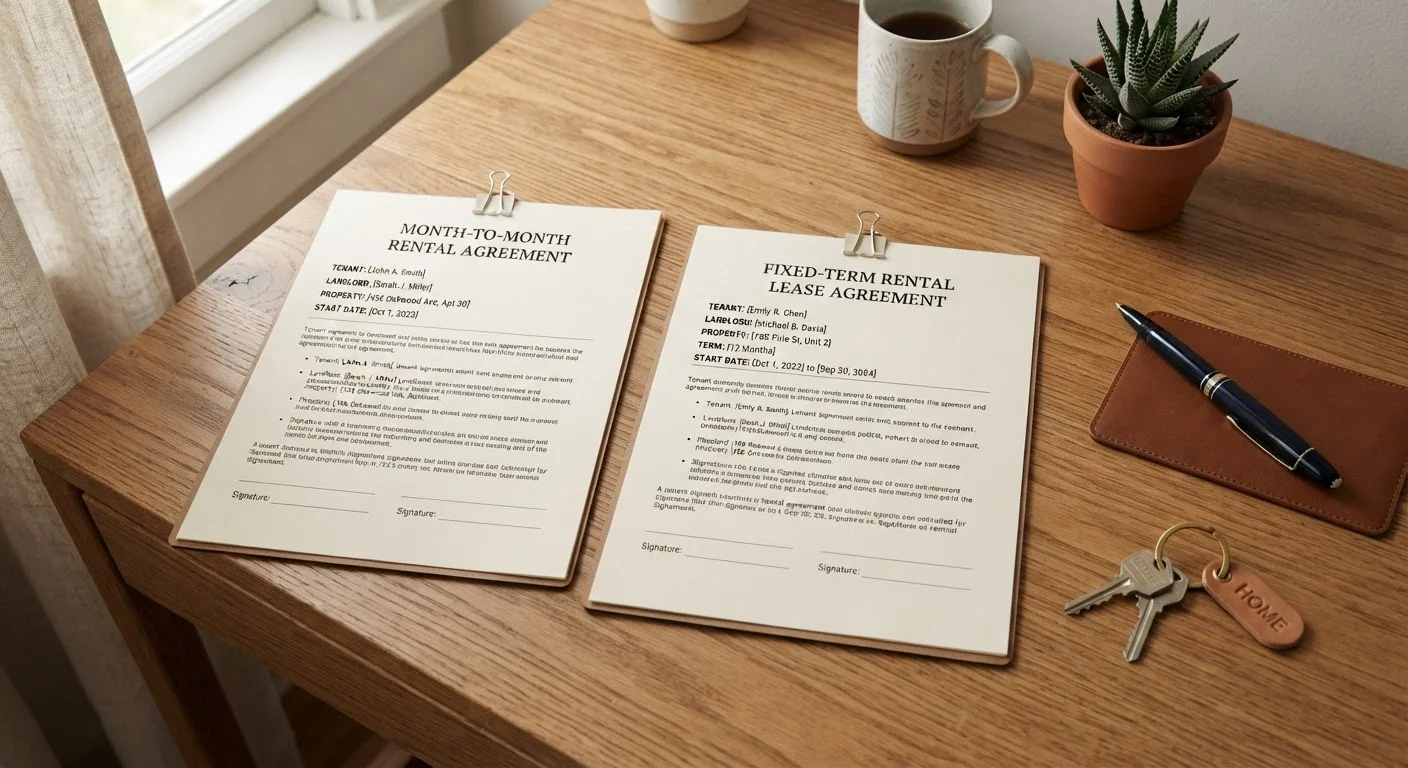
A month-to-month lease is a rental agreement that automatically renews each month unless either the landlord or the tenant provides proper written notice to end it. There is no predetermined end date. A fixed-term lease - most commonly 12 months, though 6-month and 24-month terms exist - sets a defined start and end date during which both parties are bound by the agreed conditions.
Both lease types establish the same fundamental relationship between renter and landlord: the tenant pays rent in exchange for the right to occupy the unit. What differs is the duration of that commitment and the protections or vulnerabilities that come with it. Before signing either type, it's worth reviewing what to look for in a lease before you sign, including clauses that can affect how either agreement plays out in practice.
| Criterion | Month-to-Month Lease | Fixed-Term Lease |
|---|---|---|
| Lease duration | Renews automatically each month | Set end date (typically 6-24 months) |
| Rent changes | Possible with required notice (often 30 days) | Generally locked in for the full term |
| Tenant notice to exit | Typically 30 days written notice | Must wait for term end or pay early-exit fee |
| Landlord notice to terminate | Typically 30-60 days (varies by state) | Cannot terminate without cause before term ends |
| Early exit penalty | Generally none if proper notice given | Often 1-2 months' rent or lease remainder |
| Stability against displacement | Lower - landlord can end tenancy with notice | Higher - landlord bound through term end |
| Typical renter profile | Transitional, short-term, or uncertain timeline | Settled, long-term, or budget-focused renter |
Rent Changes and Financial Predictability
One of the most consequential differences between these lease types is how and when your rent can change.
Under a fixed-term lease, the agreed-upon rent is typically locked in for the duration of the term. Your landlord generally cannot increase rent mid-lease unless the lease itself contains a specific rent-escalation clause - a provision worth scrutinizing carefully before signing. This predictability makes budgeting straightforward and protects you in markets where rents are rising quickly.
With a month-to-month lease, the landlord can propose a rent increase much more frequently - often with just 30 days' notice, depending on state law. Some jurisdictions require longer notice (45 or 60 days) for significant increases, and rent-stabilized cities may cap how much rent can be raised. However, outside of those protections, month-to-month renters are more exposed to market-rate adjustments.
~44M
Renter households in the United States
According to U.S. Census Bureau data, approximately 44 million households rent their primary residence, underscoring how widely lease terms affect American families.
30-60 days
Typical notice required for rent increases
Most U.S. states require landlords to provide 30 to 60 days' written notice before implementing a rent increase, though requirements vary considerably by jurisdiction.
Understanding what standard lease clauses actually say can help you identify rent-escalation language before it affects your budget.
Notice Periods, Termination, and Early Exit
Exit terms are where these two lease types diverge most sharply for renters.
With a month-to-month lease, either party can typically terminate by giving written notice - commonly 30 days, though some states require more. This bilateral flexibility is the defining appeal of rolling leases. You are not penalized for leaving, provided you give proper notice under your agreement and state law.
A fixed-term lease creates a mutual obligation through the end date. If you need to leave early - due to a job relocation, a family change, or other circumstances - you may owe a fee often called an early termination fee, which could equal one or two months' rent. Some leases allow subletting as an alternative; others prohibit it. A handful of states permit tenants to break a lease without penalty in specific circumstances, such as domestic violence situations or active military deployment under the Servicemembers Civil Relief Act.
Landlords operating under fixed-term leases generally cannot terminate the agreement before its end date without legally recognized cause - such as nonpayment of rent or lease violations. This provides meaningful security against displacement that month-to-month tenants do not have. For guidance on which lease terms might be open to negotiation before you sign, see negotiating lease terms with your landlord.
State and Local Law Governs Your Rights
Tenant protections - including required notice periods, allowable rent increase amounts, and permissible reasons for termination - are determined by state and local law, not by federal standards. For example, some cities have rent stabilization ordinances that cap annual increases even for month-to-month tenants, while other jurisdictions have no such limits. Always verify the rules that apply specifically to your city or county before signing any lease.
Renters should also be aware of common renting pitfalls that catch tenants off guard, including overlooked termination clauses that can create unexpected costs.
Which Lease Type Fits Your Situation
Neither arrangement is inherently superior - each serves different renter needs. The key is matching the lease type to your actual housing timeline and risk tolerance.
If your plans are firm and you value cost certainty, a fixed-term lease is generally the stronger choice. You know exactly what you'll pay, you're protected from sudden termination, and the unit is yours through the agreed date. If your situation involves uncertainty - a new city, a job search, a life transition - the month-to-month structure's flexibility can outweigh its drawbacks.
It is also worth knowing that the two types are not always mutually exclusive across a tenancy. Many fixed-term leases convert automatically to month-to-month arrangements after the initial term ends, unless either party requests a renewal. At that conversion point, both your rent and your termination exposure can change - a detail worth clarifying with your landlord well before the lease expires.
For renters weighing the broader question of long-term housing, the real trade-offs between renting and buying offers a useful framework for thinking through the decision beyond just lease structure.
This article is for general informational purposes only and does not constitute legal or financial advice. Rental laws and tenant protections vary significantly by state and municipality. Consult a qualified local attorney or tenant rights organization for guidance specific to your situation.