The Core Question: What Are You Actually Comparing?
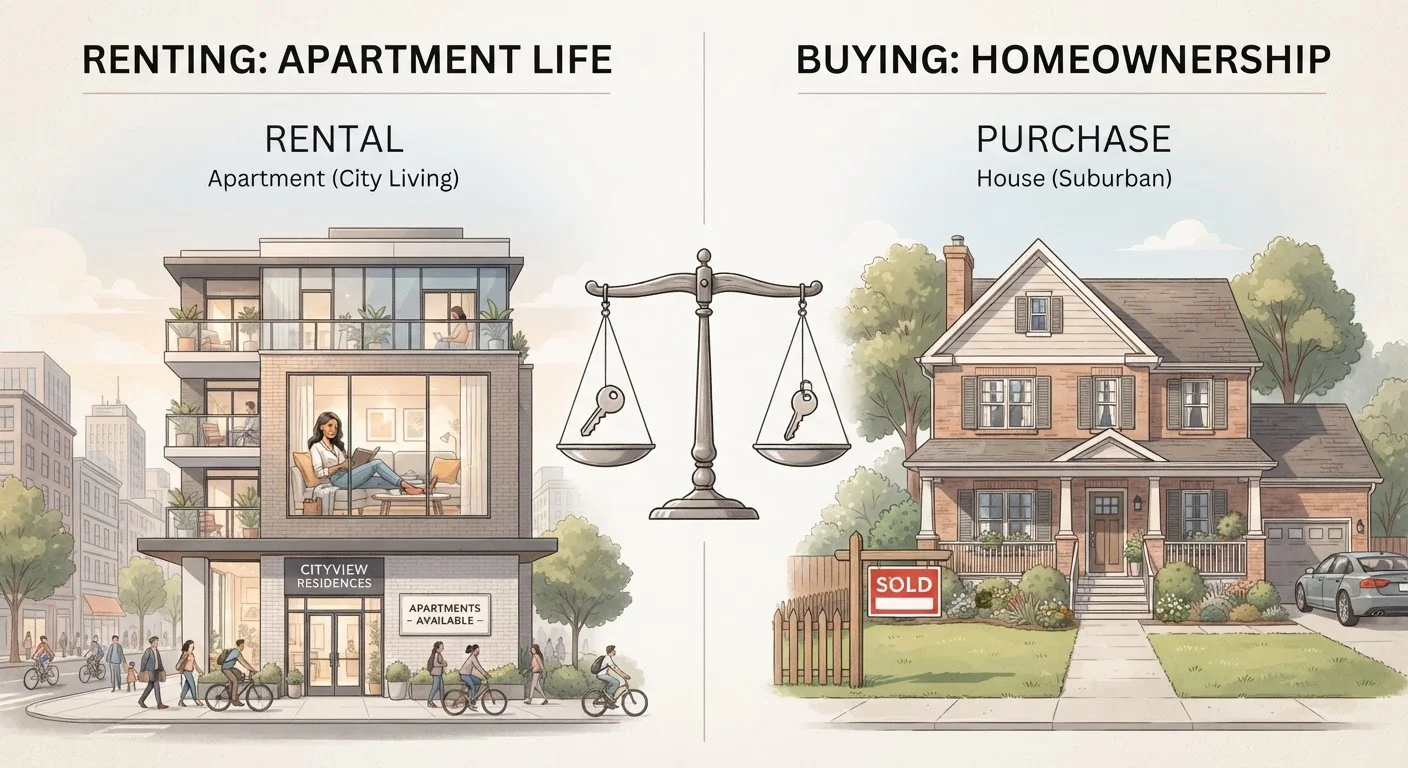
The renting-vs.-buying debate is often framed as a purely financial contest - but the two options represent different relationships with where you live. Buying a home means acquiring an asset, accepting maintenance responsibilities, and committing to a location. Renting means paying for housing flexibility while preserving liquidity. Neither is inherently wasteful or wise; both serve legitimate needs depending on circumstances.
Before running any numbers, it helps to clarify what you're optimizing for. Are you prioritizing long-term wealth accumulation, short-term cash flow, the freedom to relocate, or community stability? Your answer will shape how you weigh the trade-offs. For more on how these decisions interact with broader financial planning, see our framework for evaluating renting vs. buying in today's market.
| Renting | Buying | |
|---|---|---|
| Upfront costs | First month, last month, security deposit | Down payment, closing costs (5-25% of price) |
| Monthly cost predictability | Subject to lease renewal increases | Fixed with fixed-rate mortgage |
| Equity building | None | Yes, through principal paydown and appreciation |
| Maintenance responsibility | Landlord handles most repairs | Fully owner's responsibility |
| Flexibility to relocate | High - typically 30-60 day notice | Low - selling takes time and incurs costs |
| Market risk exposure | Minimal | Home value can decline |
| Customization | Limited by lease terms | Full control over renovations |
The Financial Case for Buying
Homeownership builds equity - the portion of the home's value you actually own - through two mechanisms: mortgage principal paydown and, historically, home value appreciation. Over long holding periods, these effects compound. According to the Federal Reserve's Survey of Consumer Finances, the median homeowner's net worth has consistently been significantly higher than the median renter's, though this reflects both the wealth-building effect of ownership and the fact that higher-income households are more likely to buy.
Buyers also benefit from predictable housing costs when using a fixed-rate mortgage. Understanding how mortgage types affect your payment is essential; our guide on fixed-rate vs. adjustable-rate mortgages breaks down how each loan structure works.
That said, buying carries substantial upfront costs - typically a down payment of 3-20% of the purchase price, closing costs of 2-5%, and ongoing expenses including property taxes, homeowners insurance, and maintenance (commonly estimated at 1-2% of home value annually).
Run Your Own Break-Even Calculation
Before deciding, estimate how long it would take for buying to become cheaper than renting in your specific market. Factor in the down payment opportunity cost, transaction costs on both ends, and realistic appreciation assumptions. Many personal finance resources offer free rent-vs.-buy calculators that can walk you through this analysis with local data. Revisit the calculation if your timeline or local market conditions change significantly.
The Financial Case for Renting
Renting is not "throwing money away" - it purchases a place to live, predictable monthly costs, and freedom from repair bills. In many high-cost metro areas, the monthly cost of owning an equivalent home significantly exceeds the cost of renting it, which means renters can direct the difference toward other investments.
The price-to-rent ratio - calculated by dividing a home's purchase price by its annual rent equivalent - is a useful benchmark. A ratio above 20 generally suggests renting may be more cost-effective in the short term; below 15 tends to favor buying. Many coastal and urban markets have ratios well above 20.
Renters also avoid the financial risk of a market downturn eroding home value, and they sidestep the transaction costs that make short holding periods expensive for buyers. If you're managing a tight household budget, the trade-offs of a very tight budget article explores how housing decisions interact with overall financial constraints.
Lifestyle and Timing Factors That Matter as Much as the Math
Financial calculations alone rarely settle this decision. Several non-financial variables carry significant weight:
- Time horizon: Most financial analyses suggest owning only pays off clearly after five to seven years, once transaction costs are absorbed by appreciation and equity growth. Shorter timelines typically favor renting.
- Job stability and mobility: Renters can relocate with relatively little friction. Homeowners face selling costs and market-timing risk if they need to move unexpectedly.
- Life stage: Growing families may prioritize school districts and stability; younger, mobile professionals may value flexibility more.
- Local market conditions: Inventory, interest rates, and local price trends all influence the math. The housing market hub covers current trends affecting buyers and renters across the country.
For a deeper examination of how lifestyle considerations intersect with this choice, renting vs. buying: weighing the real trade-offs offers a complementary perspective. Additionally, working with a fee-only financial planner can help you run personalized projections before committing either way.
This article is for general informational and educational purposes only and does not constitute financial, legal, or investment advice. Individual circumstances vary significantly - consult a qualified financial professional before making major housing decisions.