Why Nutrition Labels Exist - and What They're Designed to Do
The Nutrition Facts label is a federally standardized tool regulated by the U.S. Food and Drug Administration (FDA). It was redesigned in 2020 to reflect updated dietary science, making added sugars and vitamin D more prominent while shifting calorie text to a larger, bolder format. The goal is to give consumers objective, comparable nutrition data - in a consistent format across all packaged foods - so they can make informed choices.
The label is designed for education, not prescription. It won't tell you what to eat; it gives you reliable data to evaluate your options. Combined with a practical framework like the one in our balanced plate guide, it becomes a genuinely useful everyday tool.
Labels Are General Education, Not Personal Prescriptions
Daily Value percentages on nutrition labels are based on a 2,000-calorie reference diet and are intended for general guidance only. Your individual needs depend on your age, sex, health status, activity level, and other factors. Always consult a registered dietitian or qualified healthcare provider for personalized nutrition guidance.
How to Read the Label Step by Step
Follow these steps each time you pick up a new packaged product. With practice, the process takes under a minute.
What you will need
Packaged Food Item
Provides a real Nutrition Facts label to practice reading during each step.
Calculator or Smartphone
Useful for quick math when comparing servings or scaling nutrient amounts.
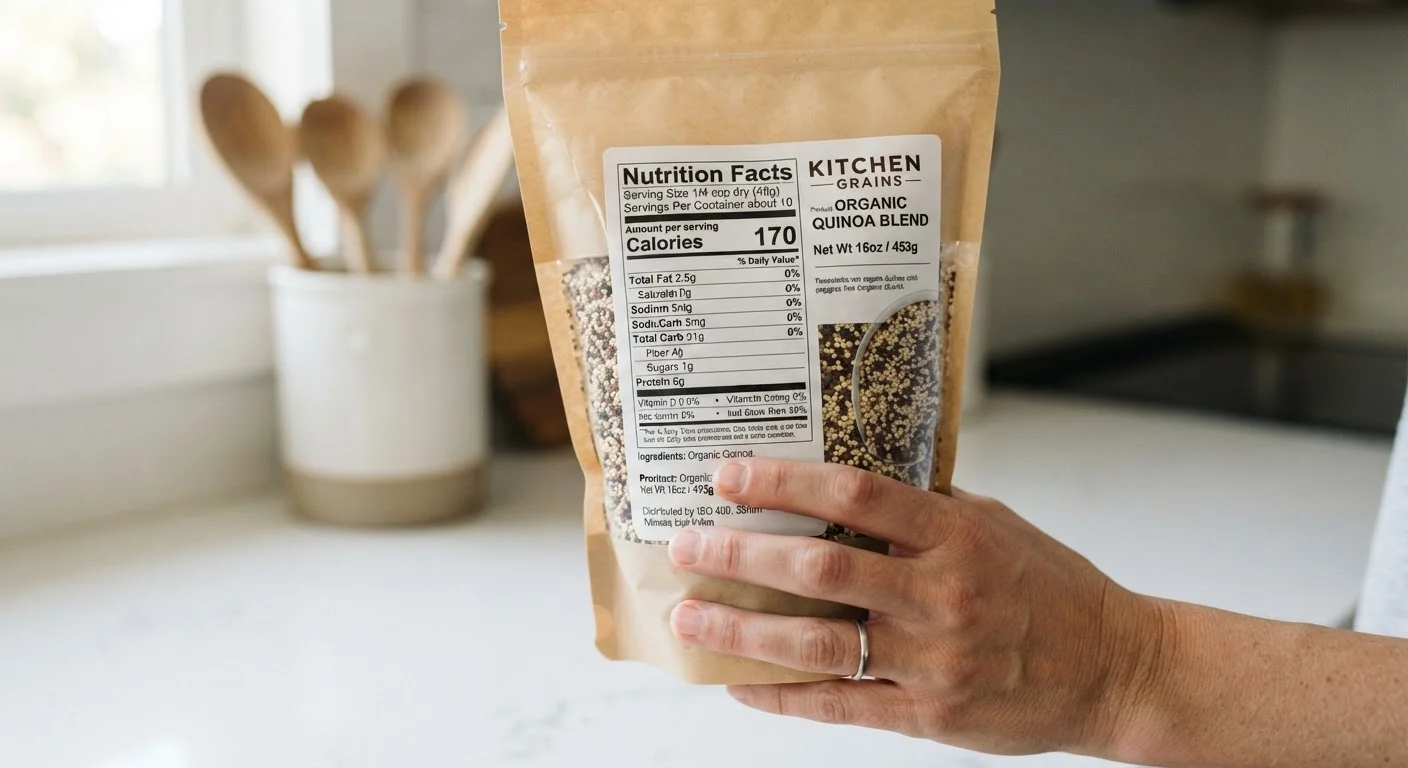
Start with serving size and servings per container
Every number on the label - calories, fat, sodium, everything - is based on one serving, not the whole package. The serving size is listed in both a common household measure (e.g., 1 cup) and grams. Below it, you'll see servings per container.
If a bag of chips lists 7 servings and you eat the whole bag, multiply every number on the label by 7. This single step prevents the most common misreading of nutrition information.
Check the calorie count in context
Calories appear in large, bold type directly below serving size. This number reflects the energy provided by one serving. Calories alone don't indicate whether a food is nutritious - a handful of almonds and a cookie might have similar calorie counts but very different nutrient profiles.
Use calories as one data point, not the whole story.
Scan the nutrients to limit
The label lists total fat, broken down into saturated fat and trans fat, followed by cholesterol, sodium, and total carbohydrates. Within total carbohydrates, look for dietary fiber, total sugars, and added sugars as a separate line.
Most Americans consume too much saturated fat, sodium, and added sugars. For these nutrients, a lower % Daily Value is generally better. Trans fat has no safe established level - look for 0g.
Note the nutrients to get enough of
Below the macronutrients, the label lists dietary fiber, vitamin D, calcium, iron, and potassium. These are highlighted because Americans commonly fall short of adequate intake. For these, a higher % Daily Value is generally a positive sign.
For a deeper look at what these and other micronutrients do in your body, see our micronutrients reference guide.
Understand the % Daily Value column
The % Daily Value (%DV) column, on the right side of the label, tells you what proportion of the recommended daily amount for each nutrient one serving provides, based on a 2,000-calorie reference diet. It's the most efficient tool for quick comparisons between foods.
Use the 5%/20% rule (described in the tip callout above) to make fast, reliable judgments without needing to memorize specific gram targets.
Glance at the ingredient list
Ingredients are listed in descending order by weight - what appears first makes up the largest portion of the product. A short ingredient list with recognizable foods is generally a good sign. If added sugar appears among the first three ingredients (or under multiple names like corn syrup, cane juice, or dextrose), that product is likely high in added sugars even if the label front looks wholesome.
Once you're comfortable reading labels, you can apply this knowledge directly at the store - our grocery shopping nutrition walk-through shows how.
Use the 5% / 20% Rule of Thumb
A quick way to evaluate any nutrient: 5% Daily Value or less is considered low, and 20% or more is considered high. Aim high for fiber, vitamins, and minerals; aim low for saturated fat, sodium, and added sugars. This simple benchmark works for most everyday food comparisons.
Common Misconceptions Worth Clearing Up
Front-of-Package Claims Can Mislead
Terms like 'natural,' 'made with real fruit,' or 'multigrain' are largely unregulated marketing phrases. A product labeled 'low-fat' may contain high amounts of added sugar. Skip the front of the package and go straight to the Nutrition Facts panel for objective information.
Another frequent misreading: assuming that 'whole grain' on the front means the product is primarily whole grain. Check the ingredient list - if a refined flour appears before whole grain flour, refined grain dominates the product. Learn more about how processing changes grain nutrition in our whole grains vs. refined grains explainer.
Similarly, 'high protein' on the label doesn't specify protein quality. The source matters - for a side-by-side comparison of protein types and their nutritional trade-offs, see our plant vs. animal protein guide.
This article provides general nutrition information and education only. It is not a substitute for personalized advice from a registered dietitian, physician, or other qualified healthcare professional. Individual nutritional needs vary significantly based on health status, age, and other personal factors.