The Core Idea: Fighting Sound with Sound
Sound travels as waves - pressure variations moving through air. When two identical waves meet perfectly out of phase, their peaks and troughs cancel each other out, a phenomenon called destructive interference. Active noise cancellation (ANC) is a deliberate engineering application of this principle.
Here is the basic chain of events inside a pair of ANC headphones:
- A microphone captures ambient sound - the hiss of an airplane cabin, the rumble of a train, or the drone of an HVAC system.
- A digital signal processor (DSP) analyzes that captured audio almost instantaneously and calculates the exact inverse of the waveform.
- A speaker driver plays the inverted wave at the same moment the original noise would reach your ear.
- The two waves collide and largely cancel each other, so your ear perceives greatly reduced noise.
The entire cycle - sample, invert, emit - happens in microseconds, which is why the technology can keep pace with continuous background sounds.
“Noise cancellation is fundamentally a signal processing problem. You're asking a small chip to hear the world, flip it upside down, and play it back - all before the original sound reaches your eardrum. The physics is elegant; the engineering challenge is doing it fast enough and accurately enough to matter.”
— Dr. Julius O. Smith III, Professor of Music and Electrical Engineering, Stanford University
Feedforward, Feedback, and Hybrid Systems
Not all ANC headphones are engineered the same way. The placement of the microphones determines how the system samples noise - and how well it performs.
Feedforward ANC
The microphone sits on the outside of the ear cup, facing outward. It picks up noise before it enters the ear cup, giving the processor a slight head start in generating the anti-phase signal. The advantage is early detection; the limitation is that the microphone is exposed to wind and other artifacts that can confuse the system.
Feedback ANC
The microphone is positioned inside the ear cup, close to the ear. It hears what you hear, allowing the system to correct any residual noise the ear cup itself has not blocked. It reacts to what actually reaches the ear rather than predicting it.
Hybrid ANC
Higher-end headphones combine both approaches, using microphones in both positions simultaneously. This gives the processor more data to work with, generally producing stronger and more accurate cancellation across a wider range of sounds.
~30 dB
Typical noise reduction achieved by strong ANC systems
Independent audio testing labs have measured leading over-ear ANC headphones reducing consistent low-frequency noise by approximately 20-30 decibels, roughly equivalent to moving from a loud office to a quiet room.
< 1 ms
Time for ANC processor to generate anti-phase signal
Modern DSP chips used in consumer ANC headphones complete the sample-invert-emit cycle in well under one millisecond, fast enough to cancel continuous low-frequency sound waves in real time.
~20-500 Hz
Frequency range where ANC is most effective
Engineering analyses of ANC systems consistently show the strongest cancellation occurring in the low-frequency band below 500 Hz, where wavelengths are long enough for the electronics to respond accurately.
What ANC Can and Cannot Block
Understanding ANC's limits helps you set realistic expectations and choose the right tool for your environment.
Where ANC excels:
- Steady, low-frequency noise - airplane and train engine rumble, air conditioning, road noise in a car
- Consistent mechanical hum from appliances or office equipment
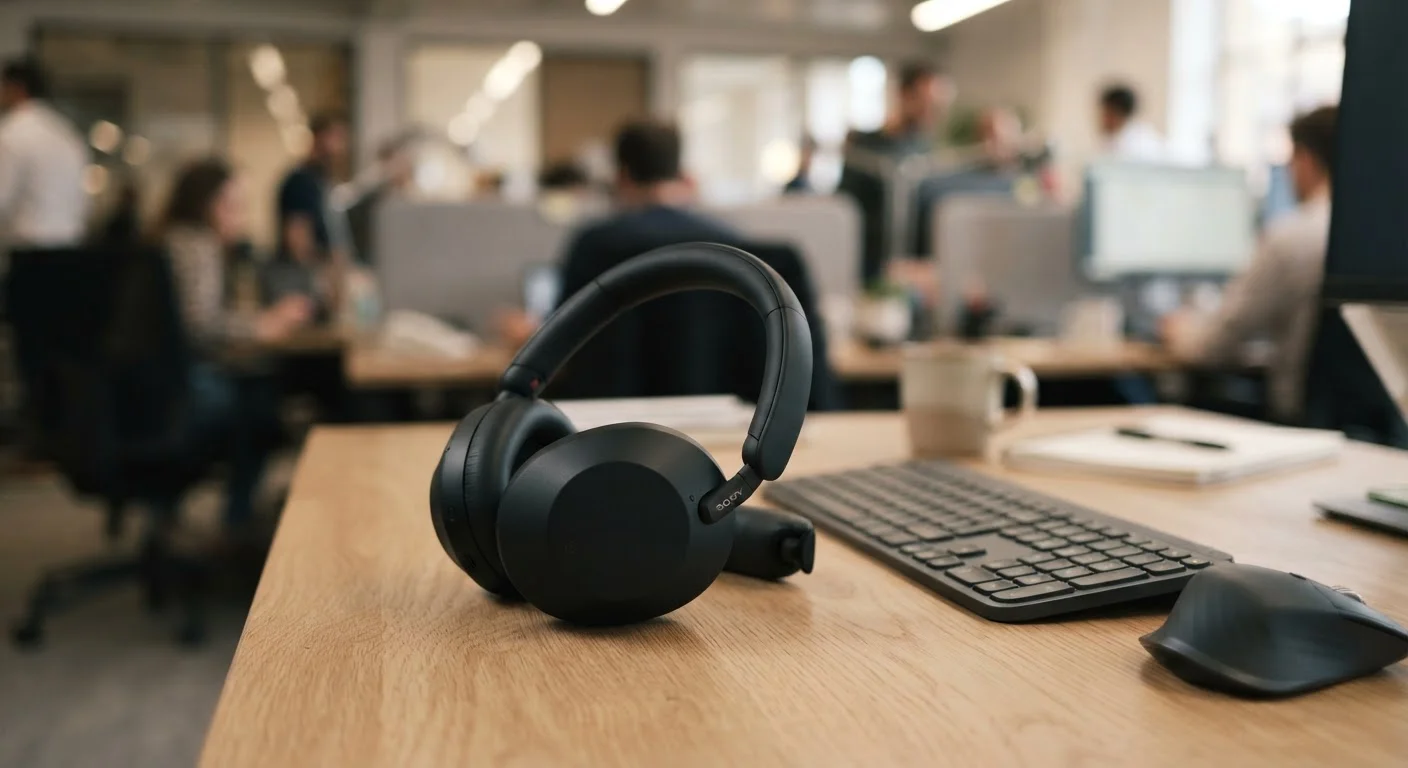
- Predictable ambient drone in open-plan offices
Where ANC struggles:
- Sudden, sharp sounds like a door slamming or someone calling your name - too fast to predict and counter
- High-frequency sounds, such as a baby crying or a high-pitched alarm - shorter wavelengths are harder for the circuitry to invert accurately
- Complex, constantly changing audio environments with many overlapping unpredictable sources
This is why passive isolation - the physical seal created by well-designed ear cups or ear tips - remains important. ANC and physical design work together, not as alternatives. If you're also weighing whether a wired or wireless connection better fits your listening needs, see our breakdown of wired vs. wireless trade-offs for a fuller picture.
Match ANC to Your Environment
If most of your listening happens on planes, trains, or in offices with steady background noise, ANC will deliver noticeable benefits. If you primarily listen at home in quiet rooms, the passive isolation of well-fitted ear cups may be sufficient - and will save battery. Think about where you actually use headphones before weighing ANC as a priority feature.
Why Your Brain Notices ANC Even When It Isn't Perfect
Even partial noise reduction has a disproportionate effect on perceived comfort. Human hearing is highly sensitive to sustained low-frequency noise - it creates mental fatigue, raises stress levels, and makes concentration harder even when you consciously tune it out. Reducing that constant drone, even by a moderate amount, can meaningfully lower cognitive load during long commutes or work sessions.
This is also why some people report a slight pressure sensation when using ANC headphones. The brain interprets the sudden reduction in low-frequency sound pressure as a change in air pressure - similar in a minor way to the sensation during an altitude change. It is not harmful, but it can feel unusual until you adapt to it.
Transparency or ambient mode, now common on many ANC headphones, effectively runs the process in reverse: external microphones pipe in selected environmental sounds so you can hold a conversation or stay aware of surroundings without removing your headphones. It is the same microphone and DSP hardware serving a different purpose.