How Each Technology Actually Moves Your Data
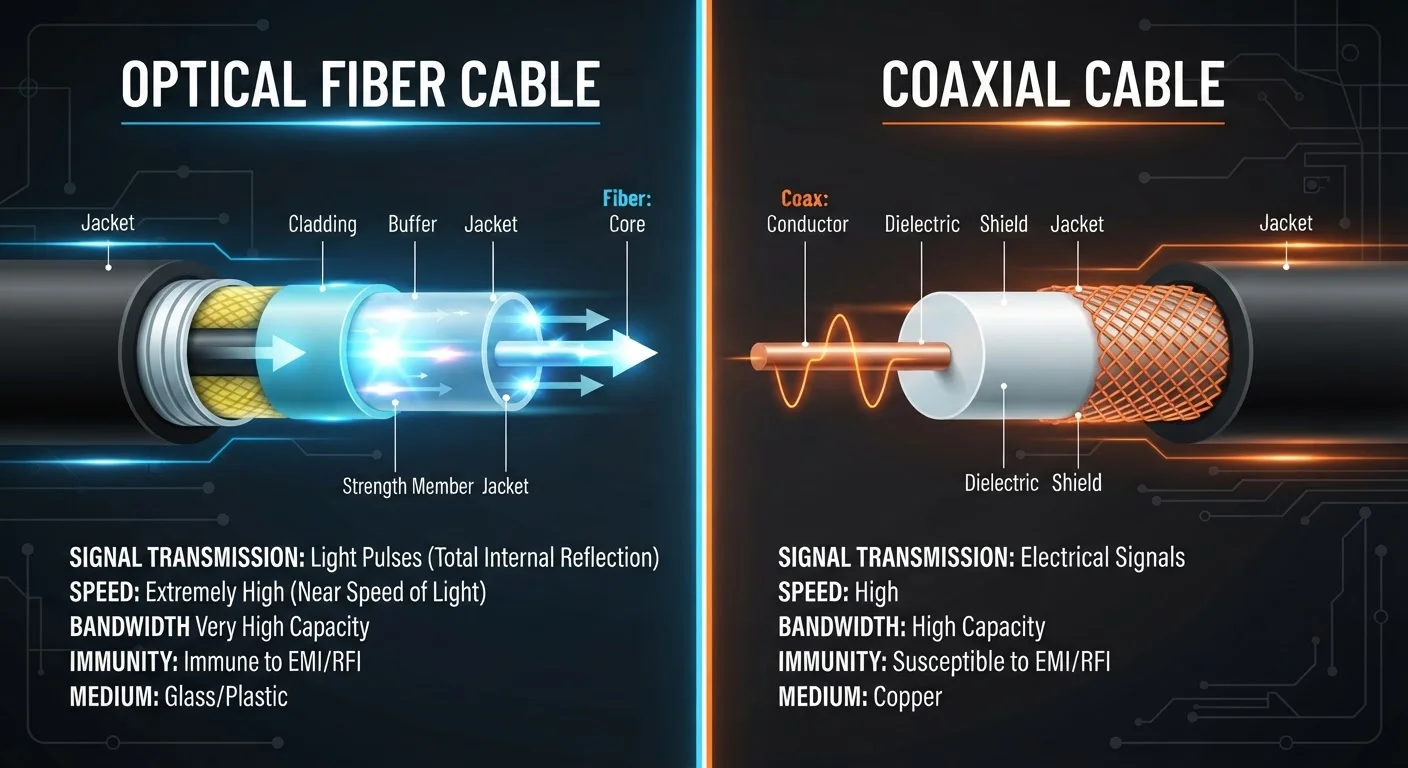
The most fundamental difference between fiber and cable internet is the physical medium carrying your data - and that medium determines nearly everything else about how each connection behaves.
Fiber optic internet encodes data as rapid pulses of light traveling through ultra-thin strands of glass or plastic. Because light travels at - well, the speed of light - and experiences virtually no electromagnetic interference, fiber is exceptionally fast and stable over long distances. The signal doesn't degrade the way electrical signals do, which means a customer located a mile from a fiber hub experiences roughly the same signal quality as one located a block away.
Cable internet delivers data as electrical signals over coaxial cable - the same type of copper-and-shielding cable historically used for television. Modern cable networks use a protocol called DOCSIS (Data Over Cable Service Interface Specification) to push broadband data across that infrastructure. DOCSIS 3.1 and the emerging DOCSIS 4.0 standard have dramatically increased cable speeds, but the underlying medium still has physical limitations that fiber doesn't share.
For a plain-language explanation of the speed metrics you'll see on any plan, see our guide to Mbps, Gbps, and latency.
| Criterion | Fiber Internet | Cable Internet |
|---|---|---|
| Transmission medium | Light pulses through glass/plastic strands | Electrical signals over coaxial copper cable |
| Upload/download symmetry | Symmetrical (equal in both directions) | Asymmetrical (upload much slower) |
| Peak-hour congestion | Minimal - dedicated path to home | Possible - neighbors share node bandwidth |
| Signal degradation over distance | Very low | Moderate - increases with distance |
| Latency (typical) | 5-15 ms | 15-40 ms |
| Maximum available speeds | Up to multi-gigabit | Up to ~2 Gbps (DOCSIS 3.1) |
| U.S. availability | Expanding but limited in many areas | Widely available, including most suburbs |
| Infrastructure maturity | Newer deployments, ongoing expansion | Established, with active upgrades underway |
Symmetry, Congestion, and Real-World Reliability
Two performance factors separate fiber and cable in everyday use: upload/download symmetry and shared network congestion.
Symmetry refers to whether upload and download speeds are equal. Fiber plans are almost universally symmetrical - a 500 Mbps fiber plan typically delivers 500 Mbps in each direction. Cable plans are asymmetrical by design: a plan advertised at 500 Mbps download may only offer 20-35 Mbps upload. For households that primarily stream video or browse the web, this asymmetry is largely invisible. For anyone on frequent video calls, uploading to cloud storage, or running a home server, it becomes a meaningful bottleneck.
Congestion is a structural issue with cable networks. In most cable deployments, multiple households in a neighborhood share bandwidth on the same node. When many users are online simultaneously - evenings and weekends - available bandwidth can drop noticeably. Fiber architectures, particularly those using a design called FTTH (Fiber to the Home), provide a dedicated optical path to each address, eliminating neighborhood-level sharing.
~35%
U.S. addresses with fiber access
The FCC's Broadband Data Collection has shown that fiber reaches a significantly smaller share of U.S. locations than cable-based broadband infrastructure.
5-15 ms
Typical fiber internet latency
Industry benchmarking consistently shows fiber connections delivering lower round-trip latency than cable, an advantage particularly relevant for real-time applications like gaming and video calls.
10-35 Mbps
Typical cable upload speed on mid-tier plans
While download speeds on cable plans frequently reach hundreds of megabits, upload allocations on standard DOCSIS 3.1 plans remain substantially lower by design.
It's worth noting that cable technology continues to evolve. DOCSIS 4.0 is designed to significantly narrow the gap with fiber in both upload speeds and congestion management, though widespread deployment is still in progress.
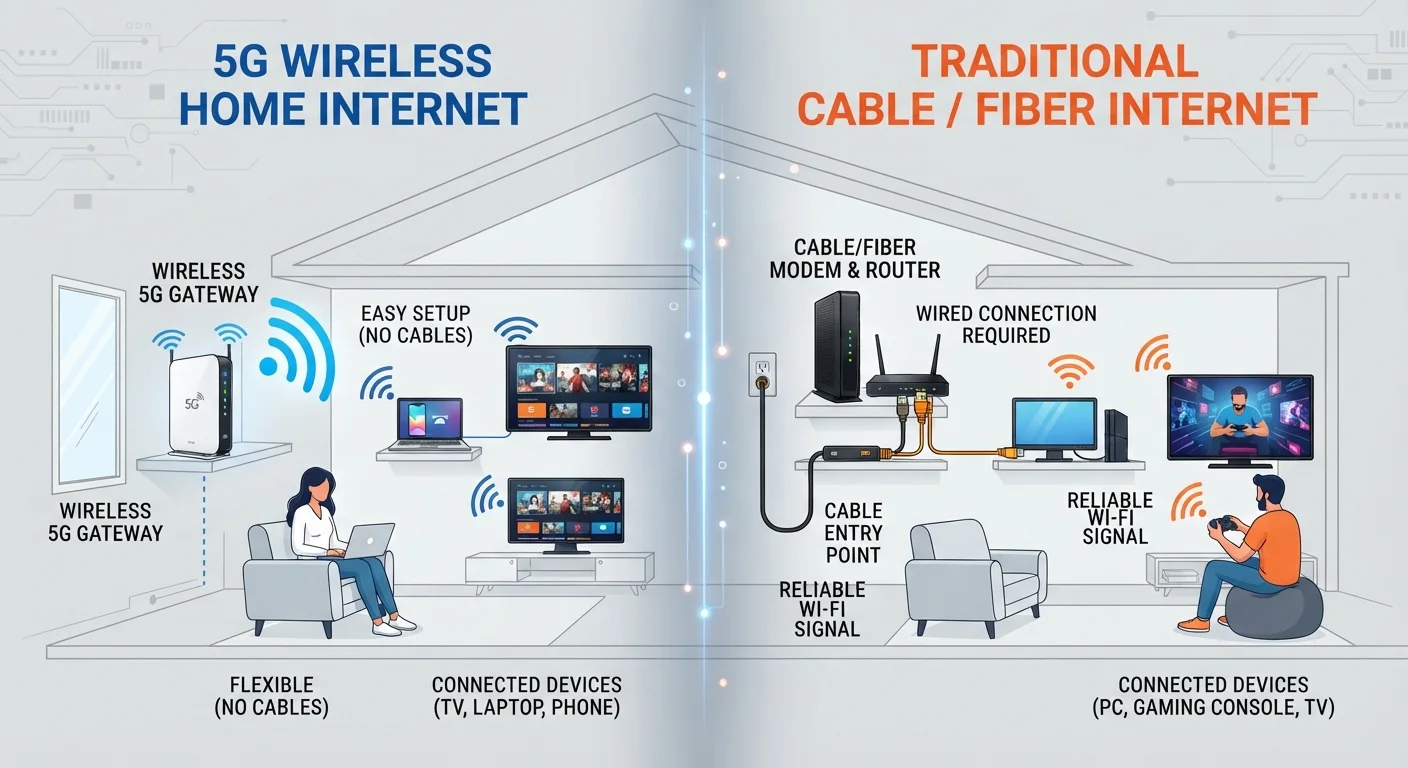
If you're weighing other broadband alternatives, our comparison of 5G home internet and traditional broadband covers another option growing in availability.
Availability, Infrastructure, and Choosing What's Right for You
The single biggest practical constraint on this comparison is geography. Fiber infrastructure requires significant capital investment to build - laying new conduit and fiber strands to individual addresses - so deployment has been uneven. According to the FCC's Broadband Data Collection, cable and other coaxial-based connections reach a substantially higher percentage of U.S. addresses than fiber does, particularly in suburban and rural areas.
If both technologies are available at your address, the technical case for fiber is strong: lower latency (the delay before data starts moving, measured in milliseconds), better upload speeds, less susceptibility to peak-hour slowdowns, and greater headroom as household device counts grow. However, the real-world gap narrows considerably at mid-tier speeds for households whose primary activities are streaming, social media, and web browsing - activities that don't stress cable's asymmetrical design.
Rural households may find neither fiber nor cable reaches them. In that context, satellite internet is a separate category entirely - one with its own distinct trade-offs. Our guide to satellite internet for rural households sets realistic expectations for what that option delivers.
Before choosing a plan, it's also worth challenging common assumptions about how much speed you actually need. Common internet speed myths show that many households overpay for capacity they never use - regardless of whether the connection is fiber or cable.