
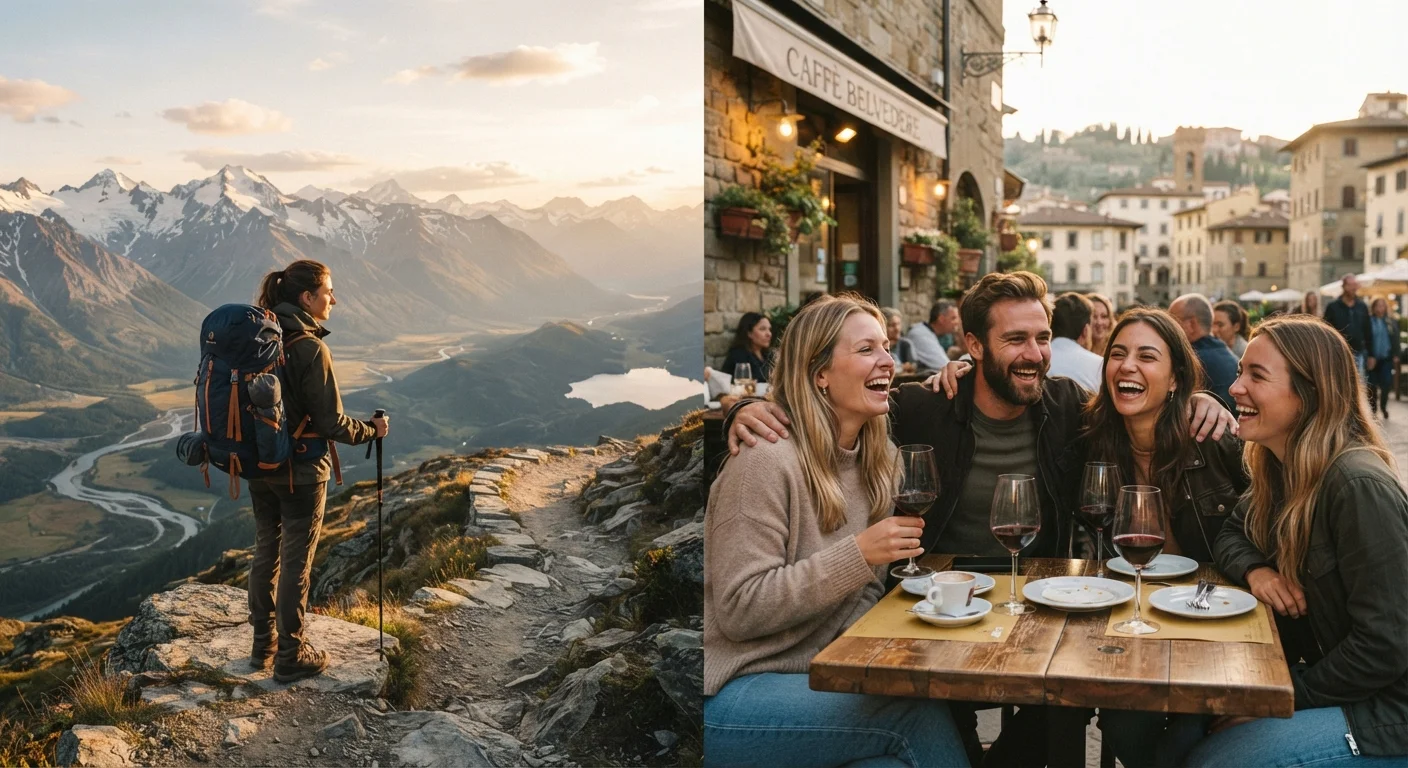
The Core Trade-Off: Freedom vs. Fellowship
Every travel format involves a fundamental exchange. When you travel alone, you trade the comfort of company for the authority to do exactly what you want, when you want. When you travel with others, you trade individual control for shared energy, divided costs, and someone to laugh with when things go sideways.
Neither is a consolation prize. A solo week in Kyoto - wandering temple gardens at your own pace, eating where instinct leads you - can be profoundly rewarding. So can a group road trip through the American Southwest where the car's playlist becomes a group negotiation and every roadside diner stop turns into a story. The question isn't which format is better in the abstract; it's which one fits the trip you're actually trying to take.
Understanding that trade-off clearly is the starting point for everything else - from how you'll structure your itinerary to how you'll budget your money. For a detailed look at where travel dollars actually go once you've committed to a format, see our travel budget breakdown.
Cost Differences: More Than Just Splitting the Bill
The financial picture is more nuanced than it first appears. Group travel does produce real savings in certain categories: shared accommodation (splitting a vacation rental, for example), group transport like van rentals or multi-person train bookings, and group-rate tours or entry fees can meaningfully reduce per-person spending.
Solo travelers, by contrast, almost always pay a premium for the privilege of going alone. Single-occupancy hotel rooms often cost 60-80% of a double room. Every meal, taxi, and tour is absorbed by one budget. Some travelers offset this by staying in hostels or choosing destinations with lower price floors - but the single-traveler premium is real and worth building into any honest comparison.
| Solo Travel | Group Travel | |
|---|---|---|
| Per-person cost | Generally higher; single supplements apply | Lower in shared categories; scales with group size |
| Schedule flexibility | Total control; change plans freely | Requires consensus; less spontaneous |
| Social experience | Meet strangers; deeper self-reliance | Built-in companionship; shared memories |
| Logistics complexity | Simpler to book; all decisions yours | Harder to coordinate; more moving parts |
| Safety considerations | Higher individual responsibility | Informal safety net from the group |
| Best trip types | City immersion, creative retreats, open-ended trips | Road trips, tours, adventure activities, celebrations |
Group size also matters. A couple or trio travels leaner than a party of eight, where coordinating flights, meal reservations, and activity bookings introduces its own time and money costs. If you're planning around a larger group, factor in the organizational overhead before assuming economies of scale will dominate. Pairing format decisions with packing choices - like whether to travel carry-on only or check bags - can further shape what each format costs in practice.
Flexibility, Pace, and the Itinerary Question
This is where solo travel's advantages become most tangible. A solo traveler can change countries on a whim, sleep in, skip a museum, and linger over coffee without consulting anyone. That fluidity is genuinely valuable - and it's a particular asset in destinations where the best experiences are unscheduled.
Group travel, even among close friends, requires constant negotiation. Someone always wants to leave earlier; someone always wants to stay longer. These small frictions accumulate. Well-organized groups mitigate this by agreeing on shared priorities upfront and building in deliberate downtime - a principle explored in depth in how to build an itinerary that leaves room to breathe.
Organized group tours sit at a different point on the spectrum. They handle logistics - transport, lodging, guides - in exchange for a predetermined schedule. For travelers entering an unfamiliar region or navigating complex logistics (remote trekking, multi-country routes), that structure can be genuinely freeing rather than constraining. The trade-off echoes decisions like choosing a single-country trip versus a multi-destination itinerary - more stops and more complexity both reward careful planning.
Consider a Hybrid Approach
You don't have to commit entirely to one format. Many experienced travelers book solo flights and accommodation for the parts of a trip where they want freedom, then join a small-group day tour or activity for specific experiences - a guided hike, a cooking class, a boat excursion. This lets you capture spontaneity and shared energy without sacrificing one for the other. Even meeting up with friends for just a portion of a longer solo trip can provide meaningful social recharge without locking in a rigid group itinerary.
Safety, Support, and When the Format Really Matters
Safety dynamics shift considerably between solo and group travel, and it's worth being direct about this rather than glossing over it. Solo travelers - particularly in unfamiliar urban environments, remote areas, or regions where they stand out visibly as tourists - carry more personal risk and more personal responsibility for managing it. This doesn't mean solo travel is inherently dangerous; millions of people do it safely every year. But it does mean the preparation bar is higher: researching local conditions, sharing itineraries with someone at home, and staying alert in ways that group travel can make feel less necessary.
Groups provide informal security through numbers and shared awareness. They also provide practical backup: if one person gets sick, loses a passport, or encounters a problem, others can help navigate the response. For travelers visiting the international travel destinations they're least familiar with, that safety net has real value.
Regardless of format, verifying current entry requirements, travel advisories, and local conditions through official government sources before any international trip is essential - information changes, and no article can substitute for current official guidance.