
Why Most Travel Budgets Fall Short
Ask most people what a trip costs, and they'll quote the flight and the hotel. Those two numbers feel like the whole story - until the credit card bill arrives. The reality is that flights and accommodation often represent only about half of what a trip actually costs. The other half is scattered across a dozen smaller categories that rarely get written down before departure.
This isn't a small-scale problem. Travelers routinely return home having spent 20-40% more than planned, not because they splurged, but because they simply didn't account for where all the money goes. Tracing spending by category is just as revealing for travel as it is for everyday household finances - the discipline is the same, but the categories are different.
Building an accurate travel budget starts with understanding the full anatomy of trip spending, from the costs you incur before you leave home to the ones that creep up on your last day.
The Pre-Departure Layer: Costs Before You Even Leave
A meaningful chunk of travel spending happens weeks or months before the trip begins. Visa application fees are an obvious example - depending on the destination, these can run from $20 to well over $150 per person. Required vaccinations or health consultations for international travel add another layer, particularly for trips to destinations with specific entry health requirements. Always verify current entry requirements through official government sources, as these change and vary by nationality.
Travel insurance is another pre-departure cost that gets skipped when budgets are assembled in a hurry. It's a real expense worth planning for. Our guide on what travel insurance actually covers walks through coverage types so you can make an informed choice.
Gear purchases - a new carry-on, packing cubes, a universal adapter, travel-sized toiletries - accumulate quietly. These feel small individually but can easily total $100-$300 for a traveler who hasn't taken a major trip recently. For a sense of how packing choices also affect travel experience, our piece on the overpacked bag is worth a read before you start stuffing a suitcase.
~50%
Of trip costs beyond flights and hotels
Travel industry surveys consistently find that food, ground transport, activities, and fees account for roughly half of total travel spending.
$150+
Common pre-departure gear and prep spend
Travelers who haven't taken a major trip recently often spend $100-$300 on new gear, adapters, toiletries, and health prep before departure.
10-15%
Recommended contingency buffer
A widely cited travel planning standard recommends reserving 10-15% of total estimated trip cost for unexpected expenses.
$75
Typical one-way airport transfer cost
Taxi, rideshare, or train transfers from major international airports to city centers frequently range from $30 to $80 or more each way.
Getting There - and Around Once You Arrive
Flights get the most attention, but the transportation budget rarely ends there. Airport transfers - taxis, rideshares, or trains to and from the airport - can cost $30-$80 each way in many major cities. Multiply that by a layover, a rental car pickup across town, or a connecting flight out of a different terminal, and it adds up fast.
Ground transportation within a destination is one of the most consistent budget blind spots. Whether it's daily metro cards, intercity trains, ferry crossings, or car rentals with fuel, these costs are often left out of initial estimates entirely. If you're weighing routing options, our breakdown of long-haul vs. connecting itineraries explores how flight structure affects both comfort and total cost.
Baggage fees deserve a specific mention. A checked bag on a budget carrier can cost as much as $35-$75 each way - which, for a family of four on a round trip, can rival a hotel night.
Food, Activities, and the Daily Spend
Daily spending on food and drink is highly variable - and that variability is exactly why it needs a dedicated estimate. A traveler in Tokyo budgeting the same daily food allowance as one in rural Portugal will be surprised in very different directions. Research typical meal costs at your destination before finalizing a daily food budget, distinguishing between casual local spots and tourist-area restaurants.
Activities and entrance fees are another category that balloons without planning. Museum admissions, guided tours, national park entry fees, cooking classes, day trips - each sounds modest in isolation, but a week of active sightseeing can easily run $200-$500 per person in fees alone. Review your planned itinerary against an honest per-activity cost to avoid mid-trip trade-offs. Our guide to building a trip itinerary that leaves room to breathe offers a framework for structuring days without overcommitting your time - or your budget.
Build Your Budget Category by Category
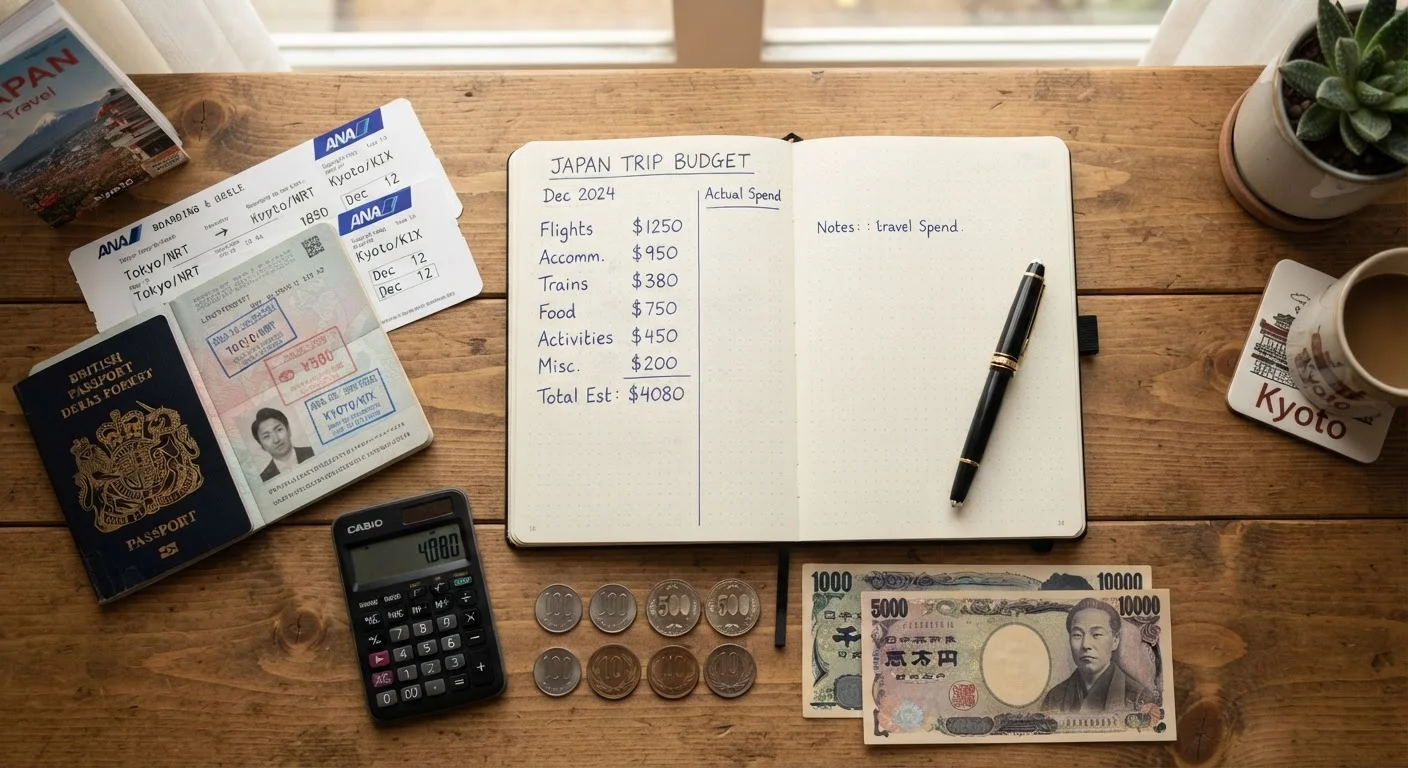
Rather than setting a single dollar total and hoping it covers everything, build your travel budget line by line: flights, accommodation, ground transport, food, activities, pre-departure costs, and a contingency fund. This approach forces you to confront each category before you leave - and makes it far easier to identify where you can adjust if the total is too high.
The Invisible Costs: Fees, Tips, and the Contingency Fund
Several costs are easy to overlook because they're transaction-level frictions rather than obvious line items. Foreign transaction fees on credit cards, ATM withdrawal charges, and poor exchange rates at airport currency kiosks each shave a few dollars at a time - but across a two-week international trip, that erosion can reach $50-$150 without a single impulse purchase. Our guide on keeping your finances intact while traveling goes deeper on managing money across borders.
Tipping customs vary by country, but in destinations where tipping is expected - including the United States and many parts of the Americas - budgeting 15-20% on top of meal and service costs is simply realistic. Souvenirs and gifts are another softly-budgeted category that tends to expand on the ground.
The most important line in any travel budget is the contingency fund. A medical copay, a delayed flight that requires an unplanned hotel night, a stolen wallet - these aren't catastrophic events, but they cost money. Setting aside 10-15% of your total estimated budget as a reserve isn't pessimism; it's what separates a stressful surprise from a manageable inconvenience.
If you're newer to budgeting in general and want a structured starting point, our plain-English guide to building your first budget lays out the fundamentals that apply to travel planning just as much as everyday finances. For international trips specifically, the complete international travel planning reference covers money, documents, health prep, and more in one place.