Three Types of Distraction - and Why All Three Matter
Distracted driving discussions almost always center on smartphones, but that framing obscures the full picture. The National Highway Traffic Safety Administration (NHTSA) defines distraction as any activity that diverts attention from driving, and it organizes those activities into three distinct categories: visual (eyes off the road), manual (hands off the wheel), and cognitive (mind off the task). A driver who is mentally replaying an argument while keeping both hands on the wheel and eyes forward is still distracted - and still dangerous.
Understanding all three categories matters because each requires a different countermeasure. Addressing only the most visible form - phone use - leaves significant risk unexamined. The list below covers the major sources of distraction across all three types, along with practical ways to manage each. For a deeper look at why even attentive drivers can miss hazards right in front of them, see why drivers miss what's right in front of them.
Smartphone Use (Visual + Manual + Cognitive)
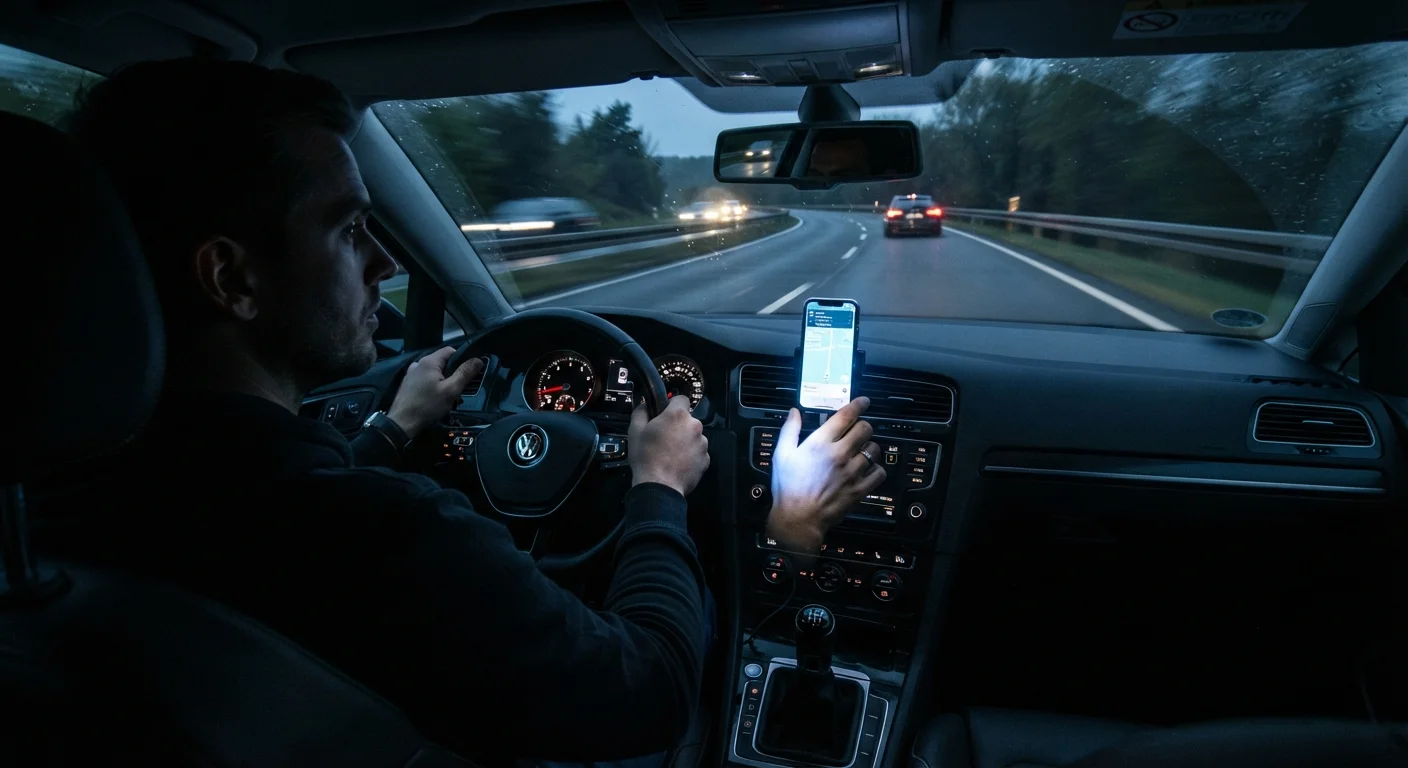
Reading or composing a text message is widely cited by safety researchers as one of the most dangerous in-vehicle activities because it simultaneously removes the driver's eyes from the road, hands from the wheel, and mental focus from driving. At highway speed, even a few seconds of eyes-off-road time covers the length of a football field with no conscious driver input.
The countermeasure is straightforward in principle: place the phone out of reach or enable Do Not Disturb driving modes before the trip begins. Many current smartphones offer automatic activation when a Bluetooth vehicle connection is detected. No message or notification warrants the risk of engaging while in motion.
Texting while driving removes eyes, hands, and mental focus from the road simultaneously.
Hands-Free Calls (Cognitive Distraction)
Hands-free calling is widely perceived as safe because it keeps both hands on the wheel. Research from the AAA Foundation for Traffic Safety has found, however, that voice-based calls still impose significant cognitive load - the brain must construct language, process responses, and maintain social engagement, all of which draw on the same mental resources needed for driving.
This is distinct from a conversation with a passenger, who can naturally pause when traffic demands attention. A phone caller has no awareness of road conditions and keeps the cognitive demand constant. For complex or emotionally charged calls, pulling over before answering is the safest option.
Hands-free calls still impose significant cognitive load, even with both hands on the wheel.
In-Vehicle Infotainment Systems (Visual + Manual + Cognitive)
Touchscreen infotainment panels have replaced many physical controls in modern vehicles, which can increase the visual and manual demand of routine actions like changing the radio station or adjusting climate settings. A rotary knob operable by feel requires less visual attention than a touchscreen menu that demands the driver look away to locate the correct target.
The practical guidance: program destinations and media preferences before departing. If an in-vehicle system requires navigation through multiple menus, treat that task the same as you would a phone interaction - handle it when stopped, or ask a passenger to manage it for you.
Touchscreen controls can demand more visual attention than the physical knobs they replaced.
Passenger Interactions (Cognitive + Occasional Manual)
Conversations with passengers are a natural part of driving, and unlike phone calls, passengers can self-regulate when the driver faces a demanding situation. The risk increases, however, with young children in the rear seats, heated discussions, or drivers who turn to face a passenger while speaking - a manual and visual distraction combined.
Parents of young children frequently identify rear-seat management as a major distraction source. Proactive strategies - snacks, entertainment, comfort items prepared before departure - reduce the frequency of in-trip interruptions. On high-demand roads or in unfamiliar areas, it's reasonable to ask passengers to pause a conversation while you navigate a complex interchange or merge.
Unlike phone callers, passengers can self-regulate - but heated conversations still increase cognitive load.
Environmental and External Distractions (Visual + Cognitive)
Accidents, unusual roadside activity, advertising displays, and scenic surroundings all draw the driver's gaze away from the path ahead. Sometimes called "rubbernecking," slowing or turning to look at an incident creates secondary collisions and traffic disruption - a well-documented pattern that emergency responders actively work to mitigate.
The countermeasure is practiced attention discipline: consciously redirect focus to the road ahead and traffic immediately surrounding your vehicle. Night driving conditions make external visual distractions particularly hazardous, as glare and reduced peripheral contrast already narrow effective vision. Keeping eyes scanning forward rather than drawn to periphery is a foundational safe-driving habit.
Rubbernecking at roadside incidents creates secondary collisions - a predictable and preventable pattern.
Eating, Drinking, and Grooming (Manual + Visual)
Food and beverage consumption behind the wheel is common enough to seem unremarkable, yet it consistently reduces steering precision and reaction speed. A sudden spill or dropped item typically triggers an instinctive reach-and-recover response - a manual and visual distraction at whatever speed the vehicle is traveling.
Grooming activities - applying makeup, adjusting hair - compound the problem by requiring sustained visual attention away from the road. These tasks are best completed before entering the vehicle or after reaching the destination. A few extra minutes in a parking lot is a small trade-off relative to the reaction-time deficits incurred while managing these tasks at highway speed.
A spilled drink triggers an instinctive reach response - a dangerous reflex at any speed.
Daydreaming and Mind-Wandering (Cognitive)
Cognitive distraction without any external trigger - simply letting the mind wander - is among the most prevalent and least discussed forms of inattention. Studies examining dashboard camera footage and driver self-reporting have consistently identified mind-wandering as a factor in a substantial share of crash events. The driver's eyes are open and nominally forward; the brain is elsewhere.
This form of distraction is particularly common on familiar routes where the drive has become automatic. Overconfidence rooted in routine is a recognized risk factor - as explored in how experience can work against you. Re-engaging attention periodically by actively scanning mirrors, checking speed, and noting landmarks helps break the autopilot pattern on routine commutes.
Mind-wandering is among the most common - and least visible - forms of distraction behind the wheel.
Building Habits That Keep Your Attention Where It Belongs
Recognizing distraction types is only useful if it leads to behavioral change. The most effective approach is to address distractions before the vehicle moves rather than trying to manage them in motion. Silence notifications, set navigation routes, adjust mirrors, and brief passengers on any ground rules before pulling out of the driveway. This simple pre-drive routine removes the in-trip temptation to handle these tasks at speed.
Start Every Trip With a Distraction Audit
Before shifting into drive, take 60 seconds to silence notifications, confirm your navigation route, adjust mirrors and climate controls, and secure any loose items. This pre-drive routine eliminates the in-motion temptation to handle these tasks at speed. Consistency is what makes it effective - treat it as a fixed habit rather than an occasional precaution.
Distraction doesn't operate in isolation, either. Fatigue amplifies the effects of cognitive load - a tired driver managing a hands-free call faces compounded impairment. The warning signs of driver fatigue article explains how to recognize drowsiness before it compounds other risks. Likewise, defensive driving principles provide a broader framework for anticipating hazards - including those created by distracted drivers around you. Treating every trip as a focused task, rather than routine background activity, is the mindset shift that reduces risk most reliably.