The Brain Doesn't See Everything You Look At
Every driver has experienced a near-miss that ended with the same bewildered thought: Where did that come from? The honest answer, supported by decades of cognitive science, is that the hazard was there all along - the brain simply chose not to register it.
Human visual attention works as a filter, not a recorder. The brain receives an enormous volume of sensory data every second and must decide what to prioritize. When it is engaged in an expected task - tracking the car ahead, preparing for a familiar turn - it actively suppresses stimuli that don't fit the anticipated scene. That suppression is inattentional blindness.
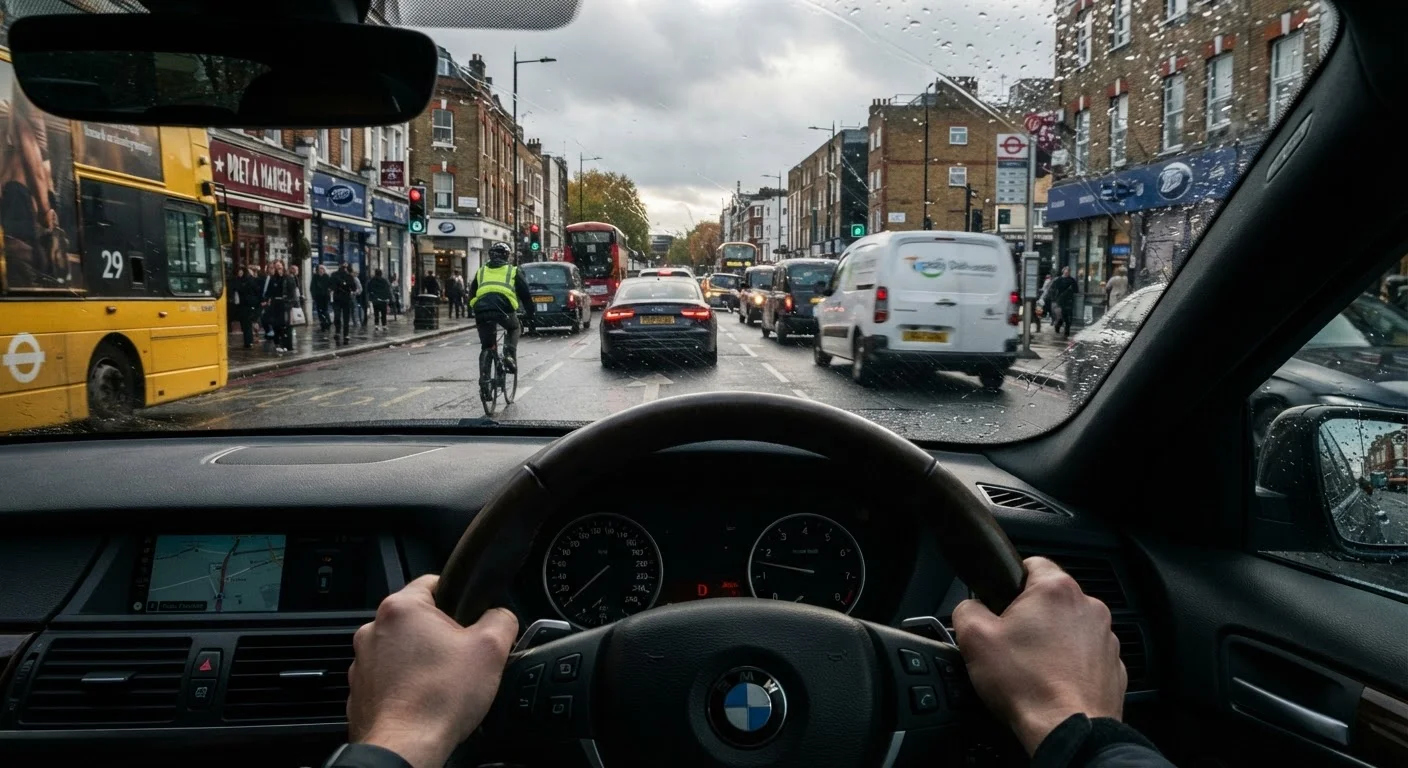
This is not carelessness, and it is not a visual defect. The driver's eyes may be aimed directly at a cyclist crossing the intersection. The light reflects off the cyclist and lands on the retina. But if the brain is occupied predicting something else, the cyclist never reaches conscious awareness. The result can be a collision with no warning and no explanation the driver can articulate.
“Attention is a limited resource. When it is fully allocated to one task, the brain has less capacity to detect unexpected events - even those directly in front of the observer.”
— Arien Mack, Psychologist and co-author of foundational inattentional blindness research
Why Familiar Routes Are the Most Dangerous
Counterintuitively, the roads drivers know best may be where inattentional blindness is most severe. On a familiar commute, the brain shifts into a heavily automated mode - sometimes described colloquially as "highway hypnosis." Pattern recognition replaces active scanning. The brain fills in what it expects to see rather than processing what is actually there.
Research in traffic psychology consistently shows that experienced drivers in familiar environments are more likely to miss unexpected hazards than drivers navigating unfamiliar roads. The novice driver is uncertain and therefore scanning consciously. The experienced driver has automated the task so thoroughly that novelty - a child stepping off a curb, a delivery truck blocking the usual sight line - can slip through unnoticed.
This is also why cognitive distraction compounds the problem so dramatically. A driver mentally rehearsing a meeting agenda while navigating a familiar road has doubled down on the brain's tendency to autopilot, leaving almost no processing capacity for unexpected events.
~36%
Cyclist fatalities involving a turning vehicle
According to the National Highway Traffic Safety Administration (NHTSA), a significant share of cyclist deaths involve vehicles making turns - a scenario where inattentional filtering of unexpected road users is most pronounced.
2x
Crash risk on familiar vs. unfamiliar roads
Research cited by traffic safety organizations suggests drivers are more likely to be involved in crashes on roads they drive frequently, where automation and reduced active scanning increase vulnerability to unexpected hazards.
~50%
Reduction in attention to unexpected hazards during phone conversations
Studies on cognitive distraction, including work referenced by the AAA Foundation for Traffic Safety, indicate that hands-free phone conversations can reduce a driver's detection of unexpected stimuli by roughly half compared to undistracted conditions.
Who Gets Missed Most Often - and Why
Not all road users face equal risk from inattentional blindness. Cyclists and motorcyclists are disproportionately affected for a specific reason: the brain builds perceptual templates based on frequency. In traffic dominated by passenger vehicles, the cognitive system is calibrated to detect cars. A cyclist occupies an awkward middle category - too fast to pattern-match as a pedestrian, too small to trigger the car-detection template - and gets filtered out.
Pedestrians in unexpected locations carry similar risk. A person crossing mid-block, or stepping from between parked vehicles, appears outside the spatial zone a driver is monitoring. Even with a clear line of sight, the brain may not generate a conscious alert.
This filtering effect is especially consequential at intersections. A driver turning left across oncoming traffic is focused on the oncoming lane - and the motorcycle or bicycle approaching in that lane may simply not register against the backdrop of faster-moving cars the brain is tracking. Understanding this dynamic is part of what makes lane positioning a genuine safety skill, not just a procedural requirement.
What Drivers Can Do About It
Awareness of inattentional blindness doesn't neutralize it - but it does enable countermeasures that meaningfully reduce risk.
- Actively reset on familiar roads. Consciously remind yourself that the familiar route is not a fixed film - unexpected elements appear every day. A brief mental reset before turning onto a well-known street can shift the brain out of pure autopilot mode.
- Use structured scanning habits. Rather than letting the eyes drift to what's expected, deliberately check mirrors, intersections, and bike lanes on a regular cycle. This is the same principle professional and commercial drivers use in formal defensive driving training.
- Reduce in-vehicle cognitive load. Conversations - even hands-free - occupy the same cognitive bandwidth that would otherwise process unexpected road events. See how all forms of distraction interact with this limitation.
- Slow down in complexity. Lower speed gives the brain more processing time per unit of distance. In environments with cyclists, pedestrians, or high intersection density, reduced speed is one of the most reliable ways to compensate for perceptual filtering. This also directly affects your stopping distance when something unexpected does appear.
Build a Scanning Habit Before Turning
Before executing any turn - especially left turns across traffic - pause your internal monologue and complete a deliberate check of all lanes, including bike lanes and crosswalks. This brief cognitive reset forces the brain out of predictive mode and into active observation. Making it a ritual on every turn, not just in unfamiliar areas, trains the habit where it is needed most.
Inattentional blindness is not an excuse for collisions - it is an explanation that carries practical responsibility. Drivers who understand why the brain fails are better equipped to build habits that make those failures less likely.