Lane Position Means More Than Staying Centered
Driver's ed teaches new drivers to keep their vehicle centered between lane markings - and that's reasonable starting advice. But centering is the floor, not the ceiling. Professional driving instructors, emergency vehicle operators, and defensive driving instructors all treat lane position as an active, constantly adjusted variable rather than a passive default.
Within any given lane, a driver actually has roughly two to three feet of usable lateral space. That small range makes a meaningful difference in what you can see, what hazards you're exposed to, and how much room you have to react. Understanding how to use that space intentionally is one of the most practical - and most overlooked - skills a new driver can develop.
Lane position
The deliberate lateral placement of your vehicle within a lane - not just staying between lines, but choosing exactly where within the lane based on conditions.
Escape route
A clear path you can steer into if you need to avoid a sudden hazard - something experienced drivers actively maintain rather than rely on finding in the moment.
Sightline
The unobstructed line of vision ahead of or beside your vehicle. Good sightlines give you more time to detect and respond to hazards.
Buffer zone
A cushion of space between your vehicle and a nearby hazard - such as a parked car, cyclist, or truck - that reduces collision risk and provides reaction time.
Dooring
A collision caused when a parked vehicle's door is opened into the path of a passing vehicle or cyclist. Lane position 2 helps create clearance to reduce this risk.
The Three Lane Positions and When to Use Them
Many driving instructors - particularly those teaching advanced or commercial driving - describe three functional positions within a single lane:
- Position 1 (center): The standard default. Offers balanced clearance from both lane boundaries. Best for normal traffic flow with no specific nearby hazards.
- Position 2 (toward the left lane marking): Increases separation from the right shoulder, parked cars, cyclists, or pedestrians. Also improves sightlines when following a large vehicle, since you can see further around its left side.
- Position 3 (toward the right lane marking): Creates buffer from an oncoming vehicle that has drifted, from cross-traffic entering from the left, or from a hazard on your left side. Use cautiously - it brings you closer to the right shoulder or parked cars.
None of these positions crosses a lane marking. The goal is controlled, purposeful placement within the lane boundary - not drifting or crowding.
How Positioning Affects Visibility and Escape Routes
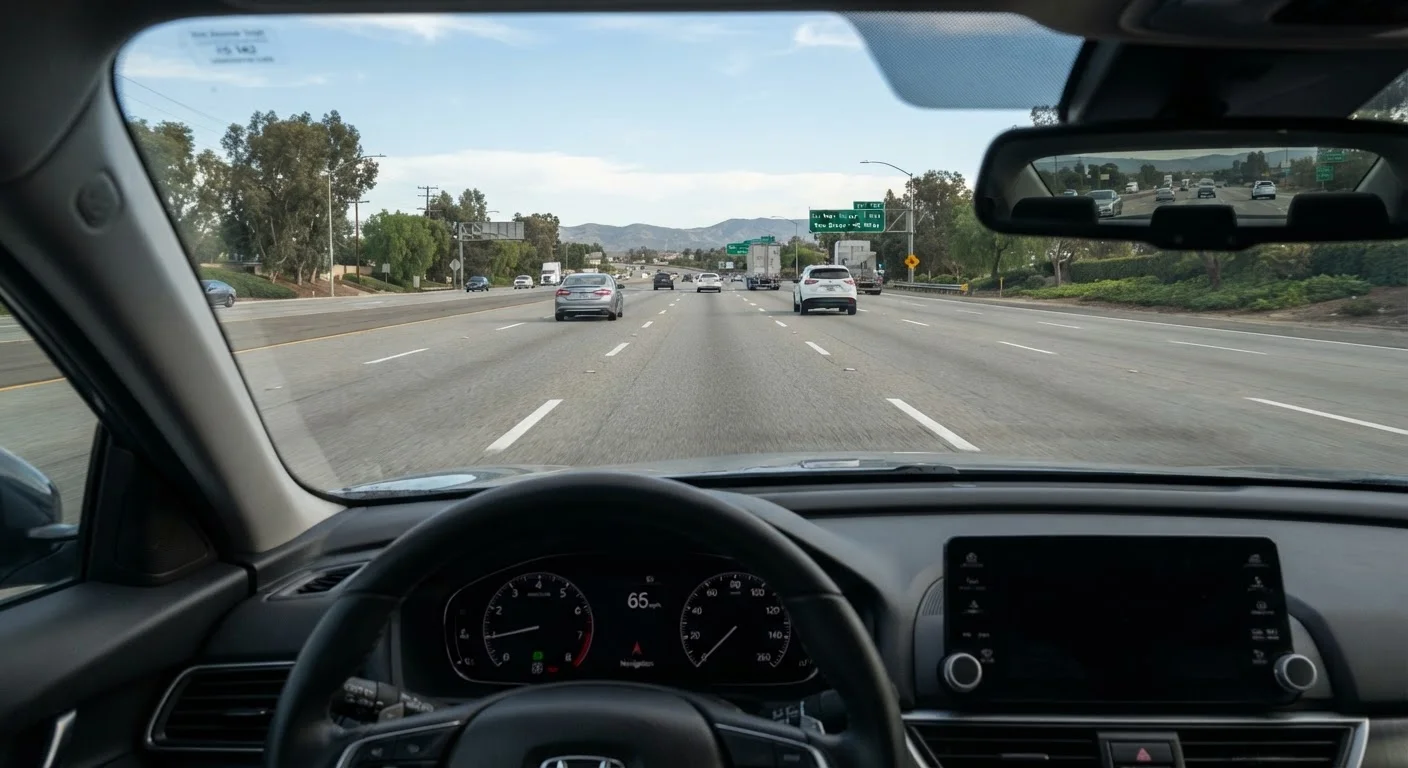
Sightlines determine how early you detect a hazard - and early detection is directly tied to how much time you have to respond. When you follow a delivery truck or SUV in position 1, the vehicle blocks a significant portion of your forward view. Shifting to position 2 lets you see further down the road along the truck's left flank, giving you a real-time preview of what's ahead.
Escape routes work on the same logic. If a driver in front of you brakes suddenly, your options depend on what's beside you. A driver already in position 2 has more usable space to the right if they need it. A driver tight to the right edge has far fewer options. As discussed in our guide on defensive driving principles, maintaining an escape route is a core habit of prepared drivers.
Use Reference Points to Track Your Position
When learning to manage lateral position, use the hood of your car relative to lane markings as a visual reference. With practice, you'll develop a feel for position 1, 2, and 3 without consciously tracking the lines. Many driving instructors recommend practicing deliberate position shifts in low-traffic conditions until the adjustments become second nature.
Common Situations Where Position Matters Most
Certain scenarios demand deliberate positioning rather than passive centering:
- Parked cars: Move to position 2 to create a buffer against an opening car door - a hazard called a "dooring" event. This is especially important in urban environments.
- Large trucks: Stay in position 2 when traveling alongside or behind a semi-truck. Their blind spots are substantial - directly behind and along much of both sides. See our companion article on navigating around large trucks for a full breakdown.
- Intersections: Position yourself to maximize visibility both ways before entering. Avoid hugging the edge of your lane where parked vehicles or road features may obscure crossing traffic.
- Curves: On a right-hand curve, moving slightly toward position 2 improves your sightline around the turn. On a left-hand curve, position 3 can help - but only where the shoulder is clear and safe.
- Merging zones: When another vehicle is merging toward you, a slight shift away from the merge point - while staying within your lane - reduces conflict risk. Our article on safer lane changes and merging covers this in detail.
Building the Habit: Scanning and Adjusting Continuously
The key to effective lane positioning is pairing it with continuous scanning. Drivers who only look immediately in front of them can't anticipate which position will serve them best in two or three seconds. Looking 10-15 seconds ahead - equivalent to roughly a city block at urban speeds - gives you time to recognize conditions and respond with a position change before the hazard arrives.
One reason drivers struggle with this is inattentional blindness - the tendency to miss hazards that are visible but unexpected. Our article on why drivers miss what's right in front of them explains this phenomenon and how to counter it.
Also consider following distance in tandem with position. A tighter following distance compresses your reaction window regardless of where in the lane you sit. For a deeper look at how spacing affects safety, the research covered in our piece on following distance myths is worth reviewing.
Position, vision, and spacing work as a system. Developing all three together - rather than treating lane-keeping as a single, static rule - is what separates a new driver from a genuinely prepared one.
Lane Position Applies to All Road Types
The three-position framework is just as relevant on city streets as it is on highways. In fact, urban environments - with parked cars, cyclists, bus stops, and frequent intersections - often demand more frequent and deliberate position changes than highway driving. Developing the habit in lower-speed settings makes it easier to apply at speed.