Why Following Distance Deserves More Attention
Rear-end collisions are among the most preventable crash types on American roads, yet they account for a disproportionately large share of traffic incidents each year. At the center of many of these crashes is a simple miscalculation: drivers consistently underestimate how much space they actually need to stop safely.
The problem isn't just lack of awareness - it's misinformation. Drivers operate on deeply held beliefs about following distance that sound reasonable but fall apart under real-world conditions. Understanding what the evidence actually shows can change habits that have been on autopilot for years. See how experience can quietly erode safe habits for a closer look at why even seasoned drivers get this wrong.
Myth
The two-second rule is always enough to stop safely in any situation.
Fact
Two seconds is a bare minimum for ideal conditions - dry roads, good visibility, and alert drivers. Many situations demand three to four seconds or more.
The two-second rule was designed as an easy-to-use baseline, not a universal constant. Reaction time alone - the gap between perceiving a hazard and pressing the brake - averages around 1.5 seconds for an alert driver. Add actual braking distance at highway speeds, and two seconds leaves very little margin. In rain, stopping distances for passenger vehicles can increase by 50% or more. On ice, that figure can multiply several times over. Treat two seconds as a floor, not a target.
Myth
Experienced drivers can safely follow closer because they react faster.
Fact
Human reaction time does not meaningfully improve with driving experience. Physics - not skill - determines how long it takes to stop a vehicle.
Studies on driver reaction time consistently show that the average alert adult takes roughly 1.5 seconds to react to an unexpected hazard regardless of years on the road. What experience can improve is hazard recognition and anticipation - but that only helps if you're paying full attention, which experienced drivers often aren't, due to complacency. A confident driver following at one second behind a vehicle at 60 mph has essentially no stopping margin at all, regardless of how many miles they've logged.
Myth
You only need extra following distance at high speeds - city driving is low-risk.
Fact
Stop-and-go traffic and frequent lane changes at lower speeds create their own rear-end collision risks that a close following distance makes worse.
City driving involves constant micro-decisions: pedestrians stepping off curbs, buses pulling out, traffic lights changing, drivers braking without warning. At 30 mph, a driver still needs roughly 120 feet to come to a complete stop - more if distracted or following closely enough to have a limited sight line. Bumper-to-bumper traffic can feel like it justifies a tight gap, but that reasoning is backward: unpredictable urban environments actually demand more buffer, not less.
Myth
Tailgating another vehicle protects you from being rear-ended from behind.
Fact
Tailgating increases your risk of causing or being involved in a collision; it offers no meaningful protection from vehicles behind you.
Some drivers follow closely because they believe it reduces the gap that trailing vehicles can exploit. In reality, tailgating eliminates your own ability to respond to what's ahead of you. If the lead vehicle brakes suddenly, you will likely collide with it - and the vehicle behind you will then collide with you. Maintaining a proper following distance actually gives you more options: you can slow gradually rather than panic-brake, which gives trailing drivers more time to respond as well.
Myth
Nighttime driving doesn't change how much following distance you need.
Fact
Reduced visibility at night means your effective hazard-detection range shrinks dramatically, requiring greater following distance to compensate.
Standard low-beam headlights typically illuminate roughly 160 feet ahead. At 60 mph, a vehicle covers that distance in under two seconds. That means a driver using low beams at highway speed is, in effect, overdriving their headlights - unable to stop for an obstacle at the edge of their visible range. Increasing following distance at night gives your headlights more time to reveal what's ahead and gives you more time to respond. High beams help when no oncoming traffic is present, but following distance remains critical either way.
Conditions That Change Everything
Even drivers who understand the core rules often apply them incorrectly when conditions shift. Rain, snow, fog, heavy load, and vehicle type all alter stopping distances in ways that require actively recalibrating the gap you maintain.
~30%
Share of all U.S. crashes that are rear-end collisions
According to the National Highway Traffic Safety Administration, rear-end crashes are consistently among the most common collision types on American roads.
50%+
Increase in stopping distance on wet roads
Safety organizations note that wet pavement can increase stopping distances for passenger vehicles by 50% or more compared to dry conditions.
95 ft/sec
Distance covered at 65 mph every second
At highway speeds, even a brief moment of inattention consumes far more space than most drivers maintain as a following buffer.
Large commercial trucks present a particularly important case. Their stopping distances at highway speeds can be significantly longer than a passenger car's - meaning that cutting in front of a truck and then slowing down is far more dangerous than it might seem in the moment. Sharing the road with large trucks requires a fundamentally different approach to spacing and lane positioning.
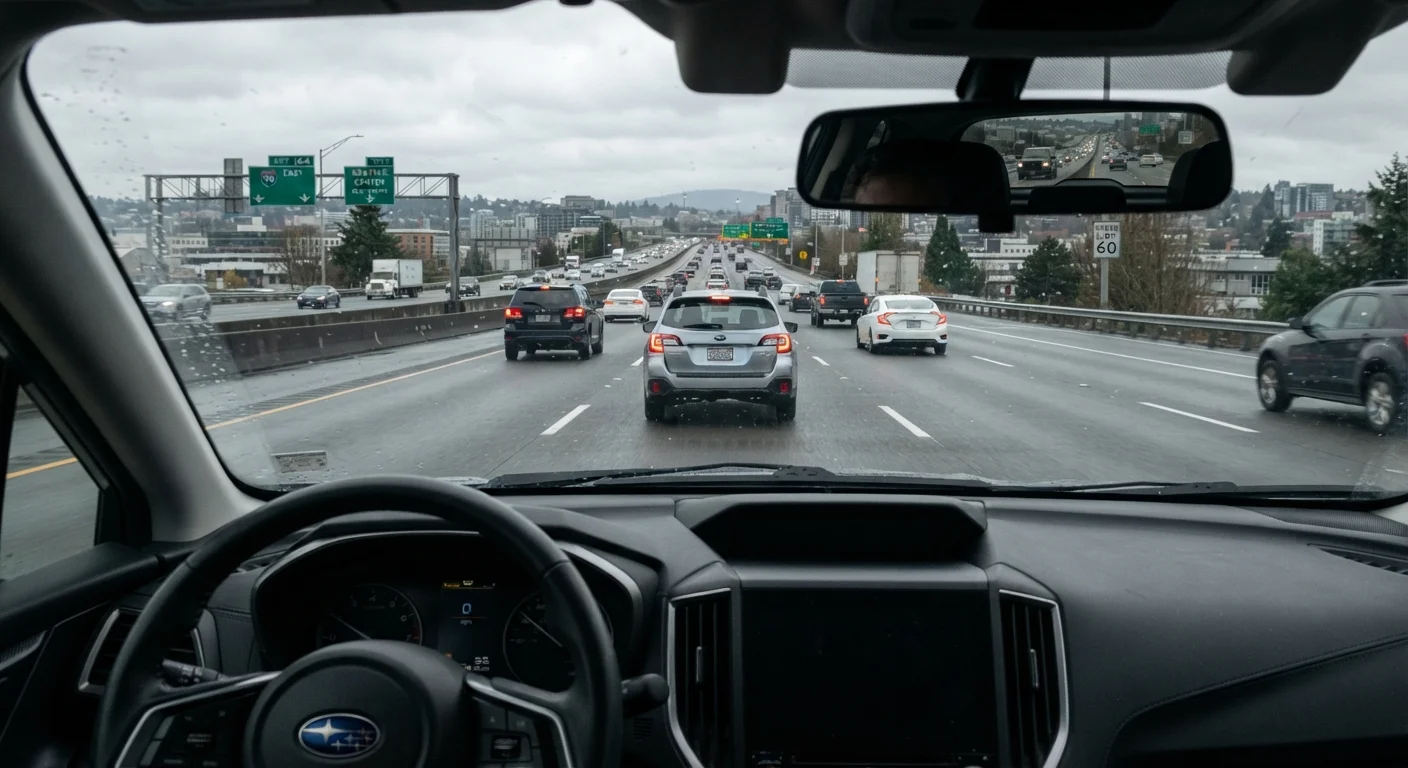
Highway driving compounds these issues further. At 65 mph, a vehicle travels roughly 95 feet per second. Even a one-second lapse in attention - adjusting the radio, glancing at a phone - can consume more space than most drivers leave as a buffer. Highway and city driving carry very different risk profiles, and your following distance strategy should reflect that difference every time you get on the interstate.
Wet and Icy Roads Demand More Space Than You Think
Many drivers simply slow their speed in poor weather without adjusting their following distance - but both adjustments are necessary. On ice, stopping distances can be four to ten times longer than on dry pavement. If you're still maintaining a two-second gap in winter conditions, you're operating with a dangerously small margin. Triple your gap as a practical starting point, and adjust further based on visibility and road surface.
Building safer distance habits doesn't require advanced training - it requires replacing inaccurate mental models with accurate ones. The myth-busting above is a practical starting point. Pair it with conscious lane positioning - covered in detail in our guide on what new drivers are rarely taught about lane positioning - and you'll have a more complete defensive driving foundation.