The Two-Part Formula Most Drivers Ignore
When a hazard appears on the road ahead, your vehicle doesn't stop the instant your brain registers danger. There's a measurable gap - in both time and distance - between perception and a complete halt. That gap is stopping distance, and it has two distinct components that drivers routinely conflate or underestimate.
Reaction distance is how far your vehicle travels from the moment you perceive a hazard to the moment your foot actually reaches the brake pedal. At 60 mph, a vehicle covers roughly 88 feet per second. With an average human reaction time of around 1.5 seconds, that's already 132 feet of travel before any braking begins.
Braking distance is what happens next - the distance your car travels while the brakes are doing their work. Under ideal dry conditions with well-maintained tires and brakes, a vehicle traveling at 60 mph may require an additional 180 feet or more to stop completely.
Add these together and you're looking at over 300 feet of total stopping distance at a speed most drivers consider routine. That's roughly the length of a football field - a fact that surprises most people when they encounter it for the first time.
300+ ft
Estimated total stopping distance at 60 mph
Based on commonly used traffic engineering estimates combining average reaction time and dry-pavement braking distance for passenger vehicles.
4×
Increase in braking distance when speed doubles
Kinetic energy grows with the square of velocity, meaning doubling speed roughly quadruples the distance required to stop - not merely doubles it.
50%+
Additional braking distance on wet roads
Wet pavement significantly reduces tire-road friction; many highway safety guidelines recommend at least doubling your following distance in rain.
Why Speed Has a Disproportionate Effect
One of the most misunderstood aspects of stopping distance is how dramatically speed amplifies the braking component. Most drivers assume the relationship is linear: drive twice as fast, stop in twice the distance. Physics tells a different story.
Braking distance is determined by a vehicle's kinetic energy, which grows with the square of speed. This means that going from 30 mph to 60 mph doesn't double your braking distance - it roughly quadruples it. A vehicle that needs 45 feet to stop from 30 mph may need closer to 180 feet from 60 mph, even under the same road and vehicle conditions.
This exponential relationship is why traffic safety engineers treat speed reduction as one of the most effective interventions for reducing crash severity. Even a 5 mph reduction in highway speed meaningfully reduces both the likelihood of a crash and the energy involved if one occurs.
For drivers, this has a direct practical implication: speed decisions aren't just about legality or comfort - they fundamentally define whether a hazard ahead is survivable. As covered in our guide on defensive driving principles, anticipating and moderating speed in response to conditions is one of the clearest markers of a skilled, safety-conscious driver.
Conditions That Extend Stopping Distance Beyond the Baseline
Published stopping distance figures typically assume ideal conditions: dry pavement, alert driver, properly maintained brakes and tires, and a vehicle traveling on a flat surface. Real-world driving rarely checks all those boxes simultaneously.
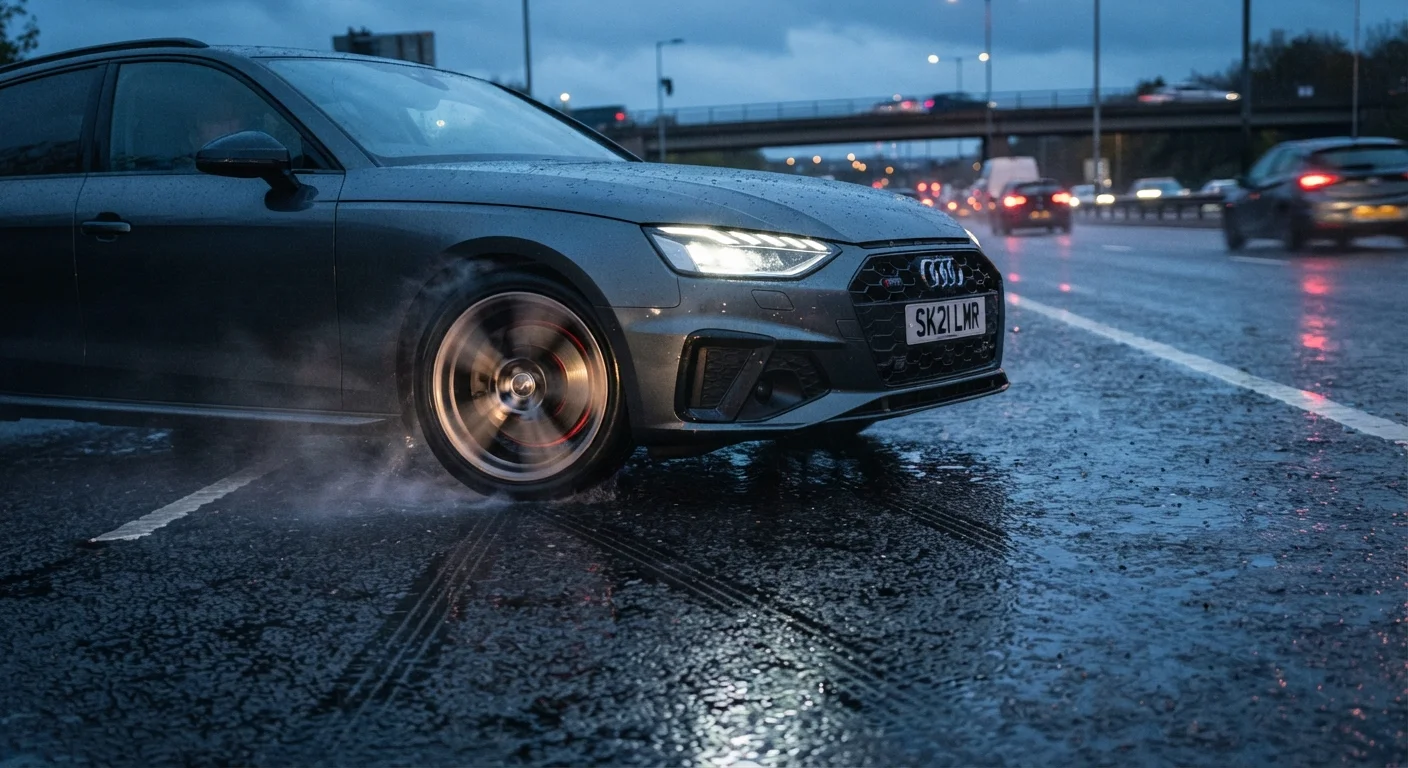
Wet roads are among the most common and consequential variables. Water on the road surface reduces friction between tires and pavement, extending braking distance by 50% or more. At high speeds, hydroplaning can sever contact between tires and road almost entirely, rendering the brakes largely ineffective.
Tire condition matters more than many drivers realize. Worn tread reduces the tire's ability to channel water and grip the road surface. A tire worn to the legal minimum tread depth stops significantly less effectively than a new tire - particularly in wet conditions. Hard braking habits accelerate this wear, as explored in our piece on habits that accelerate vehicle wear.
Driver fatigue and distraction extend the reaction time component. A driver who is drowsy or glancing at a phone for even two seconds at 60 mph has traveled 176 feet before even registering a hazard. This is closely tied to how inattentional blindness affects perception - even an alert-seeming driver can fail to process what's directly ahead.
Adjust Your Following Distance by Condition
In dry conditions at highway speeds, a three-to-four-second following gap provides a reasonable safety buffer. In rain, fog, or on roads that may be icy, extend that to six seconds or more. Count seconds from when the vehicle ahead passes a fixed point - a sign, a line on the road - to when your front bumper reaches the same point.
Why Drivers Consistently Get This Wrong
If the physics of stopping distance are well-established and widely taught, why do so many drivers follow too closely and speed through conditions that demand greater caution? Research in driver behavior points to several overlapping explanations.
Visceral underestimation: Human perception is poorly calibrated for speed and distance at scale. When following another vehicle at highway speeds, the gap that feels comfortable is typically far shorter than what physics requires. Drivers gauge safety by feel - and that feel is systematically optimistic.
Experience-driven complacency: Years of uneventful close following reinforces the mistaken belief that current habits are safe. Nothing has gone wrong yet, so nothing will. This pattern - where experience breeds overconfidence rather than refinement - is a recognized risk factor in driver psychology. Our article on overconfidence behind the wheel examines this dynamic in detail.
Social pressure: Maintaining a proper following distance often means leaving a gap that other drivers fill. This social friction nudges drivers toward shorter gaps even when they intellectually understand the risk.
Correcting these tendencies starts with replacing intuitive estimates with structured habits - counting seconds, adjusting for conditions, and treating following distance as a non-negotiable safety margin rather than a courtesy. The myths around following distance that many drivers carry make this recalibration harder but no less necessary.
“Speed is the single most important factor in road safety. The faster you travel, the less time you have to react, and the greater the forces involved in a crash. Even modest speed reductions have large effects on outcomes.”
— Road Safety Research Community, Widely referenced position in traffic safety engineering literature