What Is R-Value and Why It Matters
Before comparing insulation types, it helps to understand the central measurement: R-value. R-value measures a material's resistance to heat flow - the higher the number, the better the insulation's thermal performance. It's typically expressed per inch of thickness, which allows you to compare materials even when installed at different depths.
The U.S. Department of Energy provides recommended R-values by climate zone, and local building codes often set minimums for specific areas of the home, such as attics, walls, and crawl spaces. If you're unfamiliar with code requirements, our article on permits, inspections, and codes explains when regulations apply to insulation projects. For a quick reference on terminology, see our home improvement glossary.
Fiberglass Batts: The Familiar Standard
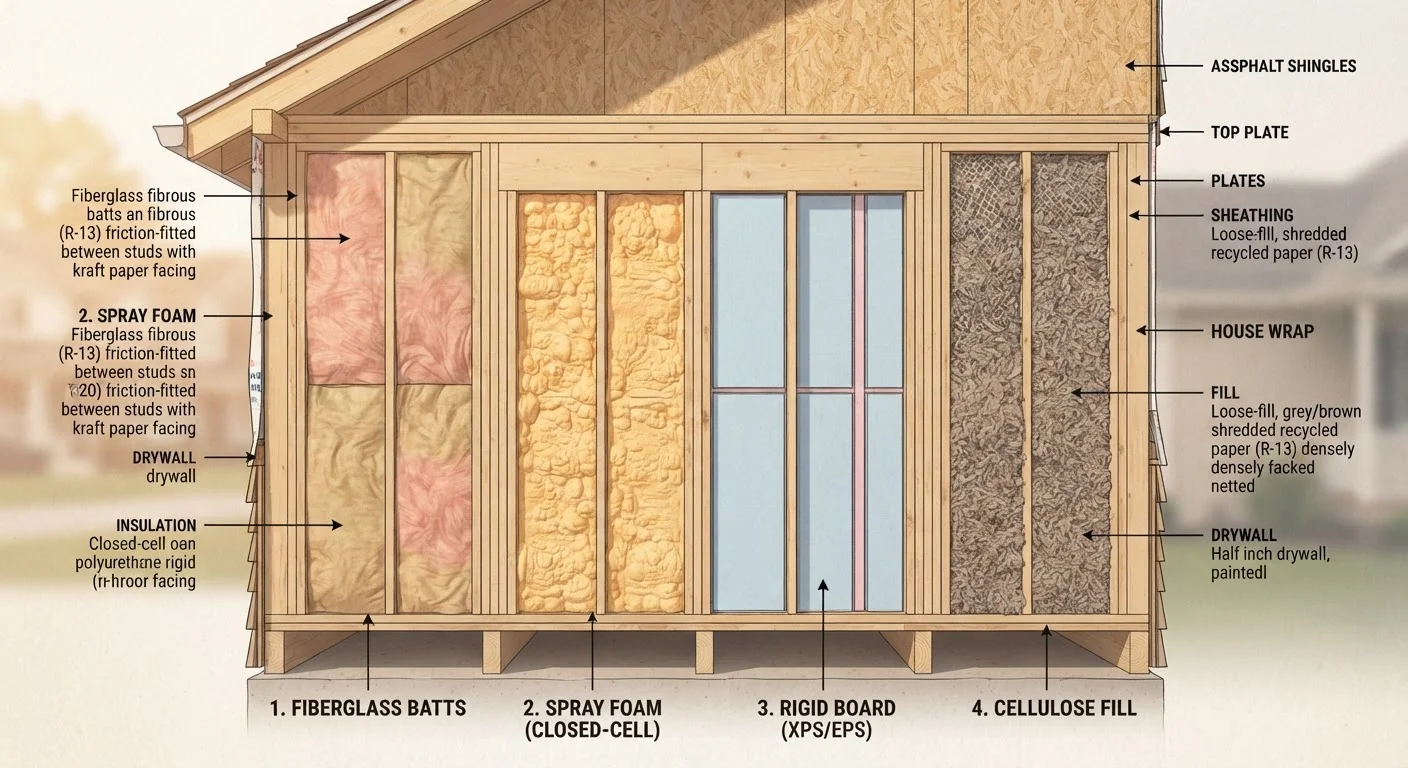
Fiberglass batts are the pink or yellow rolls most people picture when they think of home insulation. Made from spun glass fibers, they come pre-cut to fit standard stud and joist spacing (typically 16 or 24 inches on center), making them straightforward to install in open wall cavities and attic floors.
R-value: Approximately R-2.9 to R-3.8 per inch, depending on density and facing.
- Strengths: Widely available, relatively affordable, suitable for DIY installation in accessible areas, non-flammable.
- Limitations: Must fit snugly without gaps or compression to perform as rated. Fiberglass does not air-seal on its own - air can still pass through if the cavity isn't well sealed. Moisture can reduce effectiveness if batts become wet.
- Best applications: Open attic floors, new-construction walls, floor assemblies above unconditioned spaces.
Avoid Compressing Fiberglass Batts
Compressing a fiberglass batt to fit a shallower cavity reduces its R-value proportionally. A 6-inch batt rated R-19 compressed to 3.5 inches may perform closer to R-13. Always choose the correct batt thickness for your stud depth, and cut batts to fit around obstructions rather than forcing them in.
Spray Foam: The High-Performance Option
Spray polyurethane foam (SPF) is applied as a liquid that expands on contact, filling irregular cavities and creating a tight air barrier simultaneously. It comes in two main forms: open-cell foam (softer, lower R-value, vapor-permeable) and closed-cell foam (denser, higher R-value, moisture-resistant).
R-value: Open-cell: approximately R-3.5 per inch. Closed-cell: approximately R-6 to R-7 per inch.
- Strengths: Excellent air sealing, high R-value per inch (especially closed-cell), adheres to irregular surfaces, closed-cell adds structural rigidity.
- Limitations: Significantly more expensive than other options. Professional installation is strongly recommended - improper mixing or off-ratio application can result in uncured foam and off-gassing. Not easily reversible.
- Best applications: Rim joists, crawl spaces, cathedral ceilings, and tight spaces where maximum R-value per inch is needed.
11%
Estimated U.S. energy lost through air leaks
The U.S. Department of Energy estimates that air leaks through gaps, cracks, and openings can account for significant heating and cooling losses in typical American homes.
R-49 to R-60
DOE-recommended attic R-value for cold climates
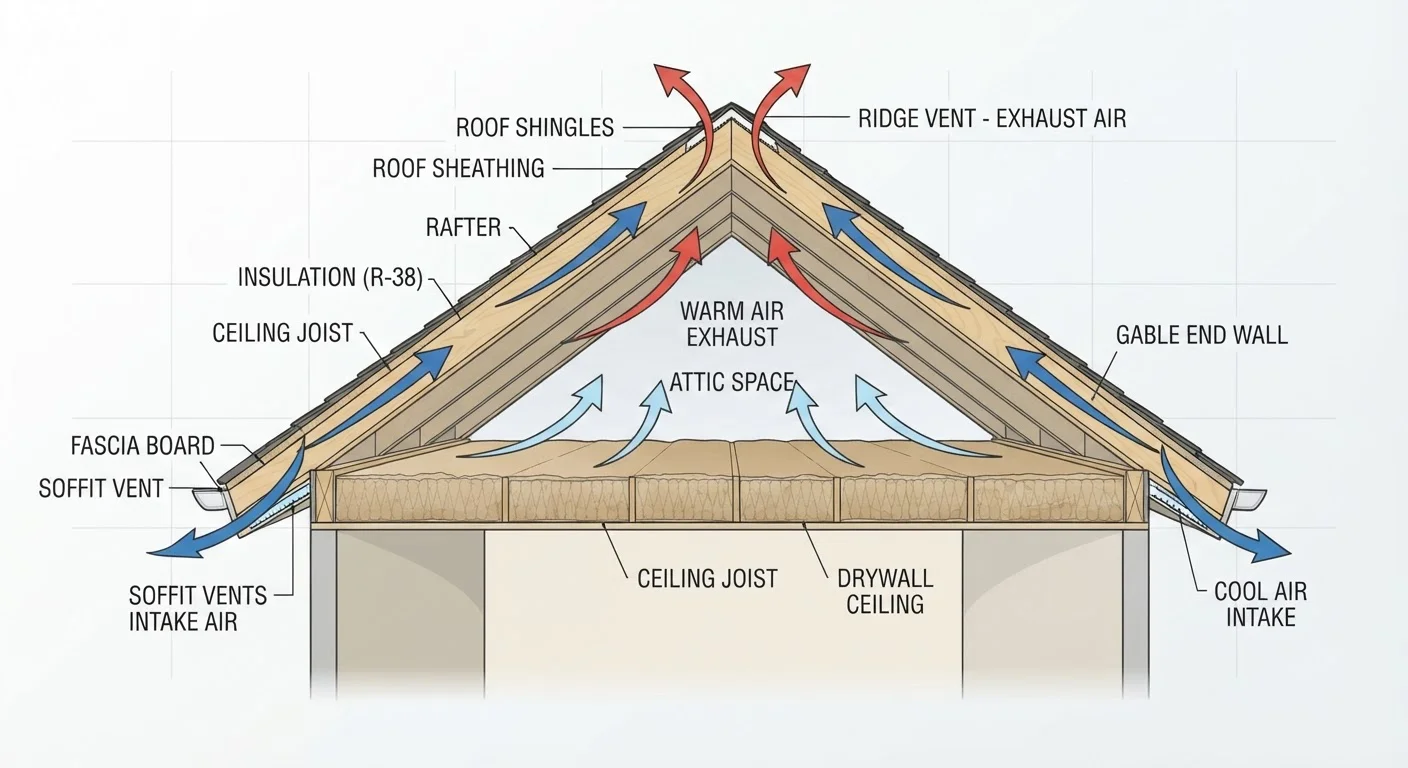
The U.S. Department of Energy recommends R-49 to R-60 for attics in colder climate zones, illustrating how depth and material choice must work together.
Rigid Board: Space-Efficient and Moisture-Resistant
Rigid foam insulation boards are manufactured panels made from polystyrene (EPS or XPS) or polyisocyanurate (polyiso). Unlike batts or loose fill, they provide a consistent, high-density thermal barrier that doesn't shift or settle over time.
R-value: Ranges from approximately R-3.8 (EPS) to R-6.5 (polyiso) per inch.
- Strengths: High R-value in a thin profile, inherently moisture-resistant (especially XPS and polyiso), good for continuous insulation layers that reduce thermal bridging through studs.
- Limitations: Must be cut precisely and sealed at edges; requires a fire-rated covering (such as drywall) when used indoors. Cost is moderate to high depending on the board type.
- Best applications: Basement walls, exterior wall sheathing, under-slab applications, garage doors.
Cellulose: The Recycled-Material Choice
Cellulose insulation is made from approximately 75-85% recycled paper fiber (primarily newsprint), treated with fire retardants. It's installed as loose fill - either blown into open attic cavities or dense-packed into closed wall cavities using specialized equipment.
R-value: Approximately R-3.2 to R-3.8 per inch.
- Strengths: High recycled content makes it one of the more environmentally conscious choices. Dense-pack installation fills irregular spaces well and reduces air infiltration better than fiberglass batts. Generally competitive in cost.
- Limitations: Settles over time, which can reduce effective R-value in attics if not installed at the correct depth. Absorbs moisture and must dry out fully to prevent mold - not ideal for consistently damp areas. Professional equipment is typically needed for wall dense-packing.
- Best applications: Attic floors (blown-in), retrofit insulation in existing closed walls (dense-pack), and floors over unconditioned spaces.
| Fiberglass Batts | Spray Foam (Closed-Cell) | Rigid Board (XPS) | Cellulose | |
|---|---|---|---|---|
| R-value per inch | ~R-3.0 to R-3.8 | ~R-6 to R-7 | ~R-5 | ~R-3.2 to R-3.8 |
| Air sealing ability | Poor (requires separate sealing) | Excellent (built-in) | Moderate (seams must be taped) | Good (dense-pack only) |
| Moisture resistance | Low | High (closed-cell) | High | Low to moderate |
| Ease of DIY installation | High | Low (pro recommended) | Moderate | Low (equipment needed) |
| Relative cost | Low | High | Moderate to high | Low to moderate |
| Recycled content | Partial (silica sand) | None | None | High (~75-85%) |
| Best retrofit use | Limited | Rim joists, tight spaces | Basement walls | Existing closed walls |