
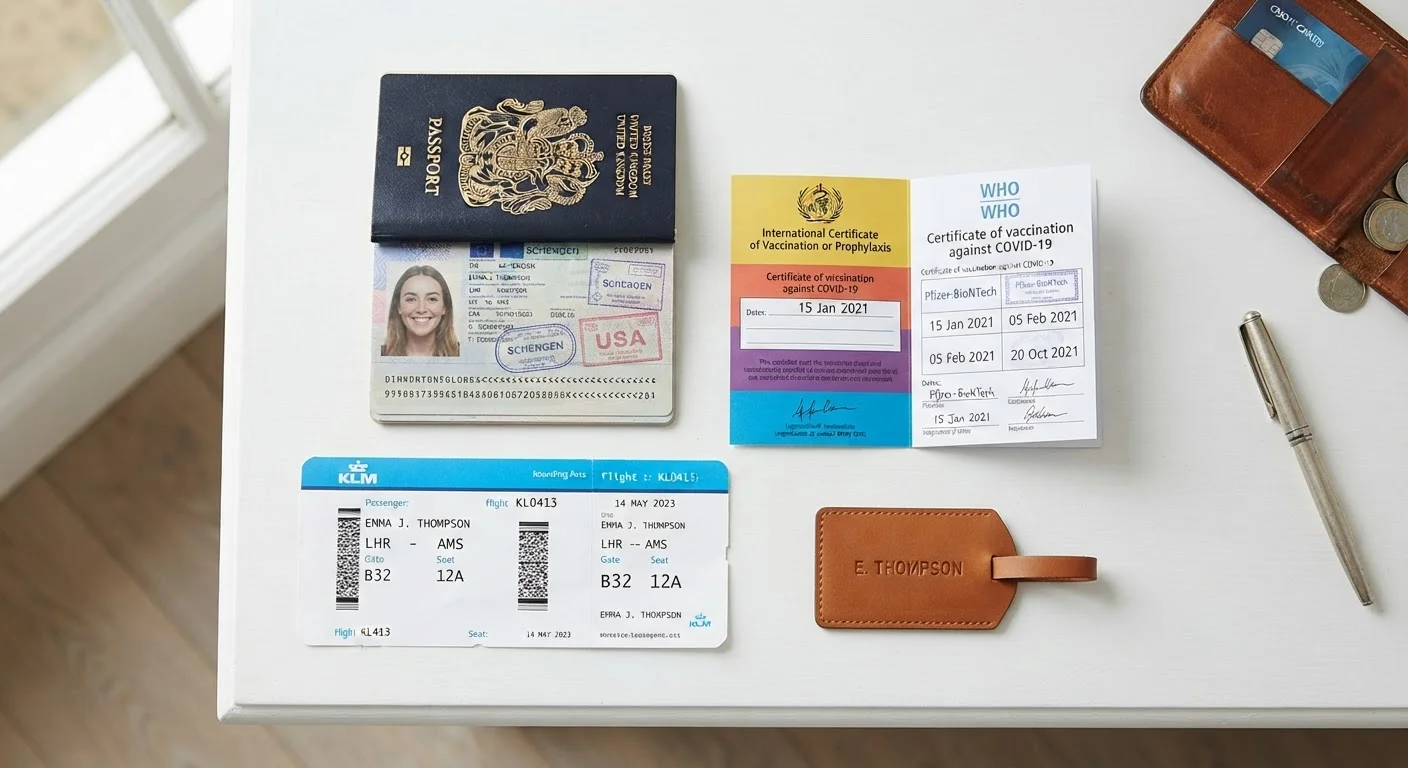
Passports: Your Most Essential Travel Document
A U.S. passport is the cornerstone of international travel - and the one document worth getting right well before your trip. Standard passport books are required for international air travel, while the smaller passport card works only for land and sea crossings between the U.S., Canada, Mexico, Bermuda, and the Caribbean. Both are issued by the U.S. Department of State.
| Passport book validity | 10 years (adults), 5 years (children under 16) (U.S. Department of State) |
| Recommended application lead time | At least 6 months before travel (U.S. Department of State) |
| REAL ID domestic air travel deadline | May 7, 2025 (U.S. Department of Homeland Security) |
| Passport card validity | 10 years (adults), 5 years (children under 16) (U.S. Department of State) |
| Countries requiring six-month passport validity | Majority of international destinations (Varies by country; verify with official embassy) |
| Yellow fever certificate (ICVP) required | Yes, for entry into many countries in sub-Saharan Africa and South America (World Health Organization and destination government requirements) |
Processing times vary significantly by season and demand. Routine processing has historically taken several weeks, while expedited service cuts that window roughly in half - for an additional fee. Neither timeline is guaranteed, so the safest approach is to apply or renew at least six months before your planned departure. Many countries also require your passport to be valid for at least six months beyond your travel dates, a rule that catches many travelers off guard.
Lost or stolen passports abroad require a visit to the nearest U.S. embassy or consulate for an emergency replacement. Before you leave, photocopy your passport's data page and store it separately from the original - or save a digital scan in a secure location. For a full pre-departure checklist, see The International Travel Prep Checklist.
Visas, Travel Authorizations, and REAL ID
Whether you need a visa depends entirely on your destination country and your citizenship. U.S. passport holders enjoy visa-free or visa-on-arrival access to dozens of countries, but many destinations - including India, China, Brazil, and Russia - require a visa obtained in advance through their embassy or consulate. Requirements can change, so always verify with the destination country's official embassy website and the U.S. State Department before booking.
Several countries that don't require traditional visas have introduced electronic travel authorizations (ETAs) - pre-trip approvals tied electronically to your passport. Canada's eTA, Australia's ETA, and the UK's Electronic Travel Authorisation are prominent examples. These are typically low-cost, fast to obtain online, and valid for multiple entries over a set period, but they are mandatory for entry and are separate from your passport.
Passport Book
The standard U.S. travel document required for international air travel. Contains a photo, personal data, and pages for entry stamps and visas.
Passport Card
A wallet-sized alternative to the passport book, valid only for land and sea entry between the U.S., Canada, Mexico, Bermuda, and the Caribbean.
Electronic Travel Authorization (ETA)
A mandatory pre-trip digital approval required by certain countries in lieu of a traditional visa. Linked electronically to your passport and typically obtained online before departure.
REAL ID
A federally compliant state-issued driver's license or ID card meeting security standards set by the REAL ID Act of 2005. Required for domestic U.S. air travel starting May 7, 2025.
ICVP (Yellow Card)
The International Certificate of Vaccination or Prophylaxis - an official document issued by an authorized provider proving you've received required vaccines, most commonly yellow fever.
Six-Month Passport Validity Rule
A requirement enforced by many countries that your passport must remain valid for at least six months beyond your intended travel dates. Travelers with passports expiring sooner may be denied boarding or entry.
For domestic air travel within the United States, a different standard applies. Starting May 7, 2025, the REAL ID Act requires that your state-issued driver's license or ID meet federal security standards to be accepted at TSA checkpoints. If your current ID is not REAL ID-compliant (look for a star marking in the upper corner), you'll need either a compliant ID or an alternative accepted document - such as a U.S. passport - for domestic flights. Contact your state's DMV to confirm compliance and update your ID if needed.
If you're new to planning international trips, Planning a Trip Abroad for the First Time offers a comprehensive starting point for first-time overseas travelers.
Health Documents, Entry Requirements, and Staying Informed
Vaccination records have become an increasingly important part of international travel. The yellow fever vaccine is required for entry into certain countries in sub-Saharan Africa and South America - and proof must typically be presented on an official International Certificate of Vaccination or Prophylaxis (ICVP), sometimes called the yellow card. Other destinations may request proof of additional vaccines depending on current health conditions. Always check entry requirements directly with the destination country's government and consult a travel medicine provider well before departure.
If you take prescription medications, crossing international borders with them requires preparation. Documentation, quantity limits, and controlled-substance rules vary widely by country. Traveling with Prescription Medications Internationally covers what documentation and rules typically apply.
Beyond health paperwork, smart travelers keep an eye on U.S. State Department travel advisories, which rate destinations from Level 1 (normal precautions) to Level 4 (do not travel). Understanding what triggers each level - and what it means in practice - can shape both your planning and your contingency thinking. See What the U.S. State Department's Travel Advisories Actually Mean for a plain-language breakdown.
For a comprehensive overview of every stage of international trip planning - from timelines to re-entry - International Travel: A Complete Planning Reference is the place to start.
This article provides general travel information for educational purposes. Entry requirements, visa rules, and health mandates change frequently - always verify current requirements with official government sources and your destination country's embassy before traveling.