Why Posted Limits Don't Account for Weather
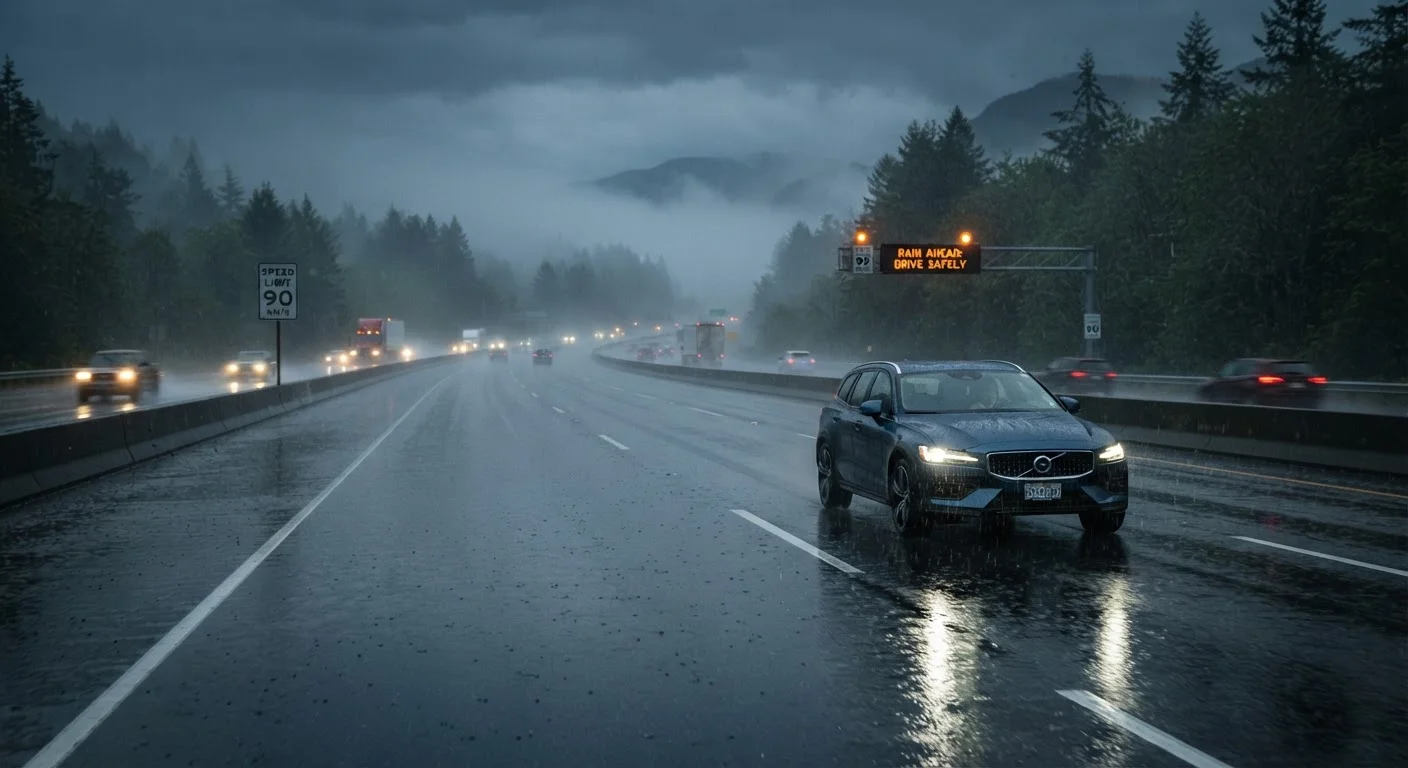
Speed limits in the United States are established by traffic engineers to reflect the maximum safe speed under normal, favorable conditions - dry pavement, clear visibility, and a road surface in good repair. They are not recalibrated in real time when it rains, snows, or when visibility drops to a fraction of a clear day's range.
This matters because the physics of driving change dramatically with surface conditions. A passenger vehicle traveling at 60 mph on dry asphalt can typically stop in roughly 180-200 feet under controlled braking. Add rain, and that number climbs. Add ice, and it can more than double or triple. Your vehicle's posted speed limit has no mechanism to account for these changes - that judgment falls entirely to the driver.
This is also not a niche concern. According to the Federal Highway Administration, weather-related crashes account for a significant portion of annual traffic fatalities in the United States, with wet pavement and rain alone involved in hundreds of thousands of crashes each year. Understanding how to match speed to conditions is one of the most consequential safety habits a driver can build.
Speed Limits Are Not Weather-Adjusted
Under U.S. traffic law, posted speed limits represent the maximum lawful speed under ideal conditions. Driving at the posted limit in rain, ice, or fog can still be considered driving too fast for conditions - and can result in a citation or liability in a crash. Always reduce speed to match actual road conditions, regardless of the posted limit.
For a related look at how reduced visibility changes your driving demands in darkness, see our guide to night driving. And since your vehicle's condition directly affects how it handles in bad weather, seasonal maintenance guidance is worth reviewing before winter arrives.
What You'll Need Before You Start
Adapting your speed in adverse conditions starts before you turn the key. Your vehicle's mechanical state - particularly tires, brakes, and visibility systems - sets the ceiling for how safely you can respond to any road condition.
What you will need
Tire tread depth gauge
Measures tread depth to confirm tires can channel water and grip slick surfaces effectively.
Vehicle owner's manual
Contains manufacturer guidance on traction control, ABS behavior, and all-wheel-drive engagement relevant to low-traction driving.
If your tires are worn, your braking distances in wet or snowy conditions will be substantially longer than manufacturer or safety estimates assume. Tread depth directly affects a tire's ability to channel water away from the contact patch and maintain grip. This is one area where skipping a check before winter or rainy-season driving carries real risk.
How to Read Road Conditions and Adjust Your Speed
The following steps walk you through how to assess and respond to the most common adverse driving conditions. Each condition has distinct characteristics - rain, ice, and fog each demand a specific approach, not simply a generic "slow down."
Use the Three-Second Rule as Your Baseline
In dry conditions, a three-second following distance is a widely used minimum. In rain, extend this to six seconds. On snow or ice, aim for eight to ten seconds. Count the gap by watching when the vehicle ahead passes a fixed point, then counting before you reach it. This single habit gives you more reaction time across all conditions.
Check conditions before you leave
Before driving in questionable weather, consult a reliable weather source for current road conditions in your area. Note the temperature - at or below 32°F (0°C), precipitation becomes ice. Check whether advisories or road closures are active. This step costs minutes and can save your trip or your life.
Reduce speed before conditions deteriorate
Slow down proactively, not reactively. If rain is intensifying or temperatures are dropping, reduce your speed before the road surface changes. A vehicle already traveling at a moderate speed has more options in a skid or emergency stop than one that brakes hard from highway speed on a wet surface.
Adjust for rain and standing water
Light rain can make roads more slippery in the first 15-30 minutes, as water mixes with accumulated oil and road grime. Reduce speed by 5-10 mph as a starting point, and more if visibility drops or water is pooling. If you see standing water across your lane, slow significantly - hydroplaning (when tires ride on top of water rather than gripping the road) can occur at speeds as low as 35 mph on worn tires or deep water. If your steering goes light, ease off the accelerator gently and steer straight until traction returns. Do not brake hard.
Adapt your speed on snow and ice
On packed snow, stopping distances can be two to four times longer than on dry pavement. On ice, this figure can reach eight to ten times. Reduce your speed significantly - state and local guidance often recommends dropping 10-20 mph below the posted limit, but conditions vary. On untreated roads, going slowly enough to stop within the distance you can see is a reliable principle. Accelerate and brake gently; sudden inputs break traction. Use low gears on downgrades to help engine braking do the work.
Drive to your visibility in fog
Fog eliminates the distance buffer you rely on to react. A widely used rule: you should be able to stop within the distance you can see ahead. If your visibility is 200 feet, you should be traveling at a speed at which you could stop in 200 feet. At highway speeds, this is impossible - slow down substantially. Use low-beam headlights (not high beams, which reflect back from the fog and reduce visibility further) and fog lights if your vehicle has them. Increase following distance significantly and avoid the temptation to use the taillights of the vehicle ahead as your only reference - they may not be slowing appropriately either.
Reassess continuously as conditions change
Weather is not static, and neither is the right speed. A highway that was merely wet at your trip's start may be icing over an hour later. Watch for visual cues: sheen on the road surface, spray from other vehicles diminishing (possibly indicating freezing), or worsening visibility. Adjust speed whenever conditions change - building this into your driving habit rather than treating it as a one-time decision makes you a more consistently safe driver in adverse weather.
Adapting your speed is a habit that applies equally at the city level and on the open highway. The risk differences between highway and city driving are worth understanding, because adverse weather can affect those environments differently - limited sight lines in a city versus high closing speeds on a wet interstate.
Black Ice Gives Almost No Warning
Black ice is a thin, nearly transparent layer of ice that forms on pavement - often on bridges, overpasses, and shaded road sections - and is extremely difficult to see. If the air temperature is near or below freezing and roads appear wet, treat every surface as potentially icy. Slow down well before curves, intersections, and elevated sections.