Why Intersection Type Matters
Intersections are among the highest-risk locations on any road network. According to the Federal Highway Administration, a significant share of all traffic fatalities and injury crashes occur at or near intersections - yet the rules governing each intersection type vary considerably. A driver who handles a four-way stop confidently may hesitate dangerously at a roundabout, or blow through an unmarked crossing without recognizing the legal obligation to yield.
Understanding the logic behind each intersection design - not just the rules - helps drivers respond correctly even in unfamiliar situations. This reference covers the three most common intersection types you'll encounter on American roads: roundabouts, four-way stops, and uncontrolled intersections.
For a broader look at how urban and rural road environments shape your risk profile, see our comparison of highway and city driving safety risks.
Roundabouts: Yield, Enter, Exit
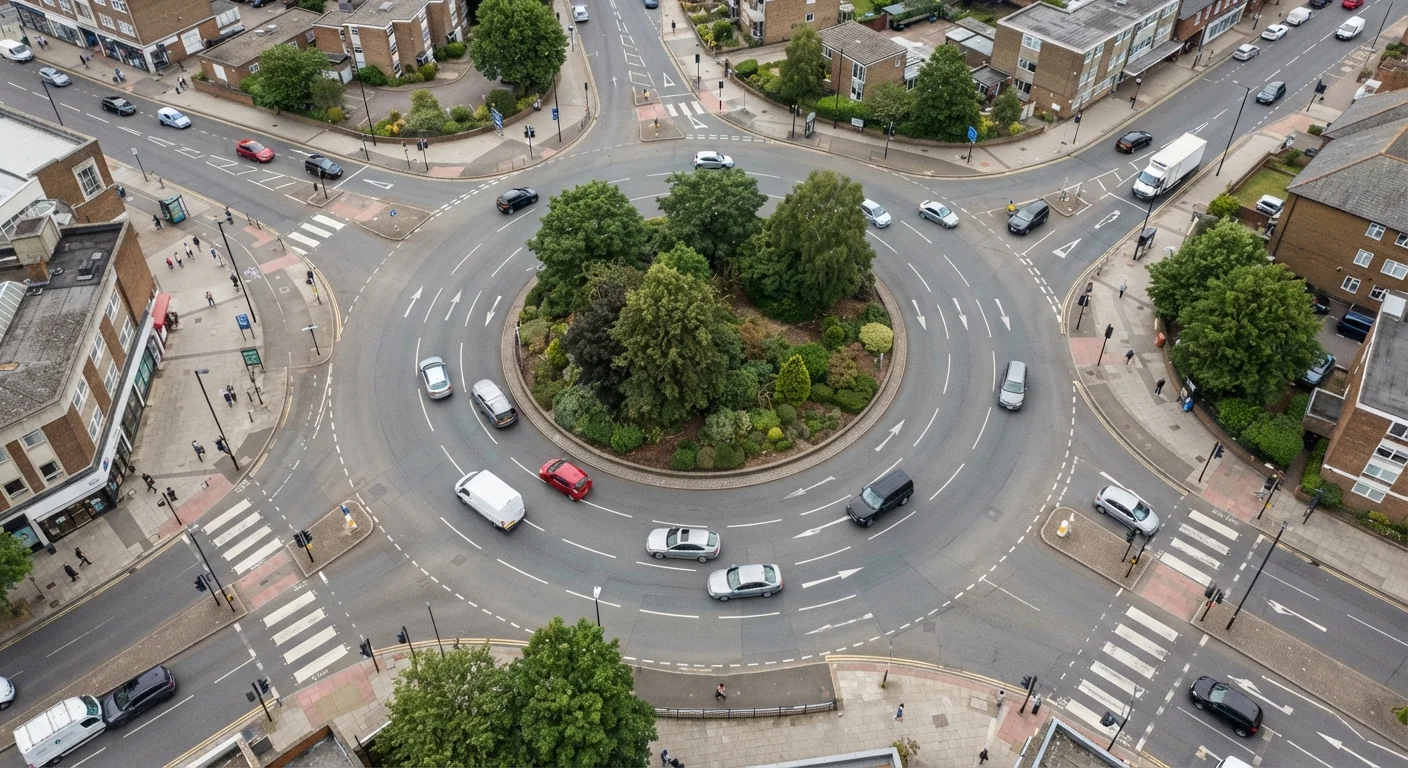
A roundabout is a circular intersection where traffic flows counterclockwise around a central island. Unlike traditional signalized intersections, roundabouts eliminate crossing conflicts - the most dangerous collision type - by converting them into merging and weaving movements.
The Core Rule: Yield to Circulating Traffic
Before entering, you must yield to all vehicles already in the roundabout. Do not treat the entry as a merge without looking - wait for a clear gap, then enter smoothly at a reduced speed (typically 15-25 mph, though posted speeds vary). Do not stop inside the roundabout unless traffic is completely blocked.
Choosing Your Lane
Multi-lane roundabouts require lane selection before entry. As a general guide: use the right lane to turn right or go straight, and the left lane to go straight or turn left. Look for pavement markings and signage - they override general rules where they differ. Signal your exit, and yield to pedestrians in the crosswalk after exiting.
Common Errors to Avoid
- Stopping inside the roundabout when you have the right-of-way
- Failing to yield at entry, particularly at multi-lane roundabouts
- Changing lanes while inside the circle
- Forgetting to check for cyclists and pedestrians at entry and exit points
Roundabout
A circular intersection where vehicles travel counterclockwise around a central island. Entering traffic must yield to vehicles already circulating inside.
Uncontrolled intersection
An intersection with no traffic control devices - no signals, stop signs, or yield signs on any approach. Right-of-way is governed by state traffic law defaults.
Right of way
The legal priority to proceed through a space or intersection before another road user. Having the right of way does not remove the duty to drive with care.
Circulating traffic
Vehicles already traveling inside a roundabout. All entering vehicles must yield to circulating traffic before merging into the flow.
Rolling stop
Slowing significantly without the vehicle's wheels coming to a complete stop. This is illegal at stop signs in all U.S. states and forfeits right-of-way protections.
Four-Way Stops: Order, Timing, and Courtesy
A four-way stop (also called an all-way stop) places a stop sign on each approach. Every vehicle must come to a complete stop before proceeding. The challenge isn't the stop itself - it's knowing who goes next when multiple drivers arrive close together.
Right-of-Way Hierarchy
- First to arrive, first to go. The vehicle that stopped first has priority.
- Simultaneous arrivals: yield to the right. If two vehicles arrive at the same time, the one on the left yields to the one on the right.
- Facing vehicles going straight beat left-turners. If you're turning left and an oncoming vehicle is going straight, the straight-through driver has priority.
When three or four vehicles arrive simultaneously, the hierarchy becomes less clear. In these cases, eye contact, a brief pause, and a courteous wave often resolve the conflict more safely than rigidly applying rules in rapid succession.
One frequent mistake is the rolling stop - slowing without fully stopping. This is illegal in all U.S. states and removes your legal right-of-way standing if a collision occurs. Your front wheels must come to a complete stop behind the line.
Good lane positioning approaching a stop also affects your visibility of crossing traffic. Our article on lane positioning for new drivers covers how to maximize your sightlines at intersections.
Uncontrolled Intersections: The Rules No Sign Posts
An uncontrolled intersection has no traffic signals, stop signs, or yield signs on any approach. These are most common in rural areas, residential neighborhoods, and older grid-pattern cities. Many drivers incorrectly assume that no sign means no rules - the opposite is true.
The Default Right-of-Way Rule
At an uncontrolled intersection, the vehicle that arrives first has the right of way. When two vehicles arrive simultaneously, the driver on the left must yield to the driver on the right. This mirrors the four-way stop rule, but without the mandatory full stop - though slowing to a near-stop to assess the intersection is strongly advisable and, in many states, legally required.
Additional Considerations
- Yield to pedestrians. In most U.S. states, pedestrians crossing at any intersection - marked or unmarked - have the right of way.
- Treat visibility limitations seriously. Overgrown hedges, parked vehicles, or blind corners at uncontrolled intersections are common. Creep forward slowly to establish a clear sightline before committing to the crossing.
- On a highway or major road, through-traffic has priority over vehicles entering from side streets, even without signage.
Adverse weather significantly increases the danger at uncontrolled intersections because reduced visibility makes it harder to spot approaching vehicles. For guidance on adjusting your approach in poor conditions, see how to match your speed to road conditions in rain, ice, and fog.