Why Decluttering With Kids Feels Different
Decluttering a home without children underfoot is mostly a logistical challenge. Decluttering with kids present is a logistical and emotional one. Children often attach meaning to objects adults view as trivial, and their energy levels, attention spans, and emotional responses are unpredictable. Standard advice - set aside a weekend, sort everything at once, follow a strict system - frequently falls apart when a five-year-old is in the picture.
That doesn't mean progress is out of reach. It means the approach needs to account for the actual household, not an idealized one. The methods below are designed around that reality.
If clutter in your home tends to feel emotionally heavy or overwhelming, it may help to first read about why clutter feels so overwhelming - understanding the mental load can make it easier to start.
What you will need
What You'll Need Before You Start
Sorting bins or laundry baskets
Hold items in Keep, Donate, and Discard categories as you sort through each zone.
Masking tape and a marker
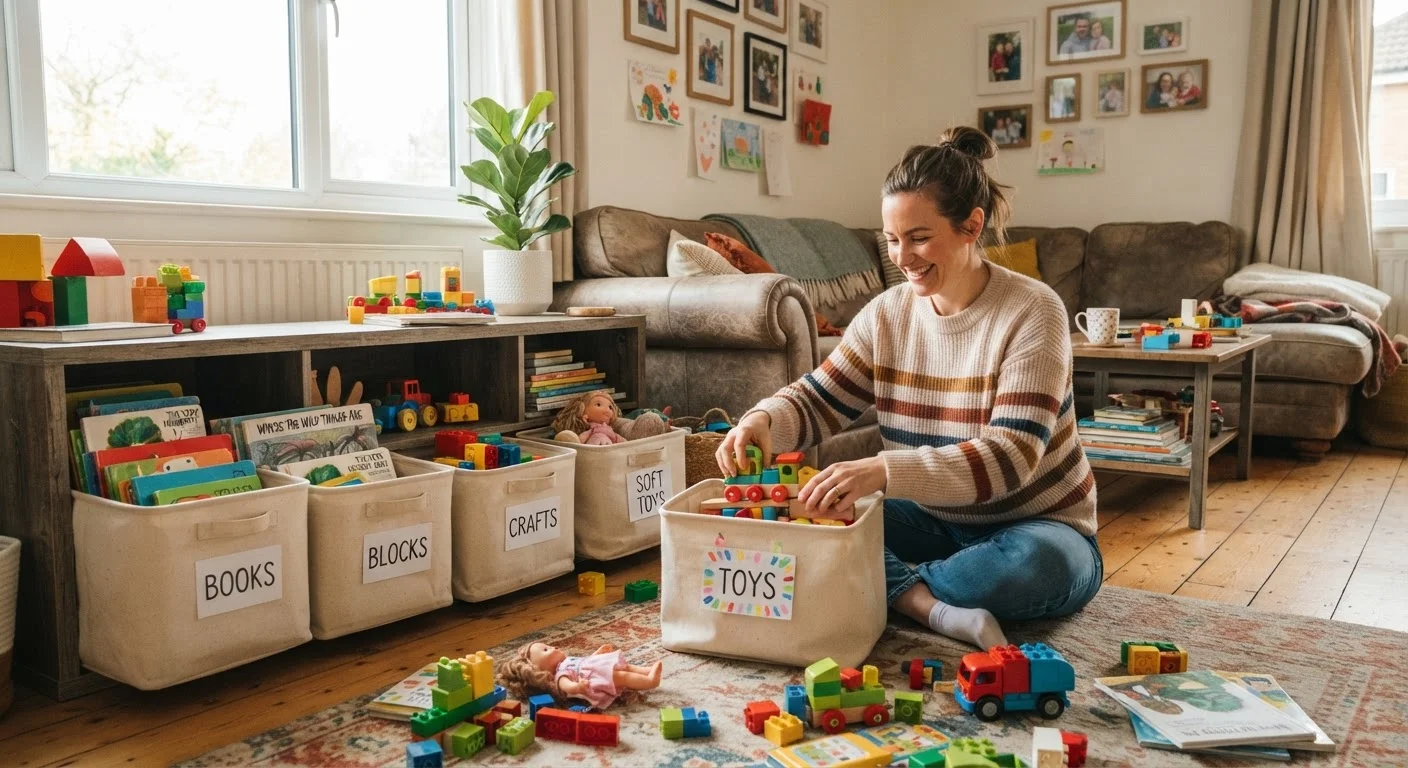
Label containers clearly so children can participate without confusion about where items belong.
Clear stackable bins or open-top baskets
Provide visible, easy-access storage that children can use and return items to independently.
Timer (phone or kitchen timer)
Keep sorting sessions brief and focused, especially when working alongside young children.
You don't need specialized products or a redesigned home to declutter effectively with children. The tools above cover most real-world situations. What matters more than equipment is structure: a clear system, a defined space to work in, and realistic expectations about how much ground you'll cover in a single session.
For a broader room-by-room audit of your home, the Room-by-Room Home Organization Checklist can help you spot where to focus first.
Step-by-Step: Decluttering a Family Space
Choose one small zone to start
Rather than tackling the whole house, pick a single contained area: one shelf, one toy bin, or one corner of a room. Small wins build momentum and are far more sustainable when children are present. A playroom floor or a bedroom bookshelf is a practical first target.
Set up your three-category sorting system
Place three clearly labeled containers in the space: Keep, Donate, and Discard. Walk children through what each category means using concrete examples - a broken crayon goes in Discard, a puzzle with all its pieces might be Donate if no one uses it anymore. Tangible categories reduce decision fatigue for kids and adults alike.
For guidance on the donate-versus-discard decision, see Letting Go of Things You Don't Use for a useful framework.
Assign age-appropriate roles to children
Toddlers (ages 2-4) can place items into bins you indicate. School-age children (5-10) can make basic keep-or-donate calls on their own belongings with gentle guidance. Tweens and older kids can take ownership of a zone entirely. Matching the task to the child's developmental stage keeps frustration low and participation high.
Use a timer to keep sessions short
Set a timer for 20 to 30 minutes per session. When children know there's a defined endpoint, they're more willing to engage. If energy holds, you can always run another session, but stopping at the timer preserves goodwill for next time. Consistency over several shorter sessions beats one exhausting all-day effort.
Re-organize what stays with accessible, visible storage
Once the Keep pile is established, store items at a height children can actually reach and in containers they can see into. Open-top baskets, low shelves, and clear bins all make self-sufficiency possible. When kids can see where something lives and reach it themselves, they're far more likely to put it back.
The Closet Organization Methods That Actually Match How People Live covers storage approaches suited to different household habits.
Remove donated and discarded items from the home promptly
Bag up Donate and Discard items immediately and move them out of the living space - ideally to your car or an exterior bin that same day. Items left sitting in bags inside the home are frequently second-guessed or picked back through, especially by children who see them again. Removing them closes the loop and solidifies the decision.
Build a simple maintenance habit into the daily routine
A 10-minute end-of-day reset - where everyone returns items to their designated spots - does more to sustain order than periodic deep cleanouts. Make it part of an existing routine, like before dinner or after bath time, so it doesn't feel like an added burden. The one-in-one-out rule and other daily habits can also help prevent re-accumulation over time.
Common Pitfalls and How to Avoid Them
Even with a solid plan, a few predictable obstacles tend to derail family decluttering efforts:
- Trying to do too much at once. A whole playroom in a single afternoon is an ambitious goal for most families. Narrowing the scope to one shelf or one category reduces the chance of an unfinished, chaotic mess mid-project.
- Making unilateral decisions about kids' belongings. Quietly discarding items while children aren't looking can damage trust and create anxiety about their possessions. Including children in the decisions - even young ones - produces more durable outcomes.
- Expecting the space to stay organized without a system. Organization without supporting habits reverts quickly. If you're finding that organized spaces keep sliding back into disorder, the issue is usually the absence of a simple maintenance routine, not willpower.
- Measuring success by perfection. A room that's 60% tidier than it was yesterday is a real improvement. Holding out for a magazine-ready result before acknowledging progress discourages everyone involved.
Families sharing space also benefit from questioning assumptions about what organization should look like. Common myths about shared-space organization often make the process feel more daunting than it needs to be.