Why Organizing Myths Persist in Family Homes
Walk through almost any American neighborhood and you'll find households quietly convinced that they're one closet organizer, one spare bedroom, or one weekend purge away from lasting order. These beliefs feel intuitive - but they don't hold up under real family conditions.
Shared spaces are uniquely challenging. Multiple people with different habits, different ages, and different ideas about where things belong are sharing the same square footage. That complexity is exactly why generic organizing advice falls short, and why so many well-intentioned systems collapse within weeks.
Before you invest time, money, or energy into reorganizing your home, it's worth examining which assumptions are actually working against you. See our room-by-room organization checklist to audit specific spaces once you've cleared these myths out of the way.
Myth
We just need more space - a bigger home would solve our clutter problem.
Fact
Additional space typically fills at the same rate it's added, because the habits generating clutter remain unchanged.
This is one of the most persistent organizing myths, and it's especially costly because it defers action. Research in environmental psychology consistently finds that people expand their belongings to fit available space - a pattern sometimes called the Diderot Effect, where one acquisition leads to more. Moving to a larger home without addressing accumulation habits generally results in more clutter spread across more rooms, not a cleaner household.
The more productive question isn't how much space do we have? but what do we actually need to keep, and where does it realistically belong? Families in smaller homes can maintain organized spaces; those in larger ones can still feel overwhelmed. If square footage is a genuine constraint, organizing strategies for small spaces show how much is achievable without moving.
Myth
You need to do a full organizational overhaul all at once to see real results.
Fact
Incremental, room-by-room changes are more sustainable and often more effective than a single large overhaul.
The appeal of the dramatic whole-home reset is understandable, but it frequently leads to burnout, abandoned projects, and spaces left mid-reorganization for weeks. Whole-home overhauls require sustained energy, uninterrupted time, and household-wide cooperation - all of which are hard to guarantee in a family with children, jobs, and competing schedules.
A more reliable approach is targeting one zone or category at a time - a single drawer, a coat closet, a kitchen shelf. Small wins build momentum and allow you to test what actually works before committing to a system across the whole house. decluttering with kids in the house offers realistic strategies for making progress without needing a completely free weekend.
Myth
Color-coded bins and elaborate label systems keep shared spaces organized.
Fact
Highly specific labeling systems tend to work for the person who created them, not the whole household.
Detailed organizational systems - color-coded by category, labeled by sub-category - are satisfying to set up but are often too rigid to survive actual family use. Children in particular do not consistently honor granular sorting rules, and when the system breaks down even once, it can feel like total failure rather than a simple reset.
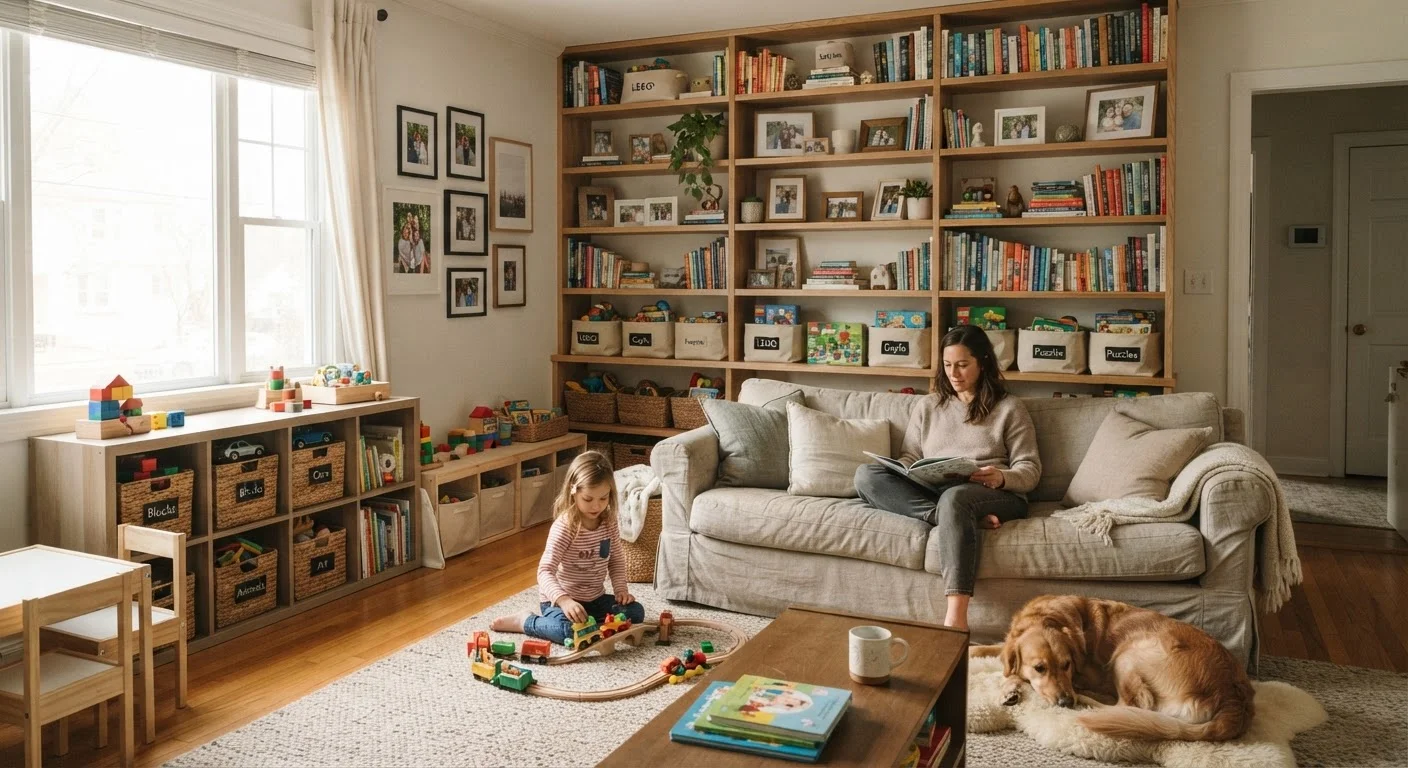
Broader zone-based storage tends to hold up far better in shared spaces: a bin for "things that live in the living room," a basket near the door for outerwear, a shelf dedicated to school materials. Fewer decision points means things actually get put away. closet organization methods matched to real households explores how different approaches fit different family styles.
Myth
Once you declutter, you don't have to do it again.
Fact
Decluttering is a recurring process, not a permanent state - households generate new items and outgrow old ones continuously.
A thorough declutter creates real breathing room, but it doesn't freeze a household in place. Birthdays, holidays, school years, and ordinary shopping all introduce new items. Children grow out of clothes and toys. Interests shift. What a family needed two years ago may no longer apply.
Treating decluttering as a one-time achievement sets up frustration when things accumulate again. More realistic is building light, regular review habits - a seasonal pass through closets, a monthly check of the entryway, a quick audit before holidays when gifts are incoming. why organized kitchens revert to clutter illustrates exactly this pattern in one of the home's most active shared spaces.
Myth
Buying the right storage products is the first step to getting organized.
Fact
Purchasing storage solutions before sorting and reducing belongings almost always results in containers that don't fit the actual need.
Storage products are a satisfying purchase, but buying them before sorting is one of the most reliable ways to end up with bins that are the wrong size, shelves that don't match the items they're meant to hold, or a garage full of organizers that never got used. The underlying inventory of belongings has to be assessed first.
The practical sequence is: sort, reduce, then measure and shop. Once you know what you're actually keeping and roughly where it needs to live, the right storage solution becomes much clearer - and you're less likely to spend money on something you'll replace in six months. For a useful vocabulary when planning storage, storage terms every home organizer should know is a helpful starting reference.
Building Systems That Last in a Shared Home
The families who maintain organized homes over time rarely have more space or fewer belongings than anyone else. What they tend to have is systems designed around how their household actually behaves - not how they wish it would behave.
That means storage solutions placed where things naturally land, not where they theoretically should go. It means category-based zones rather than obsessively labeled individual slots. And it means accepting that maintenance is ongoing, not something you finish once.
Avoid Buying Storage Before You Sort
It's tempting to start organizing by purchasing bins, baskets, and shelving - but doing so before you've sorted and reduced your belongings often means buying the wrong sizes or too many. Always sort first, measure what remains, and then shop for storage with specific needs in mind. This saves money and prevents a secondary clutter problem made of unused organizers.
If you're working with limited square footage, hidden storage opportunities in your existing home may offer more potential than you've noticed. And if shared spaces keep reverting to chaos, the habits behind the clutter are worth examining - why clutter feels so overwhelming explains what's happening beneath the surface.
The most durable organizing wins in family homes are almost always low-friction: fewer steps to put something away, clearly defined zones that everyone understands, and realistic expectations about what "organized" actually looks like when kids, partners, and daily life are part of the picture. For more on sustaining order over time, daily habits that keep clutter away offers practical routines worth building into your household rhythm.