When Grass Just Won't Cooperate
Every yard has at least one problem spot: the strip under the oak where nothing green survives, the slope that washes out every spring, or the narrow side yard that gets mowed at an awkward angle twice a season. Homeowners often respond by reseeding, fertilizing, or watering more - and still end up with the same patchy result.
The honest answer is that some sites are simply incompatible with turf. Grass needs adequate sunlight, consistent moisture, and reasonably loose soil to thrive. When those conditions aren't present, no amount of effort will produce a lawn worth maintaining. That's where ground cover plants earn their keep.
Unlike turf, ground covers are selected specifically for adaptability. Many thrive in deep shade, handle dry spells once established, tolerate poor or compacted soil, and spread steadily on their own without reseeding. They don't need mowing, and most require little to no fertilization after their first season. If you've been fighting a losing battle in part of your yard, switching to a well-chosen ground cover is often the most sensible long-term move. See our guide to common lawn watering mistakes if you're unsure whether your grass problems stem from irrigation habits rather than site limitations.
Test Your Site Before Choosing a Plant
Before selecting a ground cover, observe the area across a full day to assess light levels - 'part shade' and 'full shade' can look similar but affect plant performance significantly. Also note whether the soil holds moisture or dries quickly, and whether foot traffic is likely. Matching the plant to those real conditions is the single biggest factor in long-term success.
Ground Cover Plants Worth Considering
Creeping Phlox
Best for: Sunny slopes, rock gardens, and edging along paths
Creeping phlox (Phlox subulata) is a low-growing perennial that forms a dense, moss-like mat and produces a vivid flush of pink, white, or purple blooms each spring. It thrives in full sun and well-drained soil, tolerating poor fertility and dry conditions once established. On slopes, it's particularly effective - the fibrous root system helps hold soil in place, and the mat of foliage discourages weed establishment after the first season.
Creeping phlox spreads gradually but reliably, reaching 6-12 inches in height and spreading 2 feet or more over time. It requires very little maintenance beyond occasional trimming after bloom to keep growth tidy.
On sunny slopes, creeping phlox holds soil, suppresses weeds, and delivers spring color - all with minimal care.
Pachysandra
Best for: Dense shade beneath trees, dry shade
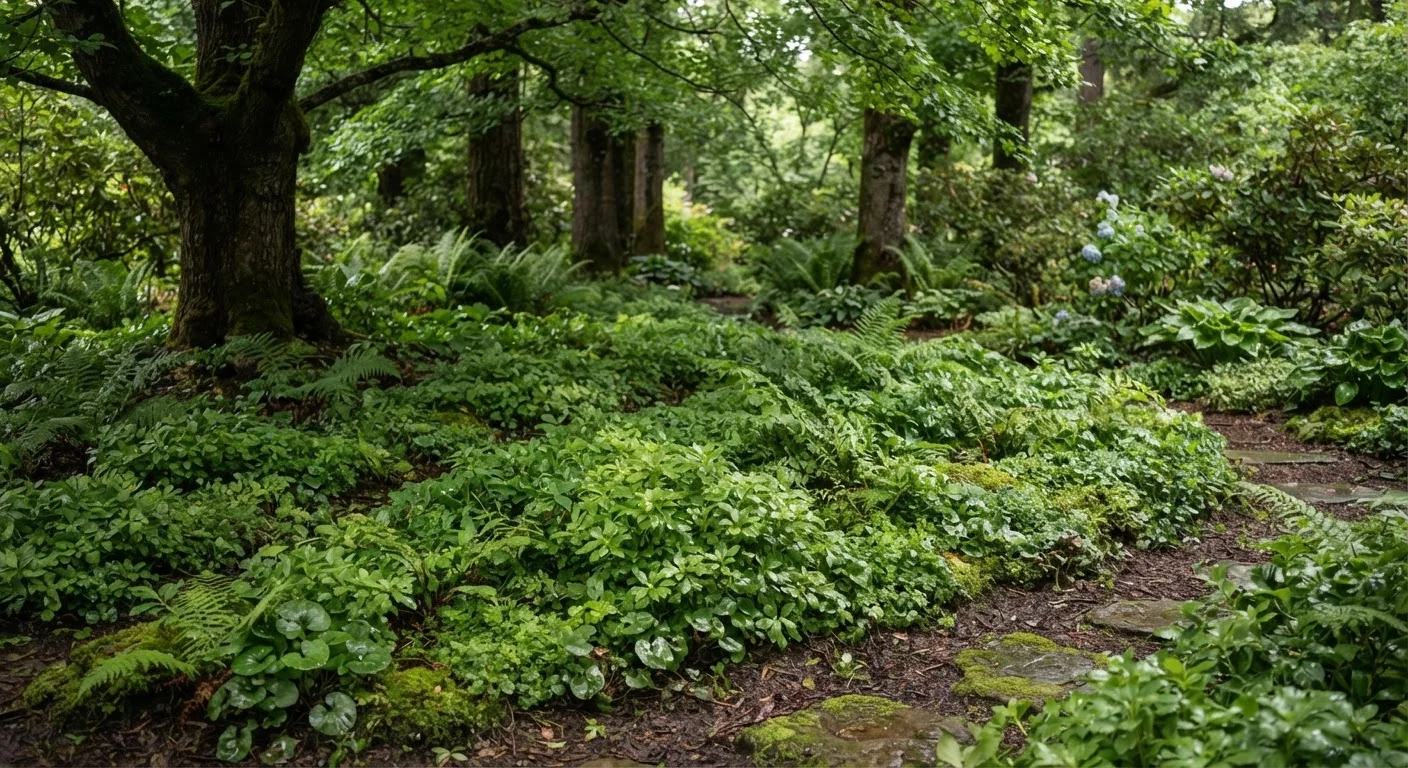
Pachysandra (Pachysandra terminalis) is one of the most reliably shade-tolerant ground covers available to American gardeners. It forms a glossy, dark-green carpet that thrives under mature trees where little else survives. It handles dry shade, competes well with tree roots, and is largely pest- and disease-resistant.
Pachysandra spreads by underground runners, filling in gradually but persistently. It's evergreen in most of the country, providing year-round coverage and staying tidy without mowing. One note: pachysandra is not native to North America, so gardeners interested in supporting local ecosystems may want to weigh this against native alternatives. See our overview of native vs. ornamental plant trade-offs for a balanced look at those choices.
Pachysandra may be the most dependable option for dense shade where almost nothing else will grow.
Ajuga (Bugleweed)
Best for: Partial to full shade, areas with moderate foot traffic
Ajuga (Ajuga reptans) spreads quickly via surface runners (called stolons), making it one of the faster-filling options on this list. It produces attractive rosettes of leaves - often deep purple, bronze, or variegated - and sends up spikes of blue or violet flowers in late spring, adding seasonal visual interest.
It tolerates a range of light conditions from partial sun to full shade and handles moderate foot traffic better than many ground covers. It's cold-hardy across most of the continental U.S. and has very low water needs after establishment. Because ajuga spreads vigorously, it's worth monitoring near lawn edges or garden beds where it can migrate.
Ajuga fills in faster than most ground covers and tolerates moderate foot traffic, making it practical for high-use shaded areas.
Wild Ginger
Best for: Moist, shaded areas; native garden designs
Wild ginger (Asarum canadense) is a native woodland perennial that forms a handsome, low carpet of large heart-shaped leaves in shaded, moist conditions. It grows slowly but is long-lived and requires very little attention once established. Because it's native to North American woodlands, it supports local wildlife and blends naturally into naturalistic or low-intervention garden designs.
Wild ginger works well beneath deciduous trees and shrubs where the soil stays consistently moist. It's not suited for dry or sunny sites, but in the right conditions it's essentially self-sustaining. Growth rate is slower than ajuga or pachysandra, so it's a better long-term investment than a quick fix.
For moist shaded spots, wild ginger is a native option that establishes slowly but requires almost no care thereafter.
Creeping Jenny
Best for: Moist or poorly drained areas, container spillovers, partly shaded spots
Creeping Jenny (Lysimachia nummularia) produces cheerful round leaves on trailing stems and spreads briskly across the ground. The golden-leafed variety ('Aurea') provides particularly bright color even in low light, making it useful for brightening shaded or damp corners. It tolerates wet conditions that would kill most turf grass - making it a smart choice for low-lying areas with drainage issues.
It spreads quickly, so placement matters. In a contained bed or alongside water features it's well-behaved and attractive. In very open areas it can spread beyond its intended boundary, so occasional trimming at edges may be needed. It's winter-hardy across much of the U.S., though stems die back in colder climates and re-emerge each spring.
Creeping Jenny thrives in moist, low-lying areas that would rot out turf - making it ideal where drainage is a chronic problem.
Liriope (Lilyturf)
Best for: Borders, edging, dry or shaded slopes in warmer climates
Liriope (Liriope muscari or L. spicata) resembles ornamental grass but is actually a member of the lily family. It forms tidy clumps or spreading mats of strap-like leaves, producing small spikes of lavender or white flowers in late summer. It's exceptionally tolerant of heat, drought, and shade, which makes it widely used in southern and mid-Atlantic gardens.
L. spicata (creeping liriope) spreads more aggressively and works better as a mass ground cover, while L. muscari forms contained clumps more suitable for borders. Liriope is largely deer-resistant and holds up well in urban conditions with compacted or thin soils. Cut it back to a few inches in late winter before new growth begins to keep plantings looking fresh.
Liriope handles heat, drought, and shade in combinations that defeat most other plants - a standout choice for southern yards.
Invasive Status Varies by Region
Some popular ground covers - including certain varieties of liriope, ajuga, and creeping jenny - are considered invasive in parts of the United States, particularly in the Southeast and Mid-Atlantic. Before planting, check your state's invasive species list or consult your local cooperative extension office. Choosing a regionally appropriate plant avoids potential ecological and legal issues down the line.
Getting Ground Covers Established Successfully
Ground covers often look deceptively slow in their first season - and that's normal. Most plants put energy into root development before spreading visibly above ground. The general rule of thumb is: sleep the first year, creep the second, leap the third. Patience during early establishment pays off with a dense, self-sustaining planting that actively crowds out weeds.
During establishment, consistent watering matters most. Once plants are rooted, most of the varieties listed here become significantly more drought-tolerant. Applying a layer of mulch between transplants at planting time suppresses weeds while the ground cover fills in - our in-depth look at mulching techniques covers how to apply it correctly for maximum benefit.
If weeds do appear during the first year or two, hand-pulling or cultivation is often the most straightforward response. Our article on managing weeds without herbicides offers practical non-chemical strategies that pair well with ground cover plantings. Once your ground cover closes in, weed pressure typically drops sharply on its own.