DSL: Widespread but Limited
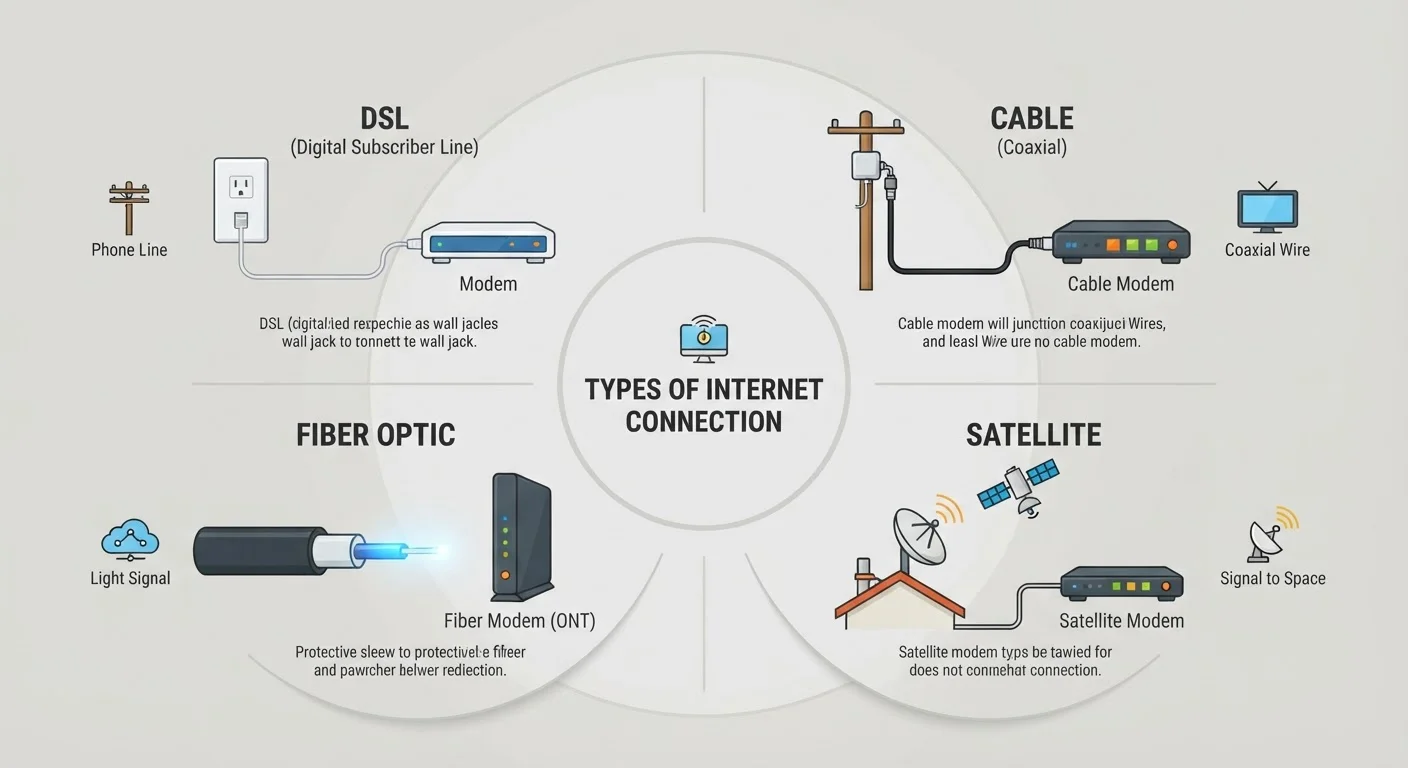
DSL - short for Digital Subscriber Line - delivers internet over the same copper phone lines that carry traditional landline telephone service. Because this infrastructure already exists in most parts of the country, DSL reaches many areas where newer technologies haven't arrived yet.
The trade-off is speed. DSL connections are highly sensitive to the distance between your home and the provider's nearest central office. The farther away you are, the weaker and slower the signal. Most DSL plans deliver download speeds between 1 and 100 Mbps, though many real-world deployments sit closer to the lower end of that range.
DSL is a reasonable fit for light internet users - households that mostly browse, check email, and stream standard-definition video. It tends to struggle when multiple people use the connection simultaneously or when tasks demand fast uploads. To put speed figures in context, see our explainer on internet speed terms every subscriber should know.
Check Actual Availability Before Comparing Plans
Not every internet type is available at every address. Before spending time comparing speeds and prices, use your provider's address-lookup tool or the FCC's National Broadband Map to confirm which connection types actually serve your location. Availability can differ even between neighboring streets in the same town.
Cable: The Everyday Standard
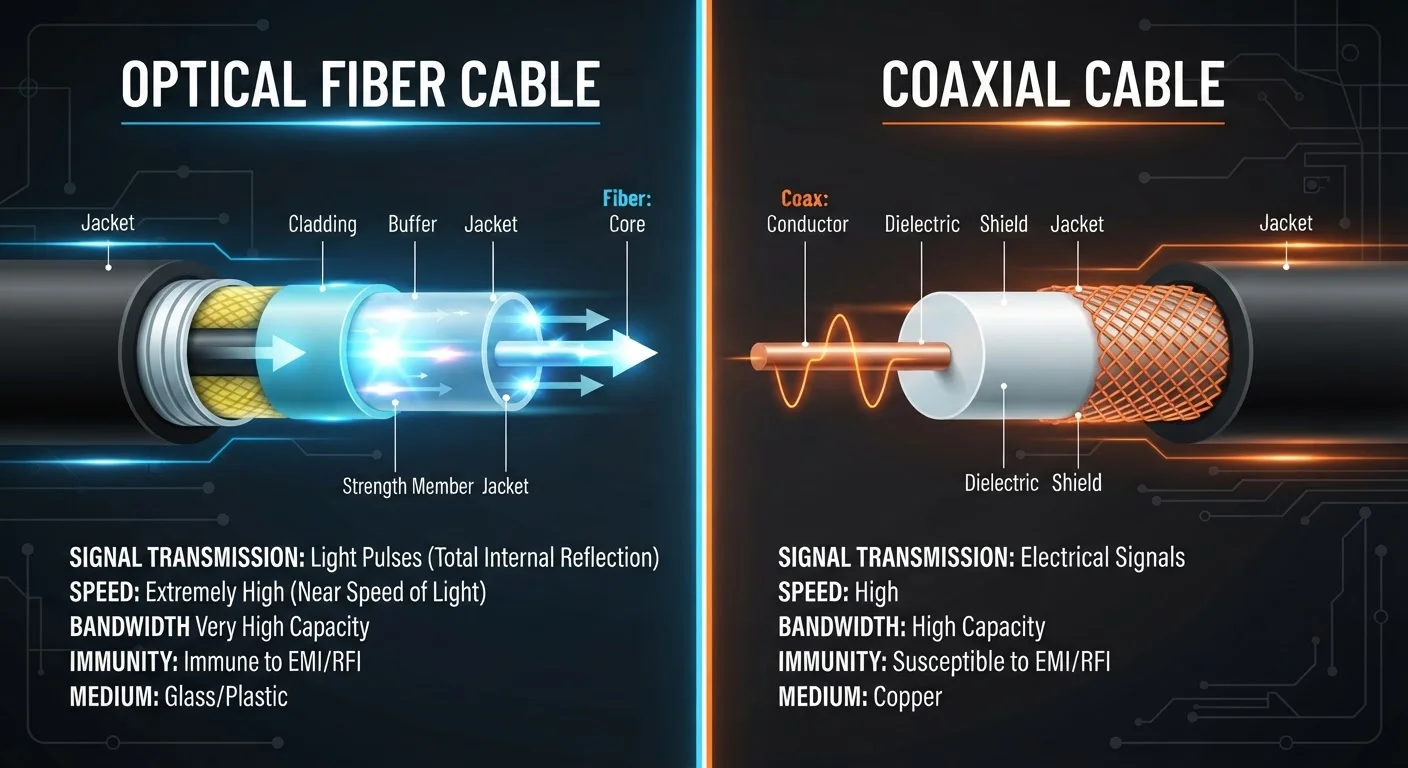
Cable internet uses the same coaxial cable infrastructure that delivers cable television. It's widely available in urban and suburban markets and supports much higher speeds than DSL - commonly ranging from 100 Mbps to 1 Gbps or more on modern networks.
One important characteristic of cable is that the local network is shared among nearby households. During peak evening hours, when many people in a neighborhood stream, game, or video call simultaneously, speeds can drop noticeably. This is sometimes called network congestion, and its severity varies by neighborhood and provider.
Cable also tends to offer significantly faster download speeds than upload speeds - a design suited to traditional internet use (consuming content) but less ideal for households that frequently upload large files, run video calls, or work from home intensively.
~90%
U.S. households with access to cable broadband
According to FCC broadband deployment data, cable infrastructure reaches the large majority of American homes, making it the most geographically widespread wired option.
600ms+
Typical latency for geostationary satellite
Traditional satellite internet round-trip times routinely exceed 600 milliseconds, compared to under 20ms for fiber, due to the extreme orbital distance data must travel.
~43%
U.S. homes with access to fiber broadband
FCC data indicates fiber availability has grown significantly but still covers less than half of U.S. locations, with rural areas underserved relative to urban markets.
Fiber: The Performance Leader
Fiber-optic internet transmits data as pulses of light through thin glass or plastic strands, rather than as electrical signals through copper wires. This fundamental difference gives fiber several meaningful advantages: greater bandwidth capacity, lower latency, and speeds that stay consistent regardless of distance from the provider's facility.
Many fiber plans deliver symmetrical speeds - matching upload and download rates - which is a significant advantage for video conferencing, cloud backups, and remote work. Gigabit fiber plans are increasingly common where the infrastructure is available.
The main limitation is coverage. Fiber requires providers to lay entirely new cable runs, which is expensive and time-consuming. Availability remains strongest in cities and growing suburbs. For a deeper look at how fiber differs from cable at the technical level, see our article on what actually sets fiber and cable apart.
Satellite: A Lifeline for Remote Areas
Satellite internet bypasses ground-based infrastructure entirely by beaming data between your home dish and orbiting satellites. This makes it the only practical broadband option for many rural and remote households where DSL, cable, and fiber simply don't reach.
Traditional geostationary satellites orbit roughly 22,000 miles above Earth, which means every data request travels an enormous distance - producing latency that can exceed 500 milliseconds. Newer low Earth orbit (LEO) satellite networks operate at far lower altitudes and achieve latency closer to 20-60 milliseconds, narrowing but not eliminating the gap with wired connections.
Satellite plans often come with data caps and can be affected by heavy precipitation or dense cloud cover. For households in areas with no other option, it can be transformative - but expectations should be calibrated accordingly. Our dedicated guide covers what rural households can realistically expect from satellite internet in detail.
LEO Satellite Is a Different Technology
Low Earth orbit (LEO) satellite networks are sometimes grouped with traditional geostationary satellite services, but they perform quite differently. LEO satellites orbit at a fraction of the altitude of older systems, producing significantly lower latency. If you're evaluating satellite options, clarify which orbital class the service uses, as the practical experience can vary considerably.
Choosing the Right Type for Your Household
No single internet technology is universally best - the right choice depends on what's available at your address, how many people use the connection, and what you do online. Fiber is generally the strongest performer where available. Cable is a reliable workaround in most urban and suburban markets. DSL serves lighter users in areas with limited options. Satellite fills the gap where no wired service runs.
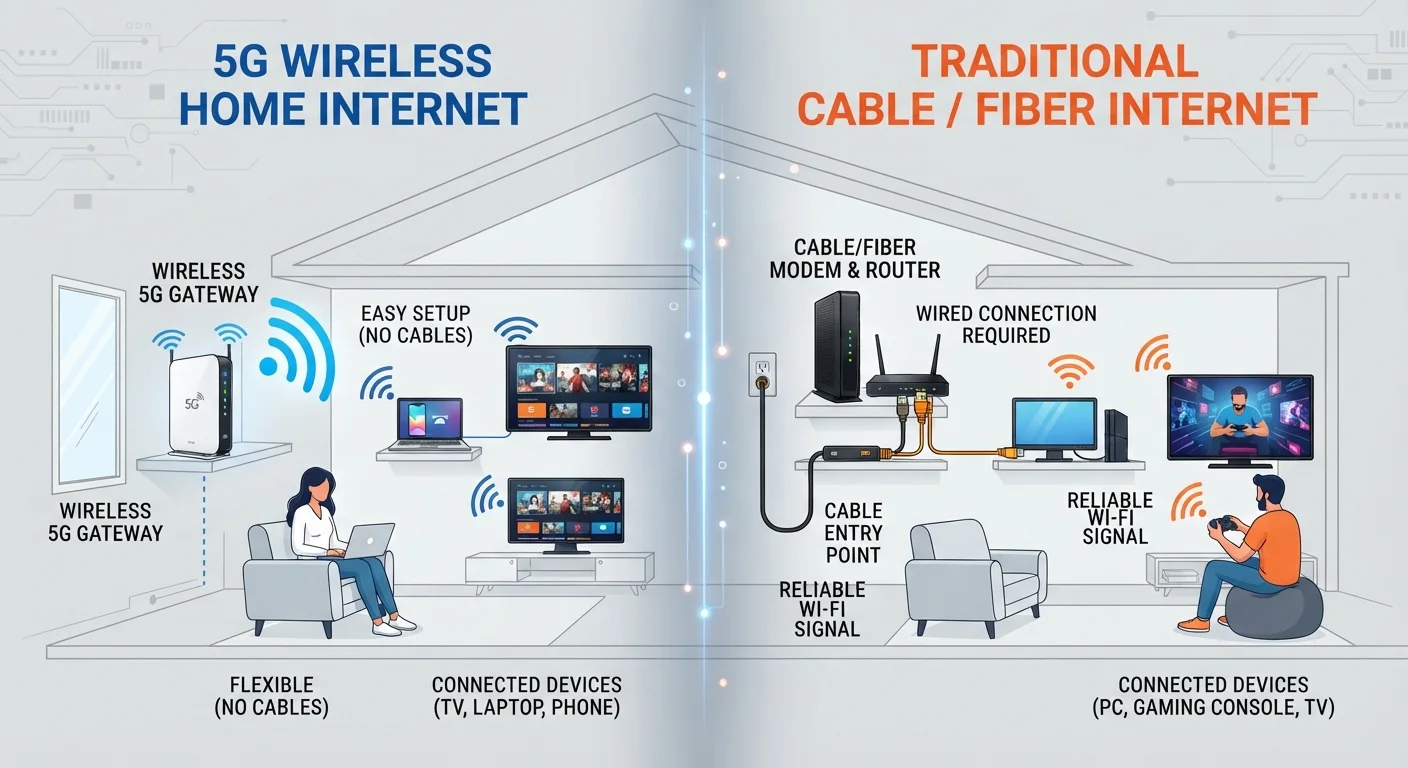
Beyond connection type, it's worth understanding that advertised speeds and real-world performance can differ. Shared network infrastructure, in-home Wi-Fi setup, and plan-level data policies all play a role. Our article on common internet speed myths can help you avoid over- or under-planning for your actual needs. You may also want to consider emerging options - our comparison of 5G home internet vs. traditional broadband covers a growing alternative for some households.