Why Drivers Keep Skipping It - and What They're Missing
For most American road-trippers, the Great Plains is something to get across rather than explore. The interstate miles blur together, the landscape feels relentlessly flat, and the mind starts counting down to the Rockies or the Gulf Coast. That reputation isn't entirely wrong - but it describes the view from the freeway, not the region itself.
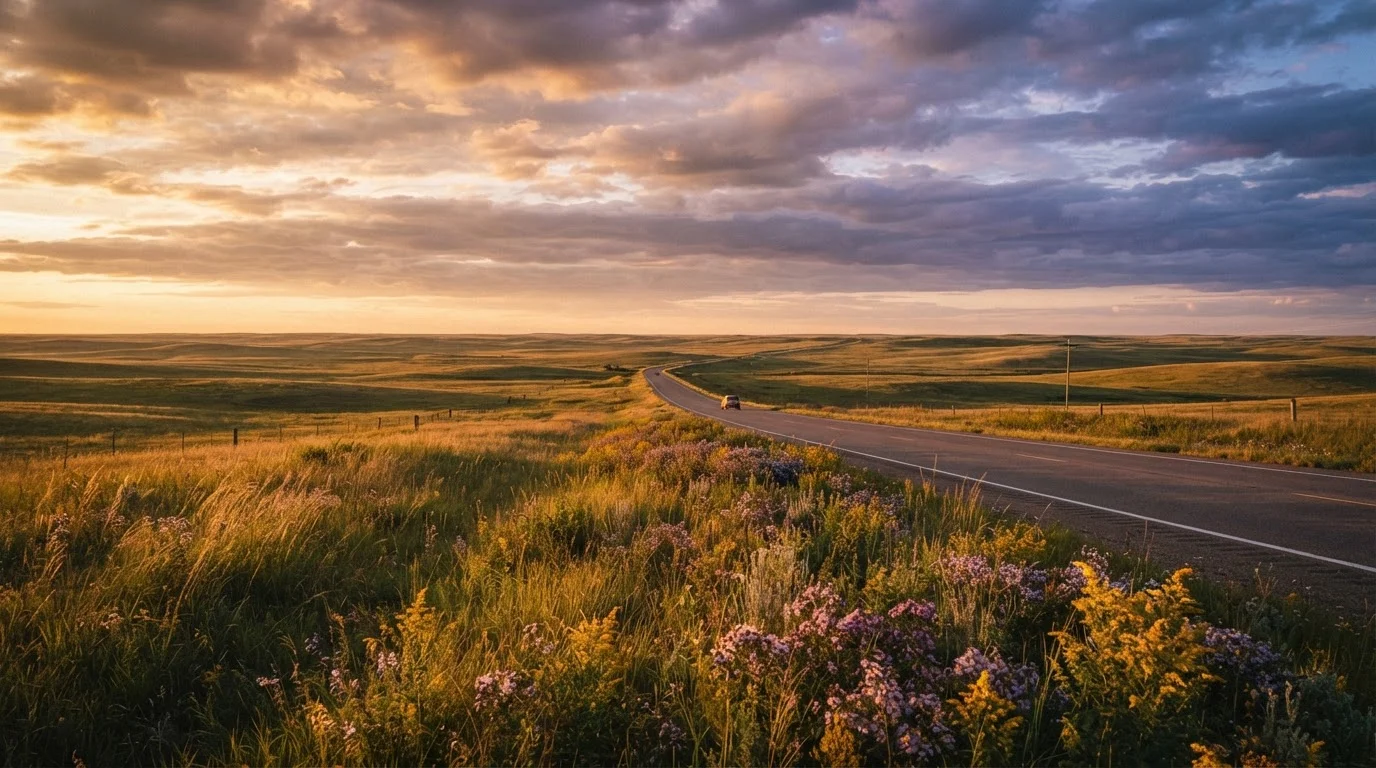
Step off I-80 or I-70 and the picture changes entirely. The Plains contain some of the continent's oldest and most intact ecosystems, a layered Indigenous history spanning thousands of years, and a string of small cities that have developed genuine cultural identities. The flatness that feels like monotony at 80 mph becomes something different when you're standing in the middle of a tallgrass prairie watching a thunderstorm build on the western horizon: vast, alive, and deeply American.
Compared to the sculpted drama of the Southwest's canyon country, the Plains ask more of a traveler's attention. The rewards are quieter but no less real.
< 4%
Original tallgrass prairie still intact
According to the National Park Service and conservation ecologists, less than four percent of the tallgrass prairie that once covered over 170 million acres of North America survives today.
500,000+
Sandhill cranes staging on Platte River
The Platte River in Nebraska hosts one of the largest wildlife migrations in North America each spring, with counts documented by Audubon Society researchers.
~1,500 mi
North-to-south Great Plains road trip distance
A Bismarck, ND to Amarillo, TX route covers roughly 1,500 miles - more than enough terrain to encounter multiple distinct ecosystems and cultural regions.
Prairie Ecosystems: The Landscape Up Close
Less than four percent of the original tallgrass prairie that once covered the eastern Plains survives today. The Flint Hills of Kansas - where the rocky substrate resisted the plow - hold the largest intact remnant, and driving the Flint Hills Scenic Byway in spring, when the grass is burning or greening after a controlled fire, is an experience unlike anything in the mountain West.
Further north and west, the mixed-grass and shortgrass prairies of Nebraska, South Dakota, and eastern Wyoming tell a different ecological story. The Sandhills of Nebraska - a sea of grass-stabilized dunes covering an ancient aquifer - look nothing like what most people picture when they think of the Plains. Theodore Roosevelt National Park in North Dakota adds badlands topography to the mix, with bison, wild horses, and prairie dog towns visible from well-marked pullouts.
The Badlands of South Dakota remain one of the most visually dramatic landscapes in the country, easily comparable - in their own stark way - to the country's lesser-known mountain regions. The eroded spires and layered sediment walls change color through the day, and the park's black-footed ferret recovery program is a genuine conservation story worth learning about at the visitor center.
Indigenous History and Living Culture
The Great Plains is Indigenous land. Understanding that isn't a prelude to the visit - it's central to understanding the region at all. The Lakota, Cheyenne, Arapaho, Pawnee, Mandan, Hidatsa, Arikara, Comanche, Kiowa, and many other nations called this landscape home for centuries before European settlement, and many continue to maintain sovereign nations across the region today.
Knife River Indian Villages National Historic Site in North Dakota preserves the earthlodge villages where the Corps of Discovery met Sacagawea. The site's interpretive program draws on Mandan and Hidatsa perspectives directly. Farther south, the Agate Fossil Beds National Monument in Nebraska carries both paleontological significance and documented connections to Lakota leaders who traveled the area. Visitors should approach these sites with genuine curiosity and respect - read the interpretive materials rather than skimming past them.
Respecting Cultural and Sacred Sites
Some sites across the Plains carry deep ceremonial or spiritual significance for Indigenous nations. Not every location is open to public visitation, and some ask visitors to observe specific protocols - such as refraining from photography. Check with the relevant tribal nation or national monument administration before visiting, and follow posted guidelines closely.
Many Plains tribal nations also operate cultural centers, museums, and tourism programs that are worth seeking out before or during a trip. Contacting tribal tourism offices directly is a good way to learn about events, guided experiences, or protocols for visiting specific sites.
Small Cities, Big Character
Rapid City, South Dakota sits at the edge of the Black Hills and operates as a genuine base for exploring Badlands, Mount Rushmore, and Wind Cave National Park. It also has a downtown arts scene, a notable collection of presidential bronze statues lining the streets, and food that leans heavily on locally raised bison and beef. Bismarck, North Dakota, often overlooked entirely, has a state heritage center that ranks among the best natural and cultural history museums in the region.
In Kansas, Wichita has rebuilt its Arkansas River corridor into a walkable arts and dining district that surprises visitors expecting nothing but wheat fields. Omaha, Nebraska, straddles the Missouri River with a revitalized Old Market district, world-class zoo, and a food scene that far outpaces its Midwest-flyover reputation.
None of these cities are destinations in the way Denver or Kansas City are. But approached as overnight stops with a genuine afternoon carved out for exploration, they consistently reward travelers who make the effort. For anyone planning a multi-week traverse, sustainable habits for extended domestic travel can help manage the cumulative fatigue of successive small-city stops.
Practical Planning Before You Go
The Plains require a different kind of preparation than mountain or coastal road trips. Services are sparse, weather shifts fast, and distances between interesting stops can be substantial. Before leaving any city, check fuel levels and top off - waiting for the next town isn't always a reasonable option on rural state highways.
Weather deserves serious attention. Severe thunderstorms, tornado watches, and in spring particularly, hail events are common across the central Plains. Monitoring the National Weather Service before and during travel is a genuine safety practice, not an abundance of caution. Winter travel on Plains highways can become dangerous with little warning; anyone planning an off-season trip should factor that in carefully.
Getting your vehicle properly checked out before departure is essential. See our vehicle readiness checklist for a thorough pre-trip mechanical review, and use our pre-trip safety check before each day's drive once you're underway. On remote Plains roads, a small breakdown can become a long wait.
Download Offline Maps Before Leaving Town
Cell coverage on rural Plains roads can disappear for long stretches. Download offline maps for your route before leaving any major city - this applies especially to routes through the Nebraska Sandhills, eastern Montana, and the Oklahoma Panhandle. A physical road atlas is a genuinely useful backup on Great Plains road trips.