How Each Oil Type Is Made
Motor oil's job is straightforward: lubricate engine components, reduce friction, carry away heat, and suspend contaminants until they're drained at your next oil change. How well an oil does that job depends heavily on how it's made.
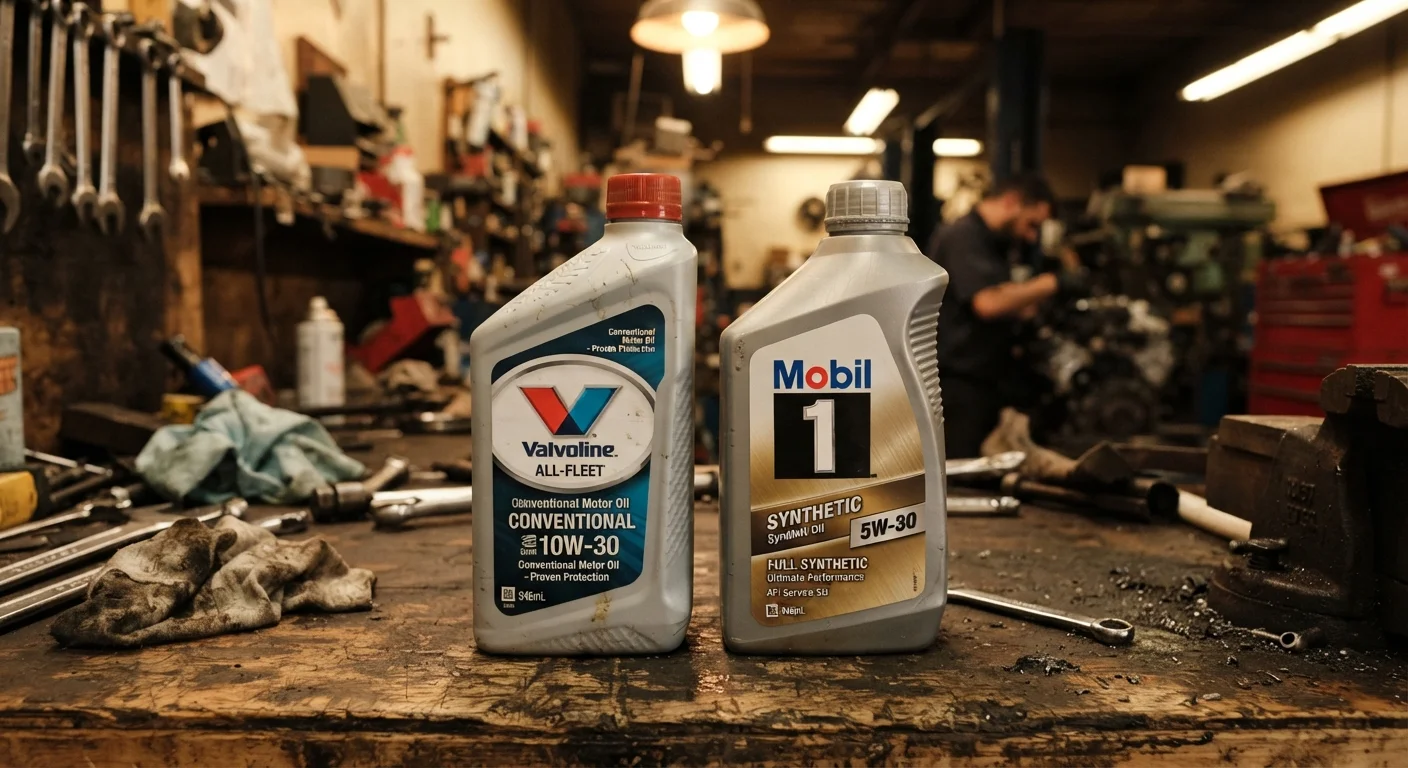
Conventional motor oil starts as crude petroleum extracted from the ground. That crude is refined to remove many impurities and blended with additive packages to improve its performance characteristics. Despite refinement, some molecular inconsistency remains - conventional oil contains a natural mix of molecule sizes, which affects how it behaves across temperature ranges.
Synthetic motor oil is built differently. Chemists start with base stocks - either derived from refined petroleum or created from other chemical compounds - and engineer the molecules to be uniform in size and structure. That uniformity is the core advantage: synthetic oil behaves more predictably, flows more easily when cold, and resists thermal breakdown when hot.
There is also a middle category - synthetic blend - which combines conventional and synthetic base stocks. Blends offer some of synthetic's benefits at a price point between the two, and they're commonly recommended for trucks, SUVs, or vehicles under moderate additional load.
| Criterion | Conventional Oil | Synthetic Oil |
|---|---|---|
| Base material | Refined crude petroleum | Engineered chemical base stocks |
| Molecular consistency | Variable molecule sizes | Uniform, precisely structured |
| Cold-weather performance | Thickens more at low temps | Flows faster at cold start |
| High-heat resistance | Breaks down sooner under heat | Resists oxidation and thermal breakdown |
| Typical change interval | 3,000-5,000 miles (varies by vehicle) | 7,500-10,000+ miles (per manufacturer) |
| Cost per change | Generally lower | Generally higher |
| Turbo engine suitability | Not recommended for most turbos | Recommended or required |
| Best use case | Older, simpler engines; mild conditions | Modern engines, extremes, extended intervals |
Where Each Oil Type Performs Better
Temperature extremes are where synthetic oil's engineered consistency earns its reputation. In cold climates, oil must flow quickly to lubricate engine parts at startup - the moment when most engine wear actually occurs. Conventional oil can thicken significantly in sub-freezing temperatures, slowing that critical first flow. Synthetic oil's uniform molecular structure keeps it flowing faster at cold starts.
At the other extreme, high operating temperatures - common in turbocharged engines, towing situations, and stop-and-go traffic - cause conventional oil to oxidize and break down faster. Synthetic resists that degradation, maintaining its protective film for longer under stress.
For a standard passenger car with a naturally aspirated engine, driven primarily on highways in a mild climate, conventional oil can provide entirely adequate protection when changed on schedule. The key phrase is on schedule - conventional oil's shorter service life means that skipping or delaying changes carries greater risk. You can read more about what that risk looks like in our breakdown of what happens when oil changes are delayed.
~40%
Engine wear occurring at cold startup
Industry estimates suggest a significant share of engine wear happens in the first seconds after starting, before oil pressure fully builds - a key area where synthetic's faster flow offers protection.
5W-20 / 0W-20
Common modern engine viscosity grades
Many current passenger vehicle engines specify low-viscosity synthetic grades; these thinner oils require synthetic's molecular stability to maintain their protective film under operating heat.
2-3×
Typical interval extension with full synthetic
Full synthetic oils are often rated for drain intervals two to three times longer than conventional oil, though the appropriate interval always depends on the manufacturer's specification for your vehicle.
Modern manufacturer specifications are worth treating as the baseline, not a suggestion. Many engines built in the last decade - particularly those with direct injection or turbocharging - specify full synthetic in their owner's manual. Using conventional oil in an engine designed for synthetic may leave it under-protected.
Making the Right Call for Your Vehicle
The single most reliable source for which oil type your engine needs is your owner's manual. It will specify the oil type and viscosity grade (such as 5W-30 or 0W-20) engineered for your engine's tolerances. Following that specification is more important than any general rule about oil types.
If you're unsure or your vehicle is older and the manual is unavailable, a qualified mechanic can advise based on your engine design, mileage, and driving patterns. Our guide to choosing between dealership service and an independent mechanic can help you find the right person to ask.
One practical consideration: if you've been using conventional oil in an older high-mileage vehicle for years, switching to full synthetic isn't always automatic. Some mechanics caution that synthetic's superior cleaning properties can dislodge accumulated deposits in aging engines, which can occasionally cause seal or gasket issues. This isn't a universal outcome, but it's worth a conversation with a trusted mechanic before switching an older vehicle.
Beyond oil type, the interval matters just as much. For a full picture of how often to change your oil and what skipping a change actually costs your engine, see our guide to oil change frequency. And if you want to build confidence checking your oil level between services, our fluid check walkthrough covers exactly what to look for.
This article provides general automotive information for educational purposes. Always consult your vehicle's owner's manual and a qualified mechanic for guidance specific to your vehicle.