Why These Three Services Get Confused
Ask most drivers what the difference is between tire rotation, balancing, and alignment, and you'll likely get a shrug. All three involve tires, all three are offered at service shops, and all three sound vaguely similar. But each one addresses a fundamentally different mechanical problem - and substituting one for another leaves the original issue unresolved.
Understanding what each service actually does gives you the information you need to ask the right questions and make sure you're getting the work your vehicle actually needs. See how these services fit into your broader maintenance picture in our guide on what your car's maintenance schedule is actually telling you.
| Tire Rotation | Wheel Balancing | Wheel Alignment | |
|---|---|---|---|
| What it fixes | Uneven tread wear across tires | Vibration from weight imbalance | Pull, drift, and edge wear from angle issues |
| Common symptom when needed | One or two tires wearing faster | Steering wheel vibration at speed | Vehicle pulls to one side; off-center steering |
| Typical service interval | Every 5,000-7,500 miles | Every 12,000-15,000 miles or as needed | Annually or after significant road impact |
| Equipment required | Lift and basic tools | Balancing machine with weights | Computerized alignment rack |
| Impact if skipped | Premature tire replacement | Bearing and suspension wear | Uneven tire edge wear; poor handling |
Tire Rotation: Evening Out Wear Across All Four Tires
Tires don't wear evenly on their own. Front tires handle steering forces and, on front-wheel-drive vehicles, also transmit engine power - so they wear faster than rear tires. Rotation periodically moves each tire to a different position on the vehicle, allowing wear to distribute more evenly across all four.
Most vehicle manufacturers recommend rotating tires every 5,000 to 7,500 miles, though your owner's manual is the authoritative source for your specific vehicle. The pattern used - front-to-back, cross-pattern, or side-to-side - depends on whether your vehicle uses directional or non-directional tires and whether it has a full-size spare that can be included.
What rotation does not do: it won't stop a steering wheel from vibrating, and it won't fix a vehicle that pulls to one side. Those symptoms point to balancing or alignment issues respectively.
Check Your Owner's Manual First
Manufacturer recommendations for rotation patterns and intervals vary by vehicle type, drivetrain, and tire design. Your owner's manual is the most reliable reference for your specific situation. If you no longer have the physical copy, most manufacturers make digital versions available through their websites.
Wheel Balancing: Eliminating Vibration from Weight Imbalance
Even a new tire mounted on a rim isn't perfectly uniform in weight distribution. Small inconsistencies in the tire's rubber or the rim's structure mean some spots are heavier than others. At highway speeds, these imbalances generate vibration that you typically feel through the steering wheel or seat - usually between 55 and 70 mph.
A technician corrects this by placing the wheel-tire assembly on a balancing machine that spins it and identifies heavy spots. Small counterweights are then attached to the rim at precise locations to offset those spots. The result is a smoother ride with less stress on wheel bearings and suspension components.
Balancing is generally recommended every 12,000 to 15,000 miles, any time you feel unexplained vibration, or whenever new tires are mounted. It's also worth checking after hitting a significant pothole, which can knock existing weights out of position.
Wheel Alignment: Correcting the Angles That Affect Handling and Wear
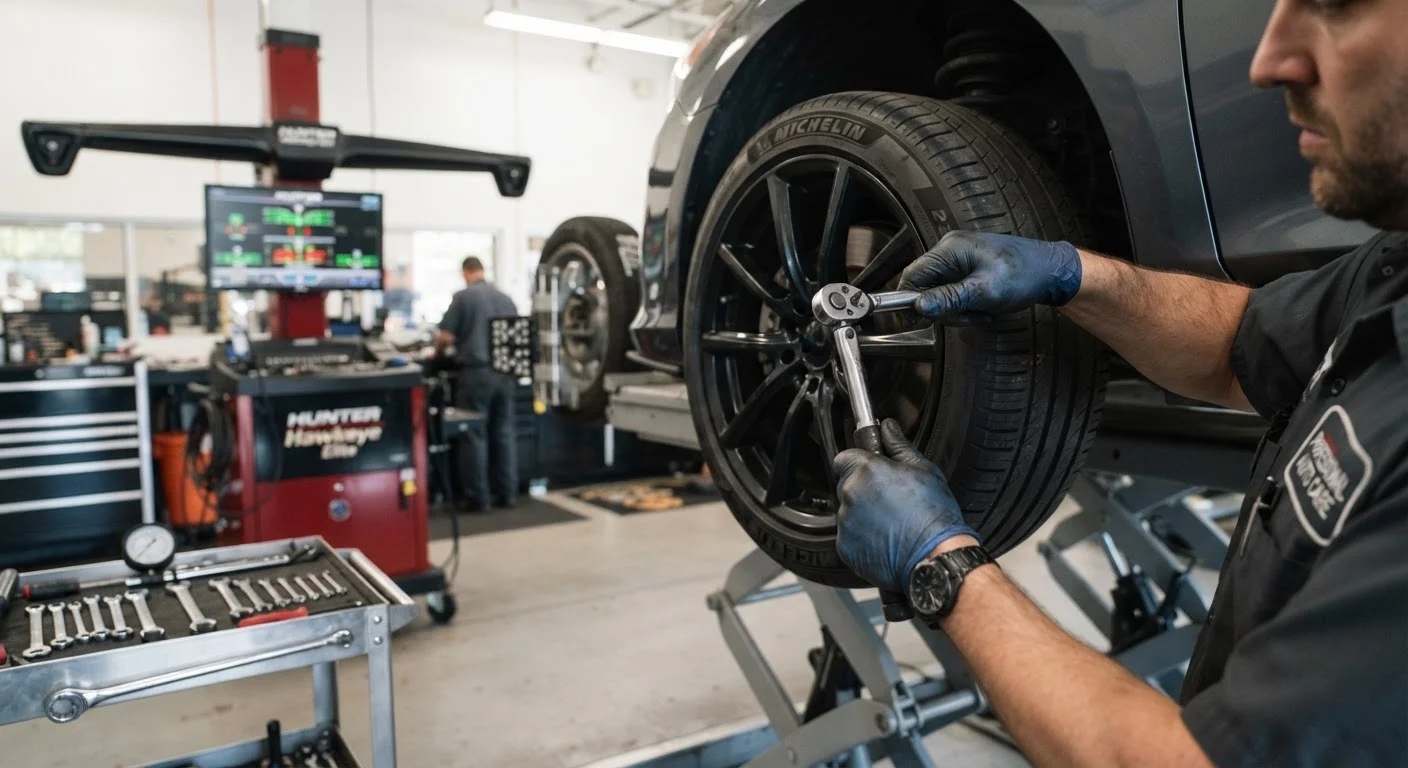
Alignment refers to the geometric angles at which your tires make contact with the road. Three key angles - camber (tilt in or out from vertical), toe (pointing in or out relative to straight ahead), and caster (the angle of the steering axis) - must stay within manufacturer specifications for your vehicle to track straight and wear tires evenly.
When alignment is off, the most common symptoms are a vehicle that drifts or pulls to one side, a steering wheel that's off-center when driving straight, or tires with wear concentrated on one edge. Road impacts, curb strikes, and general wear on suspension components are common causes of misalignment.
Unlike rotation or balancing, alignment doesn't have a universal mileage interval. Many shops recommend checking it annually or after any significant impact. Your owner's manual maintenance schedule may include guidance specific to your vehicle. Whether you go to a dealership or an independent shop, alignment requires specialized equipment - see our breakdown of dealership service vs. independent mechanic trade-offs to weigh your options.
The Real Cost of Skipping Any of These Services
Each of these services is relatively affordable on its own. Skipping them, however, creates compounding costs. Unrotated tires wear unevenly and may need replacement thousands of miles sooner than a properly maintained set. Unbalanced wheels accelerate wear on bearings and suspension bushings. Misalignment causes premature and often irreversible tire wear on specific edges.
Tires are one of the more significant ongoing costs of vehicle ownership, and premature replacement due to neglected maintenance is money that didn't need to be spent. Including these three services in your regular schedule - alongside fluid changes and brake inspections - is a straightforward way to protect that investment. Before any longer drive, a pre-trip safety check that includes a quick look at tire condition is also a good habit to build.
If you're weighing whether to keep investing in maintenance for an older vehicle, our guide on selling, trading in, or keeping your car can help you think through that decision with clear criteria.